Showing posts with label architecture. Show all posts

Saturday, December 24, 2022

Harmonics of the Shift


The critically important task for us at this time is dealing with the necessity of stopping carbon emissions from human activity almost immediately. The situation facing all of us is how to find the way to stop carbon emissions as soon as we can. The current level of carbon emissions can't continue because we've nearly crossed the climate thresholds that mark irreversible damage to the biosphere that can't be undone.

We are beginning to see a changing policy environment which is leading the manufacturing and supply chains to provide electrified buildings and electric cars, as well as power generation with wind turbines and solar panels. This is a necessarily massive shift, which will take decades to completely implement, but that can be an achievable effort by the first world countries to shut down their historically excessive carbon emissions. We're twenty years behind in this necessary effort, so it has become more difficult to accomplish. But it's still achievable if it's done as a rapid global effort to repair the damage that human civilization has done.

But can we do this in time? That task of rapid electrification that's facing us is daunting. America’s next big climate conundrum is the slow electric transmission project implementation that hinders rapid adaptation. It begins to look like the electric grid infrastructure will necessarily have to be rebuilt so that the added new clean power can take the place of fossil fuels without destabilizing the whole grid.

Congress has now passed the Inflation Reduction Act (IRA) and expanded the tax credits available to incentivize low-carbon electricity. Economics, policy, and public demand are now all aligned in favor of clean energy. This is just the first step in necessary legislation to implement solar and wind power and adapt the grid to handle this new energy. "If not addressed, transmission project delays caused by factors like an onerous permitting process could dramatically hamper America’s clean energy rollout and thus its ability to cut pollution fast enough to meet the country’s Paris commitments."

We need more than hope, we must begin significant work to change our way of life.

Friday, September 30, 2022

Building Industry Climate Action


The building industry is currently leading its climate action by developing standards and practices that decarbonize the physical construction of new and existing structures and infrastructure, as well as electrifying all energy use. The American Institute of Architects (AIA) is currently developing its national design criteria via the Committee on The Environment (COTE).

The basis for this approach is a published study done by the Worthen Foundation, for use by the industry: 

"Reducing and eliminating carbon emissions from the built environment — building decarbonization — is one of the best opportunities to combat climate change today. The built environment contributes approximately 40% of overall climate emissions, and the technologies necessary to decarbonize buildings are already proven. The William J. Worthen Foundation's Building Decarbonization Practice Guide is a free resource for design professionals, developers, funders, and policymakers, showing the steps that are required today to create a zero carbon future."

The AIA is developing the framework for building decarbonization and electrification for use by the profession, in concert with Architecture 2030.

"To support the 2030 Challenge, the American Institute of Architects created the 2030 Commitment Program, aimed at transforming the practice of architecture to respond to the climate crisis in a way that is holistic, firm-wide, project-based, and data-driven. Over 400 A/E/P firms have adopted the 2030 Commitment, and firms from all over the country have been tracking and reporting projects since 2010, with over 2.7 billion ft2 of project work reported in 2016 alone."

The architecture profession isn't waiting around for the US to adopt a formal framework along with the other countries around the globe, it's been underway for years now. The AIA is developing coursework for professionals that provide the resources and training necessary to meet the framework objectives.AIA California is leading this charge with developing coursework and Building Code revisions so that adoption is rapid and comprehensive.

"According to the latest Intergovernmental Panel on Climate Change (IPCC) report, the time for climate action is now. Architects play a crucial role in mitigating and adapting to climate change through sustainable and resilient design. Energy efficiency and renewable energy, materials transparency, the protection of water resources, and other sustainability strategies support mitigation by conserving resources and reducing carbon emissions."

The AIA was in attendance at COP26 and will also be present at COP27 in Egypt this November.

Wednesday, August 31, 2022

Climate Change: New Risks


Our warming planet is impacting the built environment as well as the natural systems, which are beginning to disintegrate. It's not just the increasing impact of burning forests and major flooding on structures that result in ongoing severe damage to entire communities now. It means that structures and traffic infrastructure will necessarily reduce their carbon content in the larger efforts to combat the increasing "forcing" of carbon emissions globally. The American Institute of Architects has taken an aggressive position on this with its 2030 Challenge, which changes how building types and construction materials are used in new construction.

This involves revising the building codes to raise the bar for decarbonization of the entire supply chain for construction and development. California is currently in the process of doing this. The insurance industry is also looking at increased risks for climate change damages, which will only increase. On the proactive side of this action is a shift in the professional liabilities involved with the design of building projects and infrastructure development. This is known as the "standard of care" that applies to licensed professionals. 

"A new report released by the Scalable Climate Action Group within the institute’s Strategic Council looks at levers of change that can potentially bring about widespread climate-change actions. These levers include climate literacy; environmental, social, and governance (ESG) investments; and policy changes. Also on the list is professional liability associated with neglecting climate concerns during design."

This reflects a changing policy environment which is leading the manufacturing and supply chains to provide electrified buildings and electric cars, as well as power generation with wind turbines and solar panels. This is a necessarily massive shift, which will take decades to completely implement, but that can be an achievable effort by the first world countries to shut down their historically excessive carbon emissions. We're twenty years behind in this necessary effort, so it has become more difficult to accomplish. But it's still achievable if it's done as a rapid global effort to repair the damage that human civilization has done.

Saturday, December 18, 2021

A Thirteenth Year - We Dig In


The decade-long drought that impacted water supplies and fueled massive forest fires is still with us, although we've been seeing the rain again, a positive development for water storage in our parched land. Our forests have gone up in flames all summer, and the local urban forests and wildlands are dangerously dry. This has made climate change an urgent priority, and our state government in Sacramento is trying to push ahead with progressive policies that will mitigate carbon emissions by 2050. Even though we know that's not even half of what we'll ultimately have to do.

Our state policies have been informed by the UNFCCC COP deliberations, via former Governor Brown and now Governor Newsom. The architecture profession is moving ahead with educating its members and providing resources to bring emissions down from the construction sector.

CarbonPositive: Architecture’s Critical Role at COP26 - a formulation of strategy for the profession."COP is three parallel events. Of course, there are intergovernmental negotiations taking place in areas inaccessible to the public. Next, is the Blue Zone open to UN accredited delegations. Architecture 2030 is admitted as an “observer” organization with access to the Blue Zone. Finally, the Green Zone is open to the public. The Venn diagram of these three events has some overlap, but not much."

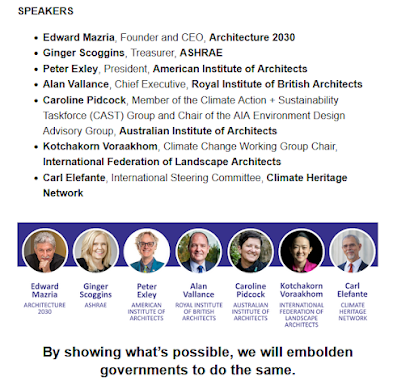
65% by 2030 / ZERO by 2040: Top 200 Global Firms and Organizations Lead With 1.5°C Climate Actions. By showing what's possible, we’ll embolden governments to do the same. The top 200 firms responsible for a significant portion of construction worldwide will present the bold actions they are taking to decarbonize the built world in order to meet the Paris Agreement’s 1.5°C carbon budget. It's one of the best discussions about the urgency of climate action presented to the public.

Carl Elefante FAIA, FAPT LEED AP a representative of the AIA at COP26, provides a summary of their dialogue over 10 days. "After a lifetime practicing architecture, I am hardwired to look for opportunities. Carbon-budgeting building projects and WLCA present many." His new podcast series from the IHBC raises awareness and understanding of how conservation philosophy and practice contributes towards meeting the challenge of climate change.


Friday, July 30, 2021

New Sheriff in Town


The new Biden administration has awakened the Federal beast, which is stirring with new life on the carbon issue. Biden’s pledge on Earth Day 2021 is in line with what environmental groups and hundreds of executives at major companies have pushed for. The president announced the target at the closely watched global leaders’ climate summit on April 22, during which he hopes to urge global cooperation to address the climate crisis.


“This is the decisive decade,” Biden said at the summit on Thursday morning. “This is the decade that we must make decisions to avoid the worst consequences of the climate crisis.”

“This is a moral imperative. An economic imperative. A moment of peril, but also a moment of extraordinary possibilities,” the president said.

At the state level, California is setting policies in concert with many organizations that are moving ahead with their goals and solutions to the carbon emission emergency that has been declared. The architects and contractors are already developing their methods for reducing not only emissions, but are also the decarbonization strategies that drastically reduce the impact of construction in cities and towns. This is being done in concert with the American Institute of Architects California (AIACA) and Architecture 2030 leadership by Ed Mazria FAIA.

Rocky Mountain Institute, headed up by Amory Lovins, is working with industry to transform the global energy system to secure a clean, prosperous, zero-carbon future for all. They are developing zero-carbon roadmaps for harder-to-abate sectors; accelerate development and deployment of breakthrough technologies; cultivate zero-carbon industries and ecosystems. These are some of the goals of their China program.

The response to the climate change issue has several major policy supporters that share similar climate goals. Recognizing that buildings account for nearly half of global CO2 emissions, the Carbon Leadership Forum, a non-profit organization at the University of Washington, is dedicated to accelerating the transformation of the building sector to radically reduce the embodied carbon in building materials and construction through collective action. This group's document was published in March 2021. To learn more about different policy initiatives related to embodied carbon or track updates on the policy initiatives in this document, visit the Carbon Leadership Forum’s Policy Toolkit.

The goals of the UNFCCC policies of 1.5C established in Paris are facing some serious pushback by the fossil fuel industry. It's not just a disinformation campaign, but steering governments to implement actions that will keep the oil flowing. For example, a human rights lawyer is facing prison for holding an oil giant to account talks about his Kafkaesque case.

"One of the critical facts is it’s not an accident. It’s a deliberately designed pollution event where Texaco decided to do it this way, essentially to play God with the people of Ecuador in order to save $2 or $3 a barrel of oil produced. The net result today, 50 years after this started, is you have the world’s worst oil disaster. You have thousands of people dead or dying from exposure. You have virtually no medical care. You have indigenous groups decimated, on the way to extinction because the forest is now poisoned by these deliberate acts of destruction. It can no longer sustain the culture, so it’s a disaster from every angle."

And at the same time, cities face new roadblocks in their quest to decarbonize buildings with policies that cripple efforts by local governments to establish sustainable policies.

The International Code Council (ICC) — an organization that manages building codes for much of the U.S. — this month removed the rights of local governments to vote on future energy efficiency building regulations, a move that could have major implications for cities as they seek to reduce their greenhouse gas (GHG) emissions within building sectors, according to industry experts.

So we're looking to Biden's leadership to help untangle these issues and policies that are colliding in the US as well as the global community acting under the United Nations oversight.

Update 10/8/21: Take three steps to begin designing zero carbon buildings today

Update 10/9/21:  CarbonPositive: COP26 


Sunday, November 29, 2020

The Gloaming


It's time now to prepare for and remember the year-ago promise of Advent with the knowing that forces are coalescing around the globe and in the US which are countermanding the denial and obstruction we see at the highest levels of global climate interaction. Groundwork has been laid, players identified, and industries have begun mobilization.

A year ago, John Kerry, the former senator and secretary of state, formed a new bipartisan coalition of world leaders, military brass and Hollywood celebrities to push for public action to combat climate change.The name, World War Zero, is supposed to evoke both the national security threat posed by the earth’s warming and the type of wartime mobilization that Mr. Kerry argued would be needed to stop the rise in carbon emissions before 2050. The star-studded group is supposed to win over those skeptical of the policies that would be needed to accomplish that. Now, under the nascent Biden administration cabinet, these policies are stirring to life with the appointment of Kerry as special presidential envoy for climate.

This clears the way for the US to rejoin the Paris Agreement of COP21 and establish leadership on building a future of zero carbon with the worldwide community of nations. The number of commitments to reach net zero emissions has doubled in less than a year, with many in the Race to Zero by 2050. According to a report by the Data-Driven EnviroLab and the NewClimate Institute, published during Climate Week NYC, that includes cities and regions covering more than the combined GDP of Japan, India and the UK, and companies with a combined revenue of over $11.4 trillion (equivalent to more than half of the US GDP). This shows that climate action has continued unimpeded by Covid-19. This joins with work in place and underway by the private foundations of Michael Bloomberg, Al Gore and Bill Gates, among many others, that have been focused on seeding efforts to implement carbon neutrality in time to avoid the worst of the impacts of climate change, which is set at a maximum of 1.5C by the Paris Agreement.

The architecture profession, along with the construction industry in the US, has risen to the challenge of implementing the requirements of carbon net zero in its construction practices. The American Institute of Architects (AIA), in concert with Architecture 2030, has incorporated tools and strategies for the industry to begin moving ahead with immediate carbon reduction in its construction materials and practices as well as significant carbon sequestration. The basis for this work is the 2017 Fourth National Climate Assessment (NCA4), Volume I, a comprehensive, multi-year scientific analysis under the auspices of the National Oceanic and Atmospheric Administration (NOAA). Very specifically, this work done by the AIA involves the evolution of its Committee on the Environment (COTE) into an overarching Framework for Design Excellence which guides the design and construction of resilient and carbon neutral projects. This goes beyond the operational carbon reduction used by the US Green Building criteria (LEED) and encompasses embodied carbon as well as water re-use and building electrification. The site and its landscaping are also contributors to carbon absorption.

The goals are that these strategies, as well as a calculation for embodied carbon in a project will bring the construction industry into closer compliance with global carbon emissions requirements. The EC3 tool is the first free tool that allows for supply chain specific analysis of embodied carbon data, utilizing the first searchable and sortable database of all United States and Canadian Environmental Product Declarations for concrete, steel, wood, glass, aluminum, insulation, gypsum, carpet and ceiling tiles.

Because the building sector is currently responsible for 39% of global energy related carbon emissions: 28% from operational emissions, from energy needed to heat, cool and power them, and the remaining 11% from materials and construction, the World Green Building Council has a call to action with the new requirements:

  • By 2030, all new buildings, infrastructure and renovations will have at least 40% less embodied carbon with significant upfront carbon reduction, and all new buildings are net zero operational carbon.
  • By 2050, new buildings, infrastructure and renovations will have net zero embodied carbon, and all buildings, including existing buildings must be net zero operational carbon. 

So we embark on a new course together with the world community to put actual practices in place for the reduction of carbon emissions to zero and a new sensibility for the value of the natural world no longer at the mercy of GDP economics.


Sunday, March 22, 2020

AIA Carbon Positive Report


The American Institute of Architects, in cooperation with Architecture 2030, put on a very important conference in Los Angeles on March 2 - 4, 2020. Ed Mazria of Architecture 2030 was a great keynote at the conference kickoff, and his slide presentation is here. An additional video of a 2010 presentation of his is here. The sessions are presented as a very, very urgent timeline for the building profession to engage and get to net zero by 2030. This is based upon the adoption of the Intergovernmental Panel on Climate Change (IPCC) Special Report, Global Warming of 1.5°C, promoted by Mazria's organization.

UN | Report of the Secretary-General  Dec. 2019:

September’s Climate Action Summit delivered important new actions, a surge in climate momentum, and a clear destination: 45% emissions cuts by 2030 on the way to a carbon neutral world by 2050. The Secretary-General’s report on the outcomes of the Summit highlights the way forward in 2020, and outlines ten priority areas of action. We are seeing unprecedented changes in the earth’s environmental and physical processes. Climate change, air pollution, reduced availability of clean water, and persistent toxic chemicals threaten human, animal, and environmental health and well-being.

A special guest presentation was made by Farhana Yamin, who is an internationally renowned environmental lawyer and Extinction Rebellion activist with more than two decades of experience advising nations and NGOs on climate change and development policy. An interview with her is here. As well as authoring numerous books and IPCC reports, she has played a key role in drawing up international treaties, including the landmark Paris Agreement on climate change in 2015. Farhana is also an associate fellow at Chatham House and visiting professor at UCL. In April she glued herself to Shell's London headquarters in protest at the oil firm's climate impact.


This has resulted in a formal challenge to the profession which was presented to the architects attending the conference. Some conference notes are here from Michael Malinowski. Ed Mazria provides further background from the conference in his message to AIA: "The numbers may be abstract, but the implications are firm: we must reduce global CO2 emissions 50% to 65% by 2030, and reach full decarbonization by 2040." A little more of the story is here on how this conference came to be through Mazria's efforts over the decades.

The targets, roadmap and vision for the systemic change needed to address climate change are clear. They were recently discussed at CarbonPositive’20, with a video library here. At this milestone event, current actions and opportunities were presented, the latest tools, technologies and advanced materials were exhibited, experiences and expertise were shared, and the future was imagined. CarbonPositive’20 focused on the actions necessary to avert dangerous climate change and limit planetary warming to 1.5 degrees Celsius above pre-industrial levels.

Additional resources shared at the conference:
Climate Positive Design Challenge
https://climatepositivedesign.com/
 
Design with Climate: form follows performance explained with a psychrometric chart analysis.

Environmental Product Declarations (EPD) present transparent, verified and comparable information about the life-cycle environmental impact of products.
https://www.environdec.com/

Beyond Net Zero
https://massdesigngroup.org/
http://www.rocagallery.com/cats/views-on-architecture

ARUP BioBuild is the world’s first self-supporting façade panel for building construction made of biocomposite materials.
https://www.arup.com/projects/biobuild-facade-system

Living Algae Buildings  Australia
https://mysteriousuniverse.org/2016/06/living-algae-buildings-are-a-growing-concept/

World Green Building Council  Net Zero
https://www.worldgbc.org/advancing-net-zero

International Living Future Institute  Zero Carbon Certification
https://living-future.org/zero-carbon-certification/

Skanska Embodied Carbon Calculation Tool
https://www.usa.skanska.com/who-we-are/media/press-releases/238250/Skanska-Conceives-Solution-for-Calculating-Embodied-Carbon-in-Construction-Materials%2C-Announces-Transition-to-OpenSource-Tool


Update 4/7/20: The AIA 2030 Commitment to transform the practice of architecture has resources for professionals.

Update 4/8/20: Architect Magazine has provided climate action resources to the profession.

Update 4/23/20: Buildings are responsible for 40 percent of carbon dioxide emissions.


Friday, February 28, 2020

Critical State


As an architect who has spent a career dealing with the physical and environmental impacts of investment calculations, I am acutely aware of the shortfalls of urban development and its destruction of the living biosphere. I've discussed these problems professionally as well as with people who are deeply concerned about our environment and trying to achieve a consensus about how to manage our existence across the planet via the 25-year-old COP mechanism of the UNFCCC. This has finally risen to the level of global discourse through scientific study and documentation of the critical state our planet and our civilization is approaching.

"A chain reaction in a sandpile that causes an avalanche is a critical state. The term critical state can mean the point at which water would go to ice or steam, or the moment that critical mass induces a nuclear reaction, etc. It is the point at which something triggers a change in the basic nature or character of the object or group. Thus, we refer to something being in a critical state when there is the opportunity for significant change," as is discussed in economic theory by John Maldin.

This holds true for the instable fingers of social media that move waves of social change. This is also true for the escalating climate damages and population migration due to the impacts of climate change that are more and more apparent to people across the planet. We are approaching a critical state that is based on the very real disintegration of the life support of our human civilization because of false GDP metrics embedded in corporate extraction supply chains that have no accountability to governments and their populations. These mechanisms are now larger than many countries, and invade their sovereignty with trade agreements, the pipeline through which wealth flows. The human reaction to this is governmental authoritarianism and a digital realm of chaos and rising conflict.

Climate researchers can measure in real time what happens to carbon emissions when one of the world's largest economies is suddenly stalled, with entire cities locked down, highways emptied, airplanes grounded, factories shuttered and millions of people confined to their homes. A continent away, from his base in Helsinki, Finland, Lauri Myllyvirta was able to piece together industry and financial data sources and satellite imagery to calculate the COVID-19 epidemic's impact on emissions in China: a decrease of about 25% in three weeks. "In terms of the absolute volume of emissions, this is absolutely unprecedented," he said. Clearly human behavior drives this and can be rapidly changed.

Christiana Figueres, former executive secretary of the United Nations Framework Convention on Climate Change (UNFCCC) from 2010-16, endorses Extinction Rebellion's civil disobedience campaigns to save the planet. To quote: “Civil disobedience is not only a moral choice, it is also the most powerful way of shaping world politics. Historically, systemic political shifts have required civil disobedience on a significant scale. Few have occurred without it.” I think we're smart enough to tackle the damage we've done to our planet if we mobilize globally and rapidly engage in multiple strategies. I'm starting to see it move, and Figueres is adding fuel to it with her new book.

The top-down consensus COP model has been blocked by corporate fossil fuel money in the US and Britain, and because of it, there is a blowback mobilization by people all over the planet that is creating the instability that underlies an avalanche of change. Cornell University professor Robert H. Frank makes a far better case for individual action because he uses social science to do it. Individual action to protect the climate “is far greater than most people realize, for two related reasons,” Frank writes. “First, they have the power to shift how the people around us behave. Second, and more important, they change who we are, making us much more likely to support the large-scale policies needed for progress. “Conscious consumption alone certainly can’t stop the warming threat,” Frank adds, “but it’s an essential step on our path forward.”

Climate activist lawsuits are also making headway in the higher courts. Friends of the Earth and Plan B took the position that the Paris Agreement is in UK law, and they both argued policymakers should have to consider it.. David Wolfe, attorney for Friends of the Earth, said the government should have considered emerging discussions and evidence on climate change when making its decision. Plan B’s Tim Crosland told the court that the Paris Agreement’s aim of limiting global warming to “well below” 2 degrees C has been the “lynchpin of government and international policy” since December 2015, so the government was bound to take it into account. Britain’s Court of Appeal issued a landmark ruling on Feb. 27 that stymied plans to build a third runway at Heathrow Airport in London, declaring that the government illegally neglected its commitments to reduce carbon emissions and protect the planet from dangerously high temperatures.

This lawsuit is based upon the Paris Implementation Blueprint, authored by Tim Crosland, Aubrey Meyer and Margaretha Wewerinke-Singh. Aubrey Meyer has developed a framework proposed for adoption by the COP for many years that could possibly come alive again as the waves of social change give it the impetus necessary to bring all parties to the table, which argues for its rapid adoption rather than abandonment. He has kept track of the immense challenge ahead of us to keep our planet from moving into an extinction event under our current carbon emissions impacts. The rising awareness of this has spurred more collaborative initiatives to address the problem at the local level.

In September of this year, thousands of climate leaders are coming to San Francisco for the Global Climate Action Summit. The event will bring together governors, mayors, legislators, CEOs, investors, researchers, and more from around the world to demonstrate progress, set more ambitious and measurable goals, and encourage national governments to go further faster. They would be wise to look to the Paris Agreement as a basis for their actions.

Update 3/2/20: The UK’s first climate change refugees?

Update 3/27/20: Homer-Dixon’s synchronous failure framing. The economic impacts are going to go far beyond the stock market and surface measures such as GDP.

Update 4/9/20: The Heathrow decision: a moment of truth.


Friday, November 9, 2018

Denial


The blaze that erupted in London's Grenfeld Tower in June of 2017, resulting in the utter destruction of the structure inasmuch as its steel framework remained standing, is under examination by the government as well as media sources. The search for blame for the inferno resulting from cheap exterior cladding has unearthed a disingenuous claim by the Daily Mail that environmental requirements were the cause of the faulty design, as cited by the Carbon Brief analysis published in The Guardian.

"On page eight is a full-page commentary from Ross Clark, sitting under the headline question: “So did an obsession with green targets lead to inferno?” Clark, who has published various climate sceptic articles and written a book attacking regulations he believes to be “strangling” the UK."

The 2012 planning documents cited by the Daily Mail – and studied by Carbon Brief – show that its reporting of their content to be highly selective and misleading, per the article. This amounts to another systematic attempt to deconstruct environmental regulations with the critique that they are onerous and lead to dangerous building structures. This kind of position could only be taken if one dismisses the facts of the matter, which are that the retrofit did not include fire sprinklers, and that a non-flammable exterior was available for an additional few thousand pounds. It's actually a result of willful disregard for life safety because of cost issues, not environmental issues.

In fact, the position of the Institution of Civil Engineers (ICE) in their report on Grenfell is an emphasis on maintaining professional competency in the engineering profession with even more oversight of design and construction approaches in the building industry.

A documentary film by Jamie Roberts points directly at the impact of pro-business policies which have permitted these kinds of fires to continue to happen over the last half century:

"The Fires that Foretold Grenfell, a well-researched, powerful documentary, is essential viewing for anyone seeking to understand the causes of and background to the June 2017 Grenfell fire tragedy. It includes harrowing interviews with survivors of five fires across the UK over a span of 45 years, their families and firefighters.

It demonstrates that the inferno which claimed 72 lives was not an accident, but a social crime. It was the result of the pro-big business policies of successive governments which ignored the lessons of five tragic fires, resulting in many avoidable deaths."

This form of denial obviously needs to be thoroughly debunked before it becomes accepted as some kind of talking point, as it's clearly fueled by disinformation put out by the fossil fuel industry which supports people who say things like this. It is at the root of the obstruction of the necessary decarbonization of our built environment and energy production. Not only that, this kind of denial serves to confuse the issues and bury the facts in deliberate misinformation about physics and building construction.

For example, this fire is typical of what happens to steel structures that are fully engulfed in major fires; the building materials are consumed, but the steel frames remain intact. And yet another denial tries to construct an alternate reality about these kinds of structures in The 9/11 Commission Report and other reports by the NIST, which have been deconstructed by the 9/11 Consensus Panel, based upon further evidence obtained in many sources as well as accurate engineering analyses. This has been published in the book, 9/11 Unmasked, which points out that no other high rises have ever been structurally destroyed by fire. The Twin Towers came down at the speed of gravity on their footprints, which points straight at a demolition scenario in order to create a "Pearl Harbor" event.

As has been established extensively in the press, this event was used as a pretext for the Bush administration to instigate wars in the middle east on behalf of their Arab allies in order to procure further fossil fuel resources. Thus denial comes full circle as a tool in its deliberate destruction of human lives and our environment on an almost unimaginable scale of annihilation. That it may lead to the extinction of life on our planet by the end of this century is a responsibility that is shirked by the oil industry in its rapacious efforts to protect its profits.

Update 11/9/18: Bill McKibben - Up Against Big Oil in the Midterms

Update 11/14/18:  There is a huge fight by the fossil fuel industry against cheap renewables.

Update 11/24/18: Hunter Lovins - Capitalism v. Ecological Economics in a Hotter World

Update 12/9/18: Large coal holdings investments are held by some of the world’s largest pension funds

Update 3/2/19: Amazon, Google, and Microsoft are quietly helping Big Oil destroy the climate.

Update 10/8/19:  The money behind the climate denial movement

Update 4/3/20:  University of Alaska Fairbanks WTC 7 Final Report


Monday, March 23, 2015

A Southern California Classic


A new book about Smith and Williams has been published by the Getty Press, reflecting an exhibit that was staged at UC Santa Barbara in 2013 and documented the work archived there by Whitney Smith. It's an interesting look back at some of the many projects done by this firm, including a brief look at the Community Facilities Planners office in South Pasadena that served as the office for this firm. It mentions in passing the roots of the firm's practice within the USC group that produced a significant body of work covered in Esther McCoy's documentation of The Second Generation of California architects.

The Case Study Houses 5 and 12 are mentioned, also a subject of an exhibit and a McCoy publication, which made use of the lath, or "screen" that became so prominent in their work as an integration of exterior and interior spaces. These became ancillary spaces to the formal structure of the collective smaller buildings themselves, as was used in the Neighborhood Church campus as an organizing element before the trellises and small buildings were demolished for a very large addition, amputating the entire site plan concept and overshadowing the existing historic Greene and Greene home on the campus (Cole House) as well as the adjacent Gamble House. This unfortunate overdevelopment obliterated the spatial qualities of the campus and erased the integration of the gardens and structures, resulting in a significant loss of coherence in the site design.

A few mentions in the book are made of post-1973 projects by Whitney Smith, but omitted is one of his last projects completed before he relocated to the pacific northwest. This small complex is located in South Pasadena as well, and makes a completely different kind of reference to the locally traditional mexican courtyard style vocabulary. He also made extensive use of skylights in the same way he did with his own separate office building designed after 1973, also in South Pasadena and not listed in this book. It's an example of the strategy of an adapted vernacular that has evolved dramatically in the profession today.

Main entrance off of the side alley
Birdseye view
The firm itself arose out of the collaborative process between many architects and professionals, and some of  that's covered in this blog as well as in another paper written by Tim Gregory as research for a residential project in San Marino. Whit started his practice with homes in this community. A further compilation of the Smith and Williams legacy and the exhibit is online here, courtesy of John Crosse.

Wednesday, October 8, 2014

The Way We Were


When the ecological alarm bells had started going off in 1999, we had anticipated that there would be a worldwide engagement in the reduction of pollution, carbon emissions and consumption of resources. At that time, the architecture profession was engaged in a dialogue about how to live on the earth more responsibly and mindfully, as the article above from The Architecture Review attests (click to enlarge). Our atmospheric concentration at the time was at 367 PPMV, and the weather had not yet begun to destabilize. This was in the decade before the limit of 350 PPMV was declared by James Hansen of NASA and became a focus of the 2009 UN COP international climate treaty.

These hopes have been dashed by the corporate sector that controls the US Congress, particularly the fossil fuel industry, as well as the governments of India and China in the chase for extreme energy development. The chart below shows how the emissions accelerated instead, resulting in the recently begun polar melting and collapse, as well as the disastrous climate impacts that we're currently experiencing.


California, in particular, has become an extreme case of climate change impact, as the NASA GRACE satellite photos show below. One can only imagine what the US Congress can be thinking as the US attempts to disrupt the climate agreements coming up at COP 20 in Lima and COP 21 in Paris so that the US, China and India can continue to spew carbon into our ecosphere and complete its destruction.


Tuesday, August 5, 2014

Lead or Follow?


Our profession holds an annual conference, this year in June at the AIA National Convention in Chicago. Ed Mazria, Founder and CEO of Architecture 2030, delivered the keynote address 'Design! Life Depends on It'. The 20-minute video lays out the blueprint for a carbon-free and just built environment by 2050, reviews the progress made in the building sector since issuing the 2030 Challenge in 2006, and outlines the critical role architects and designers must play in securing a livable future.

His organization, Architecture 2030, has the full support and endorsement of the National AIA. His challenge amounts to saying that the buidling industry must assert leadership in rapidly reducing carbon emissions. This position is important because the building and construction industry represents about 70% of urban emissions.This includes the emissions related to building these structures as well as the shipping, hauling, service delivery and maintenance involved in maintaining them, in other words, the local transportation sector and the building management industry.

As one of the myriad strategies available to reduce carbon emissions, it can represent a critical means of moving early and swiftly to make the transition to a clean economy, implementing carbon reduction ahead of global emissions agreements.

Update 8/14/14: From Architecture 2030 - Architects to phase out carbon by 2050 as declared at the 2014 UIA  General Assembly in Durban

Monday, February 10, 2014

Zero in 2050


Feldman Architecture
A 2005 Governor's Executive Order and 2006 statute establish GHG reduction goals and mandates for California. The Climate Action Initiative (Executive Order S-3-05, June 2005) set the following GHG emission reduction targets for California: by 2020, reduce GHG emissions to 1990 levels, and by 2050, reduce GHG emissions to 80 percent below 1990 levels.

This is in general alignment with the evolving global GHG emissions reductions currently being negotiated at the international level, with an agreement expected in January of 2015. In so doing this, California is at the forefront of dealing with US emissions reductions strategies and implementation.

California's new energy code - Title 24 - is requiring that all new residential buildings be net-zero in terms of emissions by 2020 and all new commercial buildings be net-zero by 2030. Fifty percent of existing state-owned buildings will be zero net energy by 2030. Other states are enacting tax credits to create incentives for similar building techniques. In coordination with these code revisions, the California Public Utility Commission (CPUC) is revising the financial incentives offered through utilities to encourage energy efficiency investments by building owners. The CPUC is reducing or eliminating past financial incentives for energy efficiency investments that are now mandated by Title 24. This year a new set of financial incentives will be launched that support comprehensive building solutions.

What is a net zero structure? Basically it's one that creates no emissions in its materials assembly and uses solar panels to offset electrical use. No natural gas is envisioned for new construction. California is aware that a steep increase in renewable energy must come with an investment in a smart electricity grid — and energy storage is a key part of the equation. Storage is intended to help address the intermittency of renewable energy generation, and can also improve the resilience of the electricity grid overall. This and other major impacts are anticipated on the physical infrastructure of our cities as well as industry codes and practices.

A case study and good example of the kind of things that will need to be done in residential construction, for example, are here at Treehugger. But the impact of these practices go far beyond simply designing in the traditional manner; this will radically change because of the real-time analysis in the design environment, enabling design decisions like form, orientation and facade design with real-time feedback using BIM program software. Integrated performance analysis lets designers understand the impacts of design options and allows for faster, more efficient design decisions with an audited design trail exported as clear reports. This represents a major shift for the architecture and construction fields, particularly since the construction product supply chain will be tracked in the design models as well, in order to comply with LEED-type standards.

This is the cutting edge of design and construction practice, being driven by the requirements of the GHG emissions reductions. Once in place, it will move rapidly on a technological learning curve which will outpace the old fossil fueled mechanics to embrace a flexible, dynamic and living environment.

Update: Emerging trends transforming the digital design and building production process. This is an approaching gamechanger for the built environment and compliance with extreme energy conservation design.

Wednesday, April 10, 2013

Soleri


The word came from Arcosanti today:

"Thank you to all the alumni, architects, writers, artists, journalists, publications, and many others who have shared their thoughts on Paolo Soleri and his work. We, at Arcosanti, are looking forward to continuing this work with even more rigor in the future.", as well as a page in memoriam on the Arcosanti website.

It was significant to me, having spent a college summer working with the building teams out on the mesa, taking in his lessons and living his examples of space and form. Most memorable, to me, was the experience of place, which is situated at a very powerful locus in the Arizona desert. Thank you Paolo. So long....all those lectures in the amphitheater, building East Crescent at dawn in 1978. Experiencing the transcendent power of moonlit desert nights. Bells in the wind. Watching those billowing electrical storms from the apse...

The New York Times provided an excellent writeup, but there are books and books out there. Paolo was prolific in his writings and drawings, and a special volume worth having is the black book full of the renderings of his ecocity dreams. Ecotecture magazine has interviewed Richard Register, who outlined the origins of Soleri's urban approach, resulting from a conference at Arcosanti in 2000. He discusses the idea of the arcology as a node of conciousness that is part of the evolution of the human species, expanding on the concept of the "Omega Point" espoused by Teilhard de Chardin and carried out even further by Soleri's habitation experiment. Soleri took the concept to its most extreme in designs and models for future cities and even space habitats for the human seeding of the universe. He saw the future as infinite and intelligent, with the principles of natural processes at its core.

And the bells! You didn't leave Arcosanti without a bell; a city built from bells...

Update 10/12/19: The history of energy in arcology at Arcosanti

Tuesday, February 5, 2013

Recognition Due


Quite a buildup is underway for a major retrospective of the work of Smith and Williams. It's part of an ongoing series, Pacific Standard Time Presents: Modern Architecture in L.A., which celebrates the city's modern architectural heritage through exhibitions and programs at arts institutions in and around L.A. starting in April 2013. Supported by grants from the Getty Foundation, Modern Architecture in L.A. is a wide-ranging look at the postwar built environment of the city as a whole, from its famous residential architecture to its vast freeway infrastructure.

UC Santa Barbara is presenting, as part of the Pacific Standard Time Presents series, an exhibition of the work of Smith and Williams. Outside In: the Architecture of Smith and Williams. This collaboration, initiated by the Getty, brings together several local arts institutions for a wide-ranging look at the postwar built environment of the city as a whole, from its famous residential architecture to its vast freeway network, revealing the city’s development and ongoing impact in new ways.

For a brief preview of the upcoming exhibition at UC Santa Barbara and links to the Smith & Williams bibliography and a video of a Shelly Kappe interview of Smith, see John Crosse's "Outside In: The Architecture of Smith and Williams, UC-Santa Barbara Art Museum, April 13 - June 16, 2013 and "Smith & Williams: An Annotated Bibliography".

Debi Howell-Ardila will include an essay on Smith & Williams in the exhibition catalogue. Whitney Smith actually attended USC just as modern reforms were being launched - along with Cal Straub, Conrad Buff, Don Hensman, Pierre Koenig and many other notable architects of the modern period.


Tuesday, December 11, 2012

Urban Regeneration


A remarkable urban green space has been developed in Copenhagen in response to a site with heavy traffic and no urban forestry. It uses ribbons of concrete that support pedestrian movement through a site of trees and native plantings, in effect, unpaving the city.

The result is a sustainable and fully accessible urban space covering an area of 7.300 m2. Like a giant dune of sand or snow it slips in between the buildings, thereby creating a spatial coherence in the design. Simultaneously, the urban space, elevated 7 meters above the surroundings, ensures the mobility of pedestrians and cyclists, leading from SEB and the harbor past The Danish National Archives and on to the Tivoli Congress Center.

This kind of creative engagement, along with net zero building structure design, is the best hope for sustainable cities as a node of intelligence and human community.

Tuesday, May 8, 2012

Chapel Notre-Dame du Haut


Experiencing an iconic project such as this one, designed by Le Corbusier in 1955, is an exercise in understanding its purpose and meaning as well as the execution of form, light, color, siting and the play of spaces that intersect with each other. This one is a masterful exercise that challenges the perceptions of inside/outside, silence/performance, form evoked in light/dark, explosive color/white austere form with "the hat". There are many, many layers of form and meaning here; it is to be experienced as part of a setting that is part pastoral, and part of the actual assembly of many people within the broad expanse of landscape. The larger part of the structure is actually not "there", an ineffable statement that says the human recognition of the sacred is an act of profound significance.

This presentation is an exceptionally good one, with some description of the design program as well as an exemplary video showing the parts of the site that generally don't show up in the architectural mags. This kind of work in a shared spiritual place is a rarity that underscores the necessity of open, peaceful space and the work of nature that quietly informs its purpose.

The place, the structure, its myriad meanings and the natural world are integrated as one.

Tuesday, April 10, 2012

April is Beancounter Month

It's the month of reckoning in the USA: taxes, filings and that great exchange between citizens and their local financial and accounting professionals. The only sure thing in life, death and taxes. And yet another element of coming to account has been laid on the table: a unified building code for sustainable practices in the USA and its properties and projects abroad, the 2012 International Green Construction Code. This is a mandatory model code which will be adopted throughout the country that supersedes a myriad collection of voluntary and local "green" standards, including the LEED standard. This overlay code came about because of the need for a common standard that complies with the requirements in the US and abroad for a means of requiring energy and water conservation and carbon reduction. As the American Institute of Architects puts it, this is a game-changer for the USA and the global community.

The International Code Council is an industry organization that writes and establishes the model codes (IBC) adopted in 50 states, the District of Columbia, the U.S. Virgin Islands, NYC, Guam, and the Northern Marianas Islands. It has just issued the new IgCC for adoption by all jurisdictions. It's the response by the building industry to create a common groundwork that attempts to reduce the impact of the built environment on ecosystems by requiring green strategies to be implemented throughout the country.

The IgCC is the first model code that includes sustainability measures for the entire construction project and its site from design through construction, certificate of occupancy and beyond. The new code is expected to make buildings more efficient, reduce waste, and have a positive impact on health, safety and community welfare. The IgCC creates a regulatory framework for new and existing buildings, establishing minimum green requirements for buildings and complementing voluntary rating systems which may extend beyond the customizable baseline of the IgCC. The code acts as an overlay to the existing set of International Codes, including provisions of the International Energy Conservation Code and ICC-700, the National Green Building Standard, and incorporates ASHRAE Standard 189.1 as an alternate path to compliance. Adoption of this code is already going forward in jurisdictions that want to benchmark the attributes of sustainable construction, rather than trying to cope with many kinds of certifications, products and processes.

The new code also tackles water reduction and grey water, ventilation system design, and most importantly, it tracks measures which improve a building’s thermal envelope. Some LEED buildings have missed their energy goals, and a big reason is because neither LEED nor code looked closely at wall assemblies, windows, and doors. HVAC equipment efficiency is also boosted, which also now includes a section on evaporative coolers.

This model code is the new consensus measure of sustainability throughout the USA, and is another step forward in the recognition that the entire industry must be responsible in the development of the built environment and focus on preservation of natural resources and processes, as opposed to the old dinosaur model of burning up our resources beyond the planet's ability to support human activities.

Tuesday, March 27, 2012

Don't Scrape the Scraper

The effort by the building industry to decarbonize the built environment has been underway for twenty years now. New York City, of all places, has made a commitment to reducing the carbon footprint of its existing structures, including its largest skyscrapers. Many of these examples were demonstrated at an APA Conference in the spring of 2001, called "Green Towers".

In 2009, a $20 million eco-refit of the Empire State Building as an addition to its $500 million renovation was announced, and in 2011 that retrofit was completed. Tony Malkin leads a discussion of the project which involves a 3 year payback on operations and maintenance. And that doesn't include a an accounting of the savings in "embodied energy" of the existing iconic structure and keeping massive amounts of demolished material out of landfills.

Existing buildings are full of energy efficiency opportunities waiting to be realized. While some savings are obvious and easy to reach via one-off upgrades of windows, lighting and appliances, by using an integrated, whole-buildings design approach, profoundly larger energy savings can often be gained at little or no added capital cost. The efficiencies of many systems work together to create a drastic reduction in energy and water use.

The specifics of a deep retrofit are described here, as one of the initiatives established by the Rocky Mountain Institute. There's many tools on this site that help determine the best approaches to different recycling and retrofit issues with these older structures. It involves a whole process beginning with selecting the goals and going all the way through to measurement and verification of the resulting improved structure, thus completing a cycle of design and management.

In greater detail, the RMI has actually made available a complete white paper that discusses creative elements of deep whole building retrofits, published by ASHRAE. It's called "Whole-Building Retrofits: A Gateway to Climate Stabilization", by Victor Olgyay and Cherlyn Seruto. Olgyay is the author of the classic book, "Design With Climate" published in 1963. This approach has been evolving for decades, and the integration of natural principles, technological advancements and digital building managment has opened the door to an era of sustainable practices with the existing infrastructure of historic buildings. You couldn't build many of them today - the structures are the result of the kind of construction labor and material resources that you can't find today, hence the greater value in preserving and improving structures like this.

It's not just an old building anymore, it's a symbol of the new approach to the urban environment, that values what has gone before and conserves the heritage, the embodied energy and keeps that carbon out of the natural environment.

Tuesday, March 6, 2012

Sacred Places

When journeying to places on this earth that establish a powerful sense of meaning and connection to the land, sky and water, one can always observe the intelligence of the structures built there as a response to the place. What we've lost in our modern urban cities and suburbs is a sense of how a place is rooted in its location, how it engages the sun and looks at the sky. Some of these places are sacred sites; some of them have been developed by earlier civilizations as a response to the land and water and also keyed to the constellations and solar and lunar solstices. They are the great mandalas, temples and pyramids that follow celestial patterns and embrace them with cultural meaning and intellectual patterns of response embodied in its form, whether it's the Golden Section of Greece or the mandalas of the far east. The ruins and temples of Peru, Bolivia, Egypt, Greece, Italy, Mexico, and so on are all grounded in an ancient world view that engages the earth with a mystic understanding of its patterns and flows, guided by older yet highly sophisticated observations of the solar and lunar cycles. These structures evolved over hundreds of years, expressing a timeframe that is beyond our comprehension; embedded in generational efforts to construct these massive places is the given culture and expression of mind that is alien to us now.

In Cambodia, Buddhist temples were built between the 9th and the 13th centuries by a succession of 12 Khmer kings. Angkor spreads over 120 square miles in South-East Asia and includes many major architectural sites. In 802, when construction began on Angkor Wat, financed by wealth from rice and trade, Jayavarman II took the throne, initiating an unparalleled period of artistic and architectural achievement, exemplified in the ruins of Angkor, center of the ancient empire. Here Angkor Wat, the world's largest temple, an extraordinarily complex structure filled with iconographic detail and religious symbolism, is sited. It was ultimately abandoned in the 15th century because of internecine rivalries and left to the ravages of time. It does, however, retain its orientation to the stellar axes and markers of the solstices; it's a means of orienting a holy form that serves the continual acknowledgement of deities and the stories of history, most markedly the Mahabharata and the Ramayana. The culture of South India has made its mark here; it's remarkable how the parts of the day are honored with the gods watching over all, prayers wafting to the sky.

Built in the later part of the 12th century by Jayavarman VII (the last king), Ta Prohm has been overtaken by jungle and is only now being slowly restored to its initial form. It has a smaller presence than the other temples, and is not as elaborate. The roots of the invading trees have crawled into the structure to the point that their removal would result in the collapse of the structure, so not all of this temple will be resurrected. It will remain firmly embedded in the Cambodian jungle as a reminder of an old civilization that failed to conquer the natural world for long and then passed into history. As have all the old civilizations. As will ours.

Update 3/24/16: The origins of Angkor Wat