Showing posts with label energy. Show all posts

Saturday, December 24, 2022

Harmonics of the Shift


The critically important task for us at this time is dealing with the necessity of stopping carbon emissions from human activity almost immediately. The situation facing all of us is how to find the way to stop carbon emissions as soon as we can. The current level of carbon emissions can't continue because we've nearly crossed the climate thresholds that mark irreversible damage to the biosphere that can't be undone.

We are beginning to see a changing policy environment which is leading the manufacturing and supply chains to provide electrified buildings and electric cars, as well as power generation with wind turbines and solar panels. This is a necessarily massive shift, which will take decades to completely implement, but that can be an achievable effort by the first world countries to shut down their historically excessive carbon emissions. We're twenty years behind in this necessary effort, so it has become more difficult to accomplish. But it's still achievable if it's done as a rapid global effort to repair the damage that human civilization has done.

But can we do this in time? That task of rapid electrification that's facing us is daunting. America’s next big climate conundrum is the slow electric transmission project implementation that hinders rapid adaptation. It begins to look like the electric grid infrastructure will necessarily have to be rebuilt so that the added new clean power can take the place of fossil fuels without destabilizing the whole grid.

Congress has now passed the Inflation Reduction Act (IRA) and expanded the tax credits available to incentivize low-carbon electricity. Economics, policy, and public demand are now all aligned in favor of clean energy. This is just the first step in necessary legislation to implement solar and wind power and adapt the grid to handle this new energy. "If not addressed, transmission project delays caused by factors like an onerous permitting process could dramatically hamper America’s clean energy rollout and thus its ability to cut pollution fast enough to meet the country’s Paris commitments."

We need more than hope, we must begin significant work to change our way of life.

Monday, October 31, 2022

Dawning of the Light

Ahead of COP27 in Egypt, it has dawned on everyone in the climate modeling refinement and measured data from all over the world that there isn't any more room in the carbon allowance space to stay within the parameters agreed to by the UNFCCC to keep the warming of the planet below 1.5C. This problem is particularly wicked because emissions have not even peaked yet, according to the stats provided by the EIA. World energy use via fossil fuels simply keeps increasing.

"UN finds ‘no credible pathway to 1.5C in place’ in the current climate crisis. Current pledges for action by 2030, if delivered in full, would mean a rise in global heating of about 2.5C and catastrophic extreme weather around the world. A rise of 1C to date has caused climate disasters in locations from Pakistan to Puerto Rico."

It remains to be seen if COP27 in Egypt in November brings any action to bear on carbon reduction processes or practices. It doesn't seem like things are going to change much. Swedish climate activist Greta Thunberg has said she will skip next month's COP27 talks in Egypt, criticising the global summit as a forum for addressing climate change.

Friday, September 30, 2022

Building Industry Climate Action


The building industry is currently leading its climate action by developing standards and practices that decarbonize the physical construction of new and existing structures and infrastructure, as well as electrifying all energy use. The American Institute of Architects (AIA) is currently developing its national design criteria via the Committee on The Environment (COTE).

The basis for this approach is a published study done by the Worthen Foundation, for use by the industry: 

"Reducing and eliminating carbon emissions from the built environment — building decarbonization — is one of the best opportunities to combat climate change today. The built environment contributes approximately 40% of overall climate emissions, and the technologies necessary to decarbonize buildings are already proven. The William J. Worthen Foundation's Building Decarbonization Practice Guide is a free resource for design professionals, developers, funders, and policymakers, showing the steps that are required today to create a zero carbon future."

The AIA is developing the framework for building decarbonization and electrification for use by the profession, in concert with Architecture 2030.

"To support the 2030 Challenge, the American Institute of Architects created the 2030 Commitment Program, aimed at transforming the practice of architecture to respond to the climate crisis in a way that is holistic, firm-wide, project-based, and data-driven. Over 400 A/E/P firms have adopted the 2030 Commitment, and firms from all over the country have been tracking and reporting projects since 2010, with over 2.7 billion ft2 of project work reported in 2016 alone."

The architecture profession isn't waiting around for the US to adopt a formal framework along with the other countries around the globe, it's been underway for years now. The AIA is developing coursework for professionals that provide the resources and training necessary to meet the framework objectives.AIA California is leading this charge with developing coursework and Building Code revisions so that adoption is rapid and comprehensive.

"According to the latest Intergovernmental Panel on Climate Change (IPCC) report, the time for climate action is now. Architects play a crucial role in mitigating and adapting to climate change through sustainable and resilient design. Energy efficiency and renewable energy, materials transparency, the protection of water resources, and other sustainability strategies support mitigation by conserving resources and reducing carbon emissions."

The AIA was in attendance at COP26 and will also be present at COP27 in Egypt this November.

Saturday, December 18, 2021

A Thirteenth Year - We Dig In


The decade-long drought that impacted water supplies and fueled massive forest fires is still with us, although we've been seeing the rain again, a positive development for water storage in our parched land. Our forests have gone up in flames all summer, and the local urban forests and wildlands are dangerously dry. This has made climate change an urgent priority, and our state government in Sacramento is trying to push ahead with progressive policies that will mitigate carbon emissions by 2050. Even though we know that's not even half of what we'll ultimately have to do.

Our state policies have been informed by the UNFCCC COP deliberations, via former Governor Brown and now Governor Newsom. The architecture profession is moving ahead with educating its members and providing resources to bring emissions down from the construction sector.

CarbonPositive: Architecture’s Critical Role at COP26 - a formulation of strategy for the profession."COP is three parallel events. Of course, there are intergovernmental negotiations taking place in areas inaccessible to the public. Next, is the Blue Zone open to UN accredited delegations. Architecture 2030 is admitted as an “observer” organization with access to the Blue Zone. Finally, the Green Zone is open to the public. The Venn diagram of these three events has some overlap, but not much."

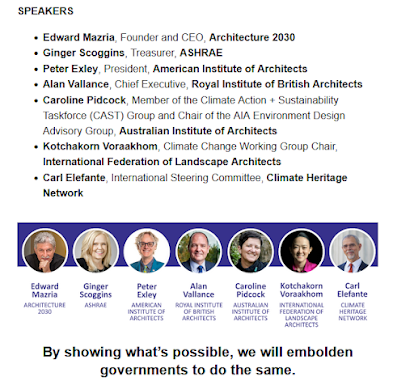
65% by 2030 / ZERO by 2040: Top 200 Global Firms and Organizations Lead With 1.5°C Climate Actions. By showing what's possible, we’ll embolden governments to do the same. The top 200 firms responsible for a significant portion of construction worldwide will present the bold actions they are taking to decarbonize the built world in order to meet the Paris Agreement’s 1.5°C carbon budget. It's one of the best discussions about the urgency of climate action presented to the public.

Carl Elefante FAIA, FAPT LEED AP a representative of the AIA at COP26, provides a summary of their dialogue over 10 days. "After a lifetime practicing architecture, I am hardwired to look for opportunities. Carbon-budgeting building projects and WLCA present many." His new podcast series from the IHBC raises awareness and understanding of how conservation philosophy and practice contributes towards meeting the challenge of climate change.


Thursday, September 30, 2021

Realpolitic


The politics of dealing with climate change solutions and the implementation of carbon reduction in various industries around the world has been so difficult that our global emissions have continued to climb, putting the entire world in serious danger. The COP meetings via the UNFCCC have so far failed to produce quantifiable results in the negotiations of the parties, largely due to intransigence by the major nations - US, China, the UK and Russia. The real work to implement these policies hasn't been undertaken as policy. Some groups have begun to put out policy frameworks to move climate change implementation into the real world.


The Wilson Center, is an independent think tank based in Washington, DC that examines specific topics and their global impacts for review by policymakers and organizations and the public. Topics they cover are listed on their website, which are extensive and relevant, such as
Foreign Policy is Climate Policy - a report from the Wilson Center. Published September 2020, Updated March 2021. A part of their report relates to the emergency of carbon reduction in the immediate future.

"A strong warning of the immediate urgency of implementing climate change policies is a call from UN Chief Antonio Guterrez that the planet is heating more quickly than current models have predicted: "Speaking at the launch of a U.N.-backed report summarizing current efforts to tackle climate change, Guterres said recent extreme weather — from Hurricane Ida in the United States to floods in western Europe and the deadly heatwave in the Pacific Northwest — showed no country is safe from climate-related disasters.

“These changes are just the beginning of worse to come,” he said, appealing to governments to meet the goals of the 2015 Paris climate accord.“Unless there are immediate, rapid and large-scale reductions in greenhouse gas emissions, we will be unable to limit global heating to 1.5 degrees Celsius (2.7 Fahrenheit),” said Guterres. “The consequences will be catastrophic.”

A very specific topic development in another report that has just been issued is the massive threat of climate change.Geostrategic Competition and Climate Change: Avoiding the Unmanageable by Robert S. Litwak on September 15, 2021. "Humanity is at an inflection point as it faces the twin threats of climate change and nuclear war. An historical vignette offers perspective. During the 1985 Geneva summit, President Ronald Reagan privately asked Soviet leader Mikhail Gorbachev if the two superpowers could suspend their Cold War differences and unite if the Earth was invaded by aliens. Today the world faces the functional equivalent in climate change. The most vital issue in international relations is whether the great powers can take concerted action to avert climate catastrophe—or will allow unconstrained geostrategic competition to undermine that urgent necessity."

Taylor & Francis Online has some comprehensive articles on Environmental Politics. This is an organization that is a reputable international publisher which publishes hundreds of journals and thousands of books. They publish and host some of the top-cited journals in different scientific fields. Their research on sources used by the US congress in their history of climate change debates is outlined in a recent article published on August 25, 2021: Weaponizing economics: Big Oil, economic consultants, and climate policy delay.

"For decades, the fossil fuel industry has hired economic consultants to help weaken and delay US and international climate policy. Among them, the economic consultants of Charles River Associates played a key role, helping to undermine carbon pricing, international climate agreements, and other climate policies from the early 1990s onward. The work of these economists was often portrayed to the public as independent, when in fact it was funded by the fossil fuel industry, and their models were incomplete and biased in favor of continued fossil fuel use. Yet their conclusions often passed without challenge and eventually came to represent a significant part of conventional economic wisdom.

Research on the climate change counter-movement has traditionally focused on documenting the promotion of disinformation regarding climate science (Brulle 2014, Franta 2021). While such disinformation has played a crucial role in delaying effective climate policy, the fossil fuel industry and broader climate change counter-movement have also made frequent use of economic arguments to justify inaction. At the same time, the fossil fuel industry has made substantial investments in influential climate economics programs across the US. Further attention is needed on the role of economists and particular economic paradigms, doctrines, and models within climate politics and the perpetuation of fossil fuels."

The political diplomacy which needs to be carried out by the US is tasked to John Kerry, the US  Special Presidential Envoy for Climate. Key workstreams and focus areas for the Special Presidential Envoy’s team include: constructive engagement in the Paris Agreement and related agreements and processes; driving global greenhouse gas emission reductions so as to keep a 1.5 degree Celsius limit on temperature rise within reach; enhancing adaptation and resilience to climate impacts; climate-aligning financial flows; driving overseas clean energy innovation and competitiveness; and better integrating climate and other areas, including the ocean, biodiversity, the Arctic, and international shipping and aviation activities. This is an extensive policy on the climate crisis which has specific urgent measures for getting to zero carbon. So we shall have to measure the outcomes of COP26 in Glasgow by the implementation of the US policies in the real world.


Thursday, April 22, 2021

Earth Day - US Policy


 VP HARRIS TALKS CLIMATE:  Earth Day 2021 on April 22 was marked by the Biden Administration presentation on streaming platforms as well as broadcast on the Discovery Channel.

This article is part of Covering Climate Now, a global consortium of news outlets strengthening coverage of the climate story. View the video at this link.

Friday, July 31, 2020

Energy Flows

Online expanded view of this chart that tracks energy from its source to its consumption. Further discussion and breakdown is here.

It's not hard to drive fossil fuels out of the US economy, quickly. The US has everything it needs to decarbonize by 2035. A World War II mobilization will be necessary for the US to decarbonize its economy fast enough to avert the worst of climate change. To do its part in limiting global temperature rise to between 1.5° and 2° Celsius, the US must reach net-zero carbon emissions by 2050 at the latest. Despite the titanic effort it would take to decarbonize, the US doesn’t need any new technologies and it doesn’t require any grand national sacrifice. All it needs, in this view, is a serious commitment to building the necessary machines and creating a regulatory and policy environment that supports their rapid deployment. A key component of this strategy is the electrification of the power grid and integration of this energy supply with the existing grid. Solar power and wind power are the prime sources of energy, especially with the continuing improvement of battery storage technologies that are part of a more advanced distributed power model. 

 The time for climate discussion has passed. Architects are taking action. The American Institue of Architects (AIA) has developed a landmark initiative to take on climate action for all. From advocating for public policy, to supporting renewable energy use in buildings, from reducing carbon emissions through building design and informed product selection, to spurring energy efficient renovations and designing for natural hazard risk – America’s architects have a leading role to play in humanity’s collective call to climate action.

The kickoff event for this nationwide push to decarbonize the construction sector was held in Los Angeles last March, and the efforts to educate the profession are underway by the AIA. In the very near future, building codes will be adopted that are based upon the ZERO code template for structures, since the AIA is interfacing with the various code agencies. 

Architecture 2030 has worked with the U.S. House of Representatives and sent them the ZERO Code and talked to them about existing buildings point of sale and emissions reduction mandates. They were given quite a bit of building sector information. Adopting a zero carbon building code today, but no later than 2030, made it into the policy recommendations, and more importantly into the 2021 IECC code as an Appendix, which means it can be used with any year of the IECC code. The availability of the IECC Appendix, and national and international ZERO Code, means that any city or jurisdiction in the world can implement policies to ensure that all new buildings are designed and built to zero carbon standards. The AIA was incredibly influential and helpful with these developments. Anica Landreneau of HOK and Carl Elefante, past president of the AIA, both testified in the House. Anika was on the IECC code committee and strongly supported the adoption of the Zero Code. The AIA is reorienting their organization’s resources to address climate change.


Monday, June 29, 2020

Pandemic Carbon Timeline


The Ted Talk Countdown on Climate series is underway with Al Gore's video presentation,  hosted by Chris Anderson.

The coronavirus brought much of the world to a standstill, dropping carbon emissions by five percent. Al Gore says keeping those rates down is now up to us. In this illuminating interview, he discusses how the steadily declining cost of wind and solar energy will transform manufacturing, transportation and agriculture, offer a cheaper alternative to fossil fuels and nuclear energy and create millions of new jobs. Stay tuned for a lively debate about geoengineering and hear Gore's thoughts about how humanity can create a clean, prosperous future through a focused global effort and a generation of young people committed to change. (This virtual conversation, hosted by head of TED Chris Anderson, was recorded June 23, 2020.)


Update 7/8/20: Netting Zero. A virtual event series on climate change from the NY Times


Sunday, May 31, 2020

Eye of the Needle


The coronavirus pandemic is reshaping our world. An article by William Rees points out that "clearing skies and cleaner waters should inspire hopeful ingenuity. If we wish to thrive on a finite planet, we have little choice but to see the COVID-19 pandemic as preview and our response as dress rehearsal for the bigger play. Again, the challenge is to engineer a safe, smooth, controlled contraction of the human enterprise. Surely it is within our collective imagination to socially construct a system of globally networked but self-reliant national economies that better serve the needs of a smaller human family. The ultimate goal of economic planning everywhere must now turn to ensuring that humanity can thrive indefinitely and more equitably within the biophysical means of nature."

This is impacting the schedule of the World Climate Foundation summit, as well as the COP26 date. "In 2020, climate action must take on a new format to ensure global momentum is maintained. Short and long-term objectives should aim to overcome the socio-economic disruptions of COVID-19 and kickstart the global economy through resilient and ambitious green agendas, prioritizing net-zero commitments and low carbon investments now and throughout the next ten years.

With the postponement of the COP26 to 2021, World Climate Foundation is equally postponing its annual World Climate Summit to 2021, and now offers an exciting new series of digital, regional World Climate Forums. At these Forums, governments can transform climate ambitions into successful markets for climate business and market players in major regions of the world and instigate collaboration on policy, innovation, and investments."For decades, scientists have been demanding that climate crisis be taken this seriously. But despite numerous international agreements, governments have been slow to take action to reduce carbon emissions."

The coronavirus pandemic may have one silver lining: the potential collapse of big oil. "As Fatih Birol, the executive director of the International Energy Agency, recently pointed out,  the drop in oil prices also offers an opportunity for countries around the world to lower or remove subsidies for fossil fuel consumption,  which disproportionally line the pockets of wealthy individuals and  corporations with money that could go to education, health care or clean  energy projects."

Optimists are encouraged by people such as the director of the Paris-based International Energy Agency, Fatih Birol, who last April called the crisis an “historic opportunity today to steer [energy] investments onto a more sustainable path.” With G20 governments already pledging around $5 trillion to stimulate their economies in the wake of the shutdown, Birol called on them to “put clean energy at the heart of stimulus plans to counter the coronavirus crisis.” Birol said he had urged political and global financial leaders to design “sustainable stimulus packages” that focus on investing in clean energy technologies and accelerate the transition away from fossil fuels. In its latest short-term projections, the US EIA says that it expects the biggest hit to oil demand in the second quarter of 2020, but that the reduction will only “gradually dissipat[e] over the course of the next 18 months”

The Rocky Mountain Institute is issuing a series of stimulus white papers to respond to the climate crisis, the economic shifts and provide guidance to governments and industry for rapid decarbonization."As the effects of the COVID-19 crisis ripple across the globe, strategic stimulus and recovery investments can get world economies back on track now and help us build back in a way that ensures greater resilience to the disruptions and crises we will inevitably face in the future. The current pandemic shows many parallels to, and interconnections with, a looming climate crisis. A response that addresses both crises at once will advance a low-carbon economy that is more resilient and helps mitigate the worst impacts of climate change, while improving the economy, the environment, and our health and communities."

In response to the impact of the pandemic, the RMI's recommended programs aim to catalyze industries, technologies, and practices shown to improve public health, decrease costs, create enduring job opportunities, and reduce greenhouse gas emissions. The four programs are:
  • Build Back Better Buildings: A building retrofit program to catalyze residential and commercial building improvements at an unprecedented scale.
  • Enhance Access and Electrify Mobility: Investment to prioritize pedestrians, cyclists, and public transit over the automobile, while also supporting the growth of the electric vehicle market.
  • Debt Forgiveness for a Sustainable Recovery: A financial incentive program to provide companies with debt relief based on verifiable emissions reductions.
  • Economic Recovery Facility for Financing Low- and Zero-Carbon Activities: A federal entity dedicated to facilitating the financing of clean energy and infrastructure projects.
A simple debt forgiveness approach can help industries and workers feeling economic pain now and build toward a more sustainable, low-emissions future.

Update 6/26/20: Degrowth: A Call for Radical Abundance

Update 7/23/20: Tom Steyer - Clean Energy as a job generator

Update 7/30/20:  Some Earth system tipping points may be linked together


Update 8/9/20: Observing recovery through a climate 'magnifying glass'

Update 8/16/20: Exponential growth bias: why most people don't understand the risk of runaway climate change.


Tuesday, September 17, 2019

Belt and Road


Architect's Newspaper Sept. 2019: "For this year’s international practice issue we looked at China’s massive Belt and Road Initiative (BRI), the trillion-dollar project aimed at tying the world to Beijing, and slavery’s role in the global construction industry. The Belt and Road initiative set up by Xi Jinping in 2013 includes hundreds of infrastructure projects financed or constructed in part or in whole by Chinese entities far beyond its borders. "Belt" refers to roads and railways, while "roads" refers to sea lanes, all of which unifies almost the entirely of Asia and Africa. The number and physical size of these infrastructure projects promises to remake urban landscapes - alter, and destroy - natural landscapes and consume untold millions of tons of natural resources, building materials and fossil fuels. The BRI is as much a geopolitcal experiment as it is an economic development strategy."

And it is definitely NOT a "green vision".  An analysis shows that China's BRI is loaded with coal power.

China is by far the biggest player in Asia, having supplied or pledged $36 billion for coal plants in 23 countries, according to the IEEFA. The Chinese government has provided financing from state-run banks and included many of the projects in its colossal Belt and Road Initiative, which is designed to expand Beijing’s influence through investments in strategic foreign infrastructure projects.

China has modernized their one-party dictatorship with market oriented reforms, i.e., its own version of authoritarian capitalism since Deng Xiaoping's rise to power after Mao's Cultural Revolution.His violent suppression of society and the government resulted in primarily military and police state power. This has led to an economic expansion and more wealth for a few Chinese connected to the right party officials and the Bank of China. It's this monolithic structure that Xi Jinping has inherited and continues to expand using economic levers in many countries with BRI as its mechanism.

A new study uncovers China's massive hidden lending to poor countries. Over 50 developing countries' Chinese debt accounts for on average 15 percent of their individual GDP. An example of their methodology is the way China isolates Taiwan with projects in poorer countries; the price of the development is breaking official ties with Taiwan. In this manner, China magnifies its influence over Taiwan without a direct confrontation with the US, which continues to sell weapons to Taipei. Beijing is withholding the $4.9 billion needed to finish the road project in Kenya, once a flagship for Xi Jinping’s Belt and Road initiative. But with concerns rising globally that BRI was loading poorer nations with unsustainable debt, Xi signaled in April that Beijing would exert more control over projects and tighten oversight. Chinese influence in Myanmar is growing. One of China’s biggest projects is the construction of a deep-sea port on the coast of Rakhine State. China’s ambitions for Myanmar also feature oil and gas pipelines to feed its insatiable energy needs. One of the pipelines cuts right through Rakhine State—suggesting an incentive for the Burmese military’s aggressiveness against the people living there. In Belarus, activists are protesting the massive industrial park development, the Great Stone Industrial Park outside Minsk. To quote one activist, "America and Europe won't give money for dirty factories like this, but China doesn't care and wants business for Chinese companies."

Earlier in 2018, the New York Times did an extensive examination of this topic: "We examined nearly 600 projects that China helped finance in the last decade, through billions of dollars in grants, loans and investments. Taken together, they show the scope and motivation of China’s strategy.41 pipelines and other oil and gas infrastructure help China secure valuable resources. We found 112 countries where China has financed projects. While most fall under its infrastructure plan known as the Belt and Road Initiative, Beijing has pushed beyond those boundaries.South Africa turned to China for $1.5 billion for a coal-fired power plant. It is one of at least 63 such plants financed by China around the world, which collectively pollute more than Spain." The Times has recently produced a longer investigation of projects in Kazakhstan, in an inaccessible area on the steppes of Central Asia, "The Trillion Dollar Nowhere".

 It's not too late to "green" that Belt and Road project. A couple of years ago, China even issued its own $2.15 billion Green Climate Bond to finance renewables and energy efficiency. But when it comes to that Belt and Road Initiative, China is not big enough. Although the Party centralized authority in Xi Jinping’s hands, those infrastructure projects come from a variety of sources in China, including different government agencies, provinces competing with each other, and the business sector. It’s hard enough for the Chinese state, even with a new and more powerful Ministry of Ecology and Environment and a cadre of environmental police officers, to impose stringent standards within the country. More to the point, China has shown little interest or capacity when it comes to imposing them outside its borders.

While the Chinese initiative initially received an overwhelmingly positive reception, since mid-2017 the democratic Quad—Australia, India, Japan, and the U.S.—and several European countries have begun to signal major reservations about the BRI. A new multi-country survey found that there is little public support for coal projects in key countries for China's ambitious BRI, knowing that country's penchant for leveraging its investments into control, such as has been experienced lately with Hong Kong.

There is rightful international concern about the agenda behind China's development push, particularly since it imposes its own culture and only honors contracts it sees fit. However, some scholars counter that there is no evidence that China’s plan is to entrap developing countries. Deborah Brautigam, director of the Africa-China Research Initiative at Johns Hopkins University, said the Sri Lanka port is the only one out of more than 3,000 Belt and Road projects that has ended in a 99-year lease. “We’ve not seen a pattern of deliberate entrapment in order to get some strategic advantage,” Brautigam said.

Update 9/23/19: Belt and Road propels Chinese contractors to top of global ranks

Update 9/24/19: China’s BRI: a Marshall Plan in reverse

Update 9/25/19: China’s BRI cargo to Europe under scrutiny as operator admits to moving empty containers

Update 10/3/19: 'Coal is still king' in Southeast Asia even as countries work toward cleaner energy

Update 10/29/19: In Laos, A Chinese-Funded Railway Sparks Hope For Growth — And Fears Of Debt

Update 12/2/19: China’s Renewed Coal Boom - Including India

Update 12/4/19: James Hansen - China's coal emissions

Update 12/14/19: China has invested heavily in the Mediterranean region as part of its Belt and Road initiative and controls a string of major eastern Mediterranean ports, including Piraeus.

Update 12/19/19: Syria plans to join China's Belt and Road Initiative

Update 3/4/20: One of China’s Most Ambitious Projects Becomes a Corridor to Nowhere.

Update 4/29/20: Is China’s 2013 Belt and Road Initiative (BRI) a debt trap?

Update 4/30/20: Belt and Road Tracker.

Update 10/3/20: China's Imperial Overreach

Update 9/12/21  China's transcontinental grid of railroads, oil pipelines

Update 10/2/21: The Winner in Afghanistan: China

Update 5/8/22: China's Belt and Road is so enormous that its impacts could accelerate climate change.


Monday, August 5, 2019

The 1984 Climate Change Documentary


from Climate State: a half hour presentation

During the late 1970s it became increasingly clear that the planet was warming, culminating in the landmark Charney Report, published in 1979. Forty years ago, scientists accurately predicted climate change. We are living it now.

This 1984 documentary outlines our understanding of global climate change at the time. Topics discussed include, the scientific consensus, weather patterns, sea level rise, adaptation, climate actions, or the greenhouse effect. There's weather, and then there's climate. Weather patterns come and go, but forecasting has become much more accurate through improved meteorological techniques. Climate change is harder to predict. But, as the CBC's Peter Kent shows in this 1984 documentary, it's happening. Carbon dioxide levels in the Earth's atmosphere have been steadily rising.

Program: The Journal / CBC Broadcast Date: Jan. 24, 1984

This and other environmental video libraries are at
Climate State TV
Climate State Patreon

On the global front, the first COP by the UNFCCC was convened in 1995, and began its long, torturous path towards the Kyoto Protocol of 1997, an international treaty which extends the 1992 United Nations Framework Convention on Climate Change (UNFCCC) that commits state parties to reduce greenhouse gas emissions, based on the scientific consensus that global warming is occurring. It came into effect in early 2005.

The global warming issue didn't publicly resurface again for a couple of decades, until Al Gore took his presentation on the road after his electoral loss to Bush in 2000. The "Inconvenient Truth" is a 2006 American concert film/documentary film directed by Davis Guggenheim about former United States Vice President Al Gore's campaign to educate people about global warming. The film features a comprehensive slide show that, by Gore's own estimate, he has presented over a thousand times to audiences worldwide beginning in 2004. That movie is available here. In 2007, Gore was awarded the Nobel Peace Prize, along with the Intergovernmental Panel on Climate Change, for “informing the world of the dangers posed by climate change.”

Some of the background on that movie and its development from the famous traveling slide show is here. Over time, cynicism and denial from the Bush administration eroded the momentum established by the movie. When the Obama administration laid out its policy for addressing climate change in the 2013 State of the Union speech, it was a signal change for addressing the issue. At that point, Gore bounced back with his Climate Reality project, which continues today in a global climate advocacy movement.

The next big global step from the UNFCCC came with the Paris Climate Accord of 2015 that promised to strengthen the global response to the threat of climate change by keeping a global temperature rise this century well below 2 degrees Celsius above pre-industrial levels. 195 countries adopted the first-ever universal, legally binding global climate deal.

Except that in June of 2017, the Trump administration announced that it would no longer participate in this treaty, which could become effective in November of 2020. With the Trump administration currently holding sway over the denialist movement and in thrall to the fossil fuel industry as well as the Saudis, Gore now continues to advance the climate change agenda with several projects that he's pushing forward, including the earth observation DSCOVR satellite with NASA.

Update 8/13/19: “Kochland” examines the Koch brothers’ early, crucial role in climate-change denial - their role went as far back as 1991.

Update 8/21/19: Readings on the pioneers of climate science


Tuesday, July 2, 2019

A Call to Leadership


Architecture 2030 is a non-profit, non-partisan and independent organization established in response to the climate change crisis in 2002. It was started back then by architect Ed Mazria, who wanted to develop building standards for the industry that embraced the UNFCCC carbon protocols and position the industry to be ahead of the game instead of behind it. At the time, it was a challenge to the American Institute of Architects (AIA), which was mostly involved with incremental code changes for energy efficiency. It wasn't a case of exhibiting leadership in environmental issues.

By 2014, the architecture profession had embraced the radical decarbonization of the built environment outlined by Architecture 2030 criteria and showcased Ed Mazria, FAIA as the keynote speaker at the national convention that year as an industry game-changer. Its ZERO Code is a pathway to zero net carbon buildings and has now been fully embraced by the AIA. At the same time, the International Union of Architects (UIA) World Congress, member organizations representing over 1.3 million architects in 124 countries worldwide unanimously adopted the 2050 Imperative, a declaration to eliminate CO2 emissions in the built environment by 2050

Meanwhile Mazria, who has become something of a building-sector Al Gore, appearing at global conferences with pie-chart slides, says he believes another industry-wide strategy could curb carbon emissions even faster than policy. “Twenty percent of all the construction in the world is influenced by a small percentage of AEC firms. That’s where the power is,” he says.

Mazria praises the precision of the global building sector, which has managed to reduce carbon emissions since 2015 even while floor area has expanded. That success story has been under reported, partly because the world is understandably more focused on record-breaking overall carbon emissions in 2017 and 2018. But Mazria believes AEC firm leaders could flip the graph during the next few critical years. He’s focusing on relationships with CEOs at the AIA’s Large First Round Table, a group that meets twice a year. Nearly all those firms have signed on to the 2030 Commitment, which, since these giant firms bill internationally, has a global impact. Mazria has brokered carbon neutrality commitments from CEOs at major AEC firms in other countries too, including China. “We understand the issue. We’ve had an awakening,” says Mazria. “Now we just have to be very, very aggressive. If we don’t solve it, it doesn’t get solved. It’s as simple as that.”

Recently the AIA has formally set out specific policies to provide a framework for the AIA to prioritize and support urgent climate action to exponentially accelerate the “decarbonization” of buildings, the building sector, and the built environment.

On the first day of the AIA Conference on Architecture on June 10 of this year, a Resolution passed -- overwhelmingly -- for AIA to:
  • declare an urgent climate imperative for carbon reduction
  • transform the day-to-day practice of architects to achieve a zero-carbon, equitable, resilient and healthy built environment
  • leverage support of our peers, clients, policy makers, and the public at large.
This is a victory for AIA's Committee On The Environment and many other groups and people who have been advocating for architects and the AIA to take a leadership stance on climate change, as its impact is seen in every community.

But this is not a proposed solution. It is a call for action.The membership has spoken and the imperative is clear.This means not only a major change in practice, but also a cultural change.

There is big work ahead.

Update 7/19/19:  AIA COTE in conversation with Paul Hawken,  Director of Project Drawdown

Update 8/11/19:  Achieving Zero Framework: Phasing out CO2 emissions in the urban built environment by mid-century

Update 8/12/19: Why Cities Matter: Global Covenant of Mayors

Update 9/20/19:  AIA announces Big Move Toward Environmental Stewardship

Update 9/21/19: Where we stand: Climate Action

Update 9/25/19:  On September 4 in Pittsburgh the AIA Board ratified Resolution 19-11

Update 10/7/19: We are in the midst of a climate emergency and timing is everything.

Update 11/12/19: Mazria - Impact that the architecture and building industries could be having on climate change.

Monday, April 22, 2019

Bending the Arc of Justice


From the inspiration of Earth Day in the writings and activism of Rachel Carson in her epic Silent Spring documentation to the present-day confrontational actions between the corporate power of profit versus the Extinction Rebellion - portrayed in the graphic above from FT - we have seen Earth Day evolve extensively from its first recognition in 1970. During that time, we have seen 24 COP's come and go; the first COP was held in Berlin in 1995.

The 25th session of the Conference of the Parties (COP 25) to the UNFCCC was to take place from 11-22 November 2019 in Brazil. Upon election as President of Brazil, Jair Bolsonaro pulled Brazil out of hosting the event. So now the Santiago Climate Change Conference, which will feature the 25th session of the Conference of the Parties (COP 25) to the UNFCCC and meetings of the UNFCCC subsidiary bodies, is expected to take place from 2-13 December 2019.

This reflects the global turbulence among countries, governments and corporate powers that are all staking a claim on planet earth, resulting in a human-induced crisis of resources, humanity and the very life systems of our environment. In the last few hundred years we've gone beyond our natural limits and show no signs of stopping carbon emissions in spite of all the agreements and discussions to date. Hence, the increasing tragedy of future environmental collapse, and the resistance personified by children like Greta and the powerful counter movements emerging as the alarms are set off by more and more people seeing an unfolding terrible, dark future.

According to a NYTimes report, more carbon has been released into the atmosphere since the final day of the Noordwijk conference, Nov. 7, 1989, than in the entire history of civilization preceding it. In 1990, humankind emitted more than 20 billion metric tons of carbon dioxide. By 2017, the figure had risen to 32.5 billion metric tons, a record. Despite every action taken since the Charney report — the billions of dollars invested in research, the nonbinding treaties, the investments in renewable energy — the only number that counts, the total quantity of global greenhouse gas emitted per year, has continued its inexorable rise.

Like the scientific story, the political story hasn’t changed greatly, except in its particulars. Even some of the nations that pushed hardest for climate policy have failed to honor their own commitments. When it comes to our own nation, which has failed to make any binding commitments whatsoever, the dominant narrative for the last quarter century has concerned the efforts of the fossil-fuel industries to suppress science, confuse public knowledge and bribe politicians.

Because our destructive, profit-focused economic system demands a fiction called GDP that requires physical consumption to increase the ledger sheet balance, the system inherently grows out of control as the markets are expanded. Destroying the environment that provides our life support is a form of insanity that leads to collapse, and that is increasingly recognized now by people all over the world, as well as by governments and the insurance industry. A view delineating this is: Collapse of Industrial Civilization ~ Finding the Truth behind the American Hologram Concerning Humanity’s Future: Interview with Nick Humphrey, Climatologist and Geoscientist. Nick makes the critical point that Nature is in control, not humans. Even our current catastrophes which were sparked by humanity’s activities were ultimately governed by the laws of Nature (physics, thermodynamics, chemistry, etc). We never were separate from it all, but a part of it. We should be telling ourselves to do what we feel is right to respect Nature and its unbreakable laws, accepting our place in the Universe as just one of many species which have a finite existence on this planet.

The enormous effort that it will take for the all the civilizations of the world to stop the self-destruction and change the entire system in time to stave off the worst impacts appear to be unachievable at this point, especially given the rise of demagogues and rampant corruption in many countries, including the US, that block even the efforts by corporations and individuals to change this systemic self-destruction. We have reached our day of reckoning, which was actually five years ago with the issuance of the IPCC's AR5 fifth assessment report, Part 2, ahead of the Paris Climate Summit.

As Chris Hays put it, Martin Luther King's idea that the moral universe inherently bends towards justice is inspiring. ... "The arc of the moral universe is long, but it bends towards justice." It means that all of us together will have to bend it with revolutionary fervor, not just foster incremental steps. The time has come, even as the natural world inflicts its wrath upon our efforts to salvage a future for ourselves and our kids.

Update 4/23/19: It’s Not Coming, It’s Here: Bill McKibben on Our New Climate Reality

Update 4/24/19: Club of Rome Climate Emergency Plan (pdf file)

Update 6/29/19: Bonn wrap-up: Shifting the levers of power toward climate justice.

Update 9/24/19: Former Governor Jerry Brown launches California-China Climate Institute.  More on that here.


Saturday, March 2, 2019

Rabblerousers


16-year old Greta Thunberg is the most recent and astonishing climate activist to emerge since last December's COP24 in Katowice left the planet with no specific agreements or targets. It started with her lone school strike during last September of 2018 that ultimately saw her scolding the adults for not taking action to meet the actual reductions necessary in carbon emissions to keep the planet habitable for her generation. At Davos in January, she told world leaders: 'I don't want you to be hopeful, I want you to panic. I want you to feel the fear I feel every day and then I want you to act.' In an impassioned warning to act now on climate change, Thunberg told her audience: 'Either we choose to go on as a civilisation or we don’t."  She's making common cause with Extinction Rebellion, a fast-growing public uprising that began in October 2018  with a petition in London to the UK government to drive radical change and create urgency around the obvious signs of climate breakdown.

Business as usual on climate change is no longer acceptable to a growing number of people, as well as the UNFCCC participants, which is reaching its own critical milestones. At the recent joint briefing by the President of the General Assembly and the Secretary-General's Special Envoy for the 2019 Climate Summit,  General Assembly President Maria Espinosa said 2019 is a critical year, the “last chance” for the international community to take effective action on climate change on Thursday, during a briefing to announce the UN’s roadmap to the Climate Summit in September. She walked the representatives of Member States through some of the key events of 2019, leading up to, and following, the Climate Summit. All of the events, she said, share two goals: a doubling of commitments and ambition at a national level, and ensuring the inclusion of diverse groups in the process of climate action.

The slowly building movement that has engaged in lawsuits against governments for failing to protect people from the harmful and destructive impacts of climate change is picking up speed as these lawsuits succeed in moving forward, despite government resistance fostered by the fossil fuel industry. In moving beyond politics, these lawsuits provide a mechanism within each country to force the government to act immediately and with significant steps to combat climate change impacts. An array of climate litigation against governments and corporations is now underway under the umbrella of the Plan B organization.

The strategy of suing governments to force action is drastic, but given the lack of progress by the COP process as well as ineffectual emissions reduction standards, it may be the future of climate change action. It involves the connection between climate change and establishing human rights around the ability to live in a world that is habitable and supports life for the billions of people on this planet.

Update 3/7/19:  Greta's story

Update 4/23/19: The speech Greta Thunberg gave to MPs at the Houses of Parliament: 'You did not act in time'

Update 9/20/19: An Hour with 16-Year-Old Climate Activist Greta Thunberg on Sept. 11 - Democracy Now

Update 9/21/19:  Our Planet Is Dying. The Time for Fairytales Is Over.

Update 12/15/19:  Vatican calls Greta Thunberg ‘great witness’ of Church’s environmental teaching


Tuesday, November 20, 2018

A Reckoning


Bill McKibben has just published an article in the New Yorker: How Extreme Weather is Shrinking the Planet. With wildfires, heat waves and rising sea levels, large tracts of the earth are at risk of becoming uninhabitable. But the fossil-fuel industry continues its assault on the facts. However, the impacts of our changing climate have now hit home with a vengeance, and it's our collective responsibility to deal with its causes and the consequences of our civilization's activities on our planet.

With the Camp Fire in northern California two-thirds contained, the Woolsey Fire in southern California all but extinguished and a sky-cleansing rain, with possible flash floods forecast for Northern California today or tomorrow, Californians are now facing a grim reality: these staggering catastrophes are becoming routine. They've been dubbed the "new abnormal". By the century’s end, simultaneous disasters—three or more at once—could in fact be California’s norm, unless aggressive measures are taken, according to a major paper published this November in the journal Nature Climate Change.

California climate policies are currently shifting rapidly to address the impacts of climate change, as well as establishing carbon-neutral strategies as a result of these catastrophic events. These extremes are now occurring regularly, as well as the impact of a drier climate that reduces the availability of water in the state, which is also happening across the entire US southwest.

But the real work lies ahead in an immediate, aggressive reduction in the carbon dioxide emissions across the planet, in order to keep the temperature changes below the 1.5C threshold as negotiated via the UN Climate Change secretariat through the annual COP meetings. At the Global Climate Action Summit, which concluded in San Francisco this last September, UN Climate Change Executive Secretary Patricia Espinosa said: “This Summit and its Call to Action make an important contribution towards achieving our collective goal: to keep global temperatures to 1.5 degrees Celsius in line with the Paris Agreement. It will encourage governments worldwide to step up their actions, demonstrating the vital role that states and regions, cities, companies, investors, and civil society are playing to tackle climate change.”

This summit was a preparation for the upcoming COP24 that will be held in Katowice, Poland this year on December 2 - 14. At this time, more commitments from all countries and worldwide corporations will need to be made so that global actions can be undertaken which moves our civilization into a radically different mode of energy use, transportation and building construction. Our forests on all continents must be restored and allowed to expand into healthy ecosystems as part of the climate mitigation that will have to happen. The preparatory dialogue for this collective action is being supported by some of the major corporations, as well. They are prepared to participate in Katowice and implement the necessary actions according to the framework and goals outlined at COP24. A good example is Iberdrola, a leading renewable energy company that exemplifies the benefits of moving rapidly to a non-carbon based economy.

It will take an enormous, unprecedented effort by all countries and corporate entities to engage in immediate and very radical transformations of our economy and our way of living in concert with the natural environment. It's the biggest challenge that humanity has ever faced, and will reflect our collective ability to undertake actions that regenerate our planet and reconfigure our cities to reduce humanity's footprint in favor of natural processes.

Update 12/13/18: Many mega-projects simply aren’t worth the risk to investors, host nations, or the environment.

Update 12/16/18: Major companies like McKinsey are pursuing business in countries with little regard for human rights.

Sunday, November 11, 2018

A Systems Approach To It


The article,"Systems Thinking and How It Can Help Build a Sustainable World", makes an important point about looking at the bigger global climate picture and identifying all the parts of a problem in order to solve it:

"Rather than asking why one should think in systems, perhaps the more piercing question is: why has holistic thinking been stamped out of us again and again over time, most vigorously so during the modern industrial age? The simple answer is that power and control are not compatible with a well-educated citizenry that sees the big picture. Modern industrial civilization is built upon the mechanization and commodification of society and nature, with those at the top benefiting from the enormous outputs generated by the “cogs in the wheel” toiling at the bottom. If we become aware of this vast, complex machine and start to understand how it works, we might want to break or change it! We might want to create a different system in which all parts of society and nature can flourish, not just those in power."

This kind of a conversation must involve everyone who is affected by it. A dialogue about the Sustainable Development Goals has to be undertaken at a global level. "The important and widespread understanding that was reached at COP22 in Marrakech is that climate change needs to be addressed systemically and not with carbon-myopia...We are facing a planetary emergency at the species level and we do need all nations — and what’s more all people — of this Earth to unite in a shared vision to redesign the human impact on Earth from destruction to regeneration."

This problem of tackling climate change requires a multivalent, systems approach to its solution, not a linear one. The primary concern is how to tackle the carbon-to-zero issue in our energy systems and our land use approaches. A framework focused on worldwide decarbonization is a first, major step that relies on economic system changes and global agreement. Then there's the rest of it, which involves fundamental changes in our society, its economics, and our culture.

I would outline the systems approach as a multiple-front strategy that focuses on key parts of the big problem: human population, intelligent organization, technology, human expansion and the methodology of this expansion. One thing I've always advocated since completing my graduate architecture thesis in 1979 on an Orbiting Space Base is that extractive industries should be exiled to on-orbit and lunar industry operations because humans will never stop exploring and reaching out for resources. Same process the animal kingdom employs, but there are natural ecological balance mechanisms for that, and unfortunately we've managed to escape those with technology. Animal populations crash in natural environments repeatedly, that's part of how the systems work when a population gets out of whack, with its checks and balances on resources driven by planetary cycles. This also applies to human civilizations across history, as well.

Humans must commit to a simultaneous ecological footprint and population reduction, with the economics grounded in making environmental restoration the most profitable industry. In other words, impose our own "smart crash" that does the least amount of harm. And it's not like we don't know how to do that. (birth control, limits to growth, restore the environment) It's a fairly socialist approach, think Sweden, but that's just fine. I've been to Scandinavia and they're happier than we are. Here's my specific points:

Human Population

But how do you achieve this preservation of the common global resources with a population that has already exceeded earth's carrying capacity since 1980? An interview with Bill Ryerson, founder of the Population Media Center, outlines how groups of people can be taught through stories to change their behavior. These stories are entertainment, soap opera, and educational documentaries. What this could do is help populations of people become self-limiting by choice, and thus diminish the demands on ecosystems that use up all available resources and diminish the critical diversity of species that is necessary for functioning ecosystems.

The fiscal reality check that we're currently experiencing on a worldwide basis has its parallel in natural system collapse, which is something that can be averted by the development of a steady-state system that produces a livable environment without consuming the world's common resources. That's the tragedy of the commons. Everyone's self-interests ends up devouring more than the planet can bear.

Intelligent Organization

The idea that human habitation can be used as a tool to regenerate ecology is finally coming into its own after experimentation with projects all over the world. It's not a zero-sum game, it's a way of bringing together all the environmental and engineering factors together in a place such that it renews natural processes instead of destroying them. It takes a great deal of skill, knowledge and experience to work out the systems that result in the creation of place that interconnects all these factors. Many major corporate engineering, design and development firms are investing in think tanks to take this to the next level, such as Arup, a global design, planning and engineering firm.

Technology

The building demonstrates how closed loop systems developed by space-based technologies can be applied to structures on this planet to bring their energy and carbon impact down to zero. Ideas such as the structural exoskeleton, use of natural light and processes, as well as a "bare-bones" approach to materials use can reduce human habitation demands on ecosystems as well as assist in the restoration of the natural world.

The planets we imagined exploring turns out to be the one we're living on.

Human Expansion

What about using a salvage yard in low earth orbit? It could provide a low-earth orbit platform for recycling and materials supply for providing industry outside of the atmospheric envelope, as well as conserving the metals used in the satellite construction which are already very highly processed. This is the essence of sustainability. We don't burn our trash in the back yard any more, why keep doing it out in the outer biosphere? Here's the online presentation of my low earth orbit base concept which could be used to develop industry and establish a foothold outside of earth's deep gravity well for interplanetary robotic launches and lunar mining processes.

Systems Design for Expansion

Key to this concept is understanding that to achieve this vision, there must be some major on-orbit infrastructure to support construction, development and launch of these exploration initiatives. My 1979 thesis outlines this strategy in a Relevance Tree and shows how a Low Earth Orbit platform, working in concert with lunar mining and large vehicle production outside of earth's gravity well allows for effective use of labor and materials, as well as providing "many futures" rather than just one projection line (dotted).

Update 11/12/18: A good climate policy rises above politics.

Update 11/16/18: Industrial agriculture and extractive industries must cease and be transformed.

Update 1/17/19: This systemic crisis is complex and requires new approaches


Monday, October 8, 2018

Keep It Simple


The IPCC Special Report is here from the UN. It documents the immediate impacts on the environment that 1.5C will likely have. It warns that strong efforts would be required to prevent disastrous consequences from dangerous levels of climate change. This means that World War II was a cakewalk compared to this, all hands on deck. An analysis of the report: "The best time to start reducing emissions was 25 years ago. The second best time is today."

Johan Rockström, chief scientist at Conservation International speaks about it.“Climate change is occurring earlier and more rapidly than expected. Even at the current level of 1C warming, it is painful,” he told the Guardian. “This report is really important. It has a scientific robustness that shows 1.5C is not just a political concession. There is a growing recognition that 2C is dangerous.” In order to blunt the coming climate change at that level, it's necessary to abandon coal and other fossil fuels in the next decade or two.

Having said all that, there's immediate, large-magnitude things that can happen right away to drastically reduce emissions. Such as protecting, preserving and restoring our great forests. Such as elimination of fossil fuel subsidies by governments across the globe. Such as rapid technology advancement in wind and solar, along with the upgrading of the electrical grids and establishing many stand-alone power sources at its periphery. Transportation in all areas, such as auto, truck, rail, airlines, and especially port traffic from overseas, will need to become electrified and supplied with renewable fuels. These strategies are not difficult, and can be widely employed in all countries, which need to develop the revenue for this. Decarbonization also has possibilities in the future with the nascent carbon capture industry that's progressing now.

There are many other things that can be done by private industry and by municipalities that can contribute to the lowering of carbon emissions in the very near future. But we don't have much time, and we need to mobilize. All of us.

Update 10/8/18: Nobel Prizes are awarded and given to economists referencing ways to adapt growth to climate change.

Update 10/9/18: 2C is nowhere near safe from a climate impacts perspective; now it's 1.5C

Update 11/2/18: Absurd for society to kneel before the dictates of the marketplace and that its primacy should determine how you structure government.

Update 11/12/18: The IPCC report tells us that climate breakdown is inevitable if we continue with growth-based neo-liberal economics.

Update 12/17/18: A new IPCC report says we’re looking at climate catastrophe as early as 2040.

Update 1/14/19: Silent Spring - Why it’s time to think about human extinction  Dr David Suzuki on economic growth

Update 7/1/19:  Scientists are calling for an end to capitalism as we know it.

Saturday, September 22, 2018

A Letter from Gaia


 Oil Change International - California Hypocrisy

In a letter published by David Turnbull, Sept 22, 2018:
 
"Last week, as leaders from across the world gathered for the Global Climate Action Summit (GCAS) in San Francisco, hundreds of people, with Indigenous and frontline leaders out front, took to the streets outside the convention center, marching right up to the entrance to demand real climate leadership, not half-measures.

It was fitting that the summit took place in California, a state that has done a lot to incentivize renewable energy, yet continues to also be a substantial oil and gas producer. While California’s Governor Brown talks a good game on climate change, he’s resisted any effort to take on the state’s oil and gas producers."

Many environmentalists have been tracking the efforts by the Brown administration in California with respect to its climate change policies as well as the international cap-and-trade agreements put into place a decade ago, and have spotted the actions that failed to follow the talk. The fact that he's been relying on oil revenue to balance the state budget was no secret, and Brown replied to the criticism at the summit by saying "politics runs on money".

This kind of fossil fuel activism can reach to the federal level with highly focused actions and programs:

"The Paris Agreement was watered down at the behest of the Obama administration compared to a more rigorous treaty, with common base year and targets, recommended by the European Commission (Spash, 2016a). Obama made clear his commitment to protect American jobs over the environment and specifically over any need to address human induced climate change. In this logic, environmental policy is justified if it creates jobs and growth, which always come first despite the inevitable contradictions. Obama’s administration massively expanded domestic oil and gas exploration to make the USA the worlds largest oil exporter (Spash, 2016a: 70). Non-conventional oil has been part of this strategy, despite the world already having over 6 times the reserves it could possibly burn and still have a ‘likely chance’ of the 2°C target (Spash, 2016b). Obama boasted that under his administration enough oil and gas pipelines had been built to ‘encircle the Earth and then some’ (see full quotation in Spash, 2016a). He ignored the associated ecological and social harm, not least that to indigenous communities. In 2016, Native American protestors at Standing Rock opposing construction work on the Dakota Pipeline that, now operational, transports fracked oil, were brutally suppressed by the combined efforts of the construction corporation’s security forces, riot police and the national guard. All that was before the election of a climate denialist with personal investments in fossil fuels."

As an example of how this environmental policy action develops, here is the Climate Silence Case Study from ClimateTruth.org Action, which is a program of Oil Change USA, a nonprofit organization. It shows how it forced President Obama to address Federal responsibility for climate action policies.


Update 12/15/18: Big polluters get help from the state, renewing doubts about California’s climate goals.