Showing posts with label another_year. Show all posts

Sunday, December 18, 2022

A Fourteenth Year - Exceptional Drought


The western United States' drought continues to worsen. The garden is dry as a bone, and the watering restrictions make it difficult to keep the plants going. We are allowed to water our trees, which are struggling. That this is the inexorable result of burning of fossil fuels is no longer any doubt. It will continue to worsen, and in an accelerating pace. The heating of our planet will continue because the carbon content of the atmosphere is approaching levels not seen in millions of years, and emissions show no sign of slowing.

Exposing Massive Threats from Permian Basin Development: The six-part Permian Climate Bomb series explores the ongoing oil, gas and petrochemical boom in the Permian Basin, a story of runaway toxic infrastructure, environmental injustice and climate overshoot. 

"This series analyzes the climate, public health, economic and social impacts of the Permian fracking boom. It illuminates the Permian Basin's link to environmental injustice and petrochemical expansion on the Gulf Coast. The report also follows the flow of Permian hydrocarbons to export markets. Finally, it gives voice to the impact fossil fuel infrastructure places on communities, spotlighting the individuals confronting the oil and gas industry in the region."

Saturday, December 18, 2021

A Thirteenth Year - We Dig In


The decade-long drought that impacted water supplies and fueled massive forest fires is still with us, although we've been seeing the rain again, a positive development for water storage in our parched land. Our forests have gone up in flames all summer, and the local urban forests and wildlands are dangerously dry. This has made climate change an urgent priority, and our state government in Sacramento is trying to push ahead with progressive policies that will mitigate carbon emissions by 2050. Even though we know that's not even half of what we'll ultimately have to do.

Our state policies have been informed by the UNFCCC COP deliberations, via former Governor Brown and now Governor Newsom. The architecture profession is moving ahead with educating its members and providing resources to bring emissions down from the construction sector.

CarbonPositive: Architecture’s Critical Role at COP26 - a formulation of strategy for the profession."COP is three parallel events. Of course, there are intergovernmental negotiations taking place in areas inaccessible to the public. Next, is the Blue Zone open to UN accredited delegations. Architecture 2030 is admitted as an “observer” organization with access to the Blue Zone. Finally, the Green Zone is open to the public. The Venn diagram of these three events has some overlap, but not much."

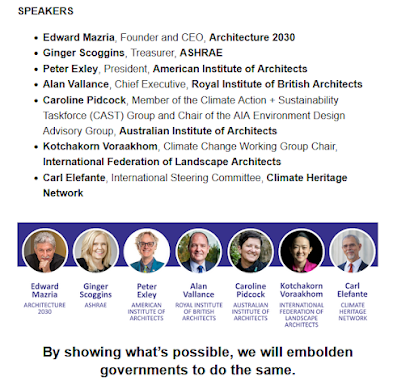
65% by 2030 / ZERO by 2040: Top 200 Global Firms and Organizations Lead With 1.5°C Climate Actions. By showing what's possible, we’ll embolden governments to do the same. The top 200 firms responsible for a significant portion of construction worldwide will present the bold actions they are taking to decarbonize the built world in order to meet the Paris Agreement’s 1.5°C carbon budget. It's one of the best discussions about the urgency of climate action presented to the public.

Carl Elefante FAIA, FAPT LEED AP a representative of the AIA at COP26, provides a summary of their dialogue over 10 days. "After a lifetime practicing architecture, I am hardwired to look for opportunities. Carbon-budgeting building projects and WLCA present many." His new podcast series from the IHBC raises awareness and understanding of how conservation philosophy and practice contributes towards meeting the challenge of climate change.


Friday, December 18, 2020

A Twelfth Year - Bone Dry


Typically Southern California's wet winter weather sets in during the month of November. This year, there has been NO RAIN. It's an ugly portent for our future, with an ominous potential for even worse wildfires than we have seen this past year. Visions of water rationing and massive rate increases are now in the offing.

It's imperative for global cooperation to happen right now for potentially getting to zero carbon emissions. ""This decade is a moment of choice unlike any we have ever lived," says  Christiana Figueres, the architect of the historic 2015 Paris Agreement.  The daughter of Costa Rica's beloved President José Figueres Ferrer,  she shares how her father's unwillingness to lose the country he loved  taught her how stubborn optimism can catalyze action and change. With an  unshakeable determination to fight for the generations that will come  after us, Figueres describes what stubborn optimism is (and isn't) --  and urges everyone to envision and work for the future they want for  humanity."

The United Nations, United Kingdom and France were proud to co-host the Climate Ambition Summit 2020 on Nov. 1 - 12, in partnership with Chile and Italy. This is a monumental step on the road to the UK-hosted COP26 next November in Glasgow. The COP26 summit brought parties together to accelerate action towards the goals of the Paris Agreement and the UN Framework Convention on Climate Change. The COP26 Presidency will demonstrate the urgency and the opportunities of the journey towards a zero carbon economy and the power of international cooperation to address the gravest challenges the world faces.

Many countries are also still pouring money into high-CO2 activities as they strive to recover from the coronavirus crisis and recession. Guterres noted that G20 countries were spending 50% more in their stimulus packages on fossil fuels and CO2-intensive sectors than they were on low-CO2 energy.


The UK will stop funding overseas fossil fuel projects.“This is unacceptable,” Guterres told the online Climate Ambition Summit, co-hosted by the UN, the UK and France. “The trillions of dollars needed for Covid recovery is money that we are borrowing from future generations. This is a moral test. We cannot use these resources to lock in policies that burden future generations with a mountain of debt on a broken planet.”

More than 70 world leaders, civil society activists, business chiefs and city mayors attended the Climate Ambition Summit, which marks five years since the landmark Paris climate agreement.
 

The US awaits the re-entry to the Paris Climate Agreement in January, when the Biden administration plans to officially align its climate policies with the global agreement. Although California is not waiting for federal policy to take effect. It has positioned itself for leadership in climate policy. Other states are beginning to implement different aspects of getting off of fossil fuels. New York State Comptroller Thomas DiNapoli announced that over the next five years, the state’s $226 billion employee pension fund would divest fossil fuel stocks and shares of other companies that do not meet the fund’s new target of net-zero greenhouse gas emissions by 2040. This is a huge win in the divestment space.

Wednesday, December 18, 2019

An Eleventh Year - Showers


We've had a recent winter rainstorm now in Southern California, similar to the pattern we saw last year, which is drier. Finally a series of cool days but not like there used to be. The changing climate continues to evolve into dry and warm weather with much less rainfall, and this will evidently progress as our carbon emissions heat up the planet. The global attempts to deal with this have not succeeded in any kind of significant change in human behavior around this. COP 25 in Madrid was a severe disappointment in the face of a climate emergency.

Swedish climate activist Greta Thunberg, on Dec. 11, denounced the pledges of wealthy countries and businesses to curb climate change as hollow and deceptive, calling them "clever accounting and creative PR" in a speech before world leaders at the United Nations' annual COP 25 climate meeting in Madrid. The talks are aimed at finalizing guidelines for implementing the 2015 Paris Agreement, which called for measures to prevent global temperatures from rising more than 3.6 degrees Fahrenheit and mitigate the consequences of climate change. She says that business and political leaders are misleading the public by holding negotiations that are not leading to real action against warming temperatures, which she referred to as a climate "emergency."

Subsequent to the panel presentations, climate activist Dr. Peter Carter (video here) , Director of the Climate Emergency Institute spoke up with a summary of the proceedings: "It is missing the most important document, the 2018 IPCC report of 1.5 degrees C. It showed that 2 degrees C, the old target since 1996 is total catastrophe and that 1.5 degree C is still disastrous but that is where we must aim. All of the scientists are now agreed that they support the 1.5 degrees C. We are already there now. We must reduce global emissions 50% by the year 2030. Every year matters. Even as every COP has been set up to fail due to the requirement that major decisions will be made by consensus, for which there is no definition of "consensus". So we know that the US, Russia, Kuwait, Saudi Arabia are blocking science from the negotiations."

A reporter in attendance at COP 25 wrote: "The U.S., along with Australia, Brazil, Japan, and Saudi Arabia, has helped create a gridlock in this year’s negotiations. The vacuum left by the U.S. has led countries interested in maintaining the status quo — including Australia, a major coal exporter, and Brazil, led by a right-wing government promoting deforestation of the Amazon — to block stronger rules for a global carbon-emissions trading system that are supposed to go in effect next year"

Carbon dioxide emissions continue to grow amidst slowly emerging climate policies A failure to recognize the factors behind continued emissions growth could limit the world’s ability to shift to a pathway consistent with 1.5 °C or 2 °C of global warming. Continued support for low-carbon technologies needs to be combined with policies directed at phasing out the use of fossil fuels. This paper lays it out.

James Hansen has just issued a position paper called "Climate Change in a Nutshell: The Gathering Storm" as a summary of the issues involved in climate change and a warning to the world. It's part of the support for his Juliana v. United States lawsuit which is on behalf of the young people of the world.

"More sinister still is the growing power of the fossil fuels lobby over the world media and also over governments – not only the floundering western democracies, but also states like Russia, China, Brazil, India and Saudi Arabia. Media organisations such as the Murdoch News Corporation serve as an unofficial propaganda front for fossil fuels, brainwashing an unquestioning audience with a round-the-clock thunder of deceit, half-truths and misdirection."

The centuries-long history of extractive greed continues to subvert attempts to reduce carbon emissions, in the name of profit. Two years after spilling 407,000 gallons of oil in South Dakota, the Keystone Pipeline erupted again. In November, a North Dakota portion of the pipeline leaked another 380,000 gallons – adding to the millions of gallons of crude oil that have spilled from pipelines over the last decade, as Undark has reported. As the climate crisis worsens, the fossil fuel industry has clearly messaged its apathy by continuing to pollute the planet. But these horrific leaks aren’t simply one-off “incidents.” They reveal a long history of oppression on communities of color and the planet.

The results of the unabated carbon emissions are now a frightening climate emergency for this planet. The hope for change now rings hollow.

Update 12/19/19: Oil companies and their trade associations have since gone all in pushing carbon markets, and they’ve been all over COP25.


Monday, December 17, 2018

A Tenth Year - A Rainstorm


Los Angeles experienced a good storm last month, about two inches. But that was it. Nothing much in our forecast for December. Very much like the 2016 winter, in which California was still in drought, although that season eventually produced four inches above average later in the season. The Earth System Science Education Alliance has a page that shows how the precipitation and temperature changes have shifted over the last 100 years, with a warming trend as well as a much more variable precipitation profile that has a moving average of less rainfall.

Climate change has forced big changes in the way that water is used and conserved all over California. For example, at UC Santa Barbara, the use of recycled water for irrigation has drastically reduced potable water consumption. The campus utilizes treated water from Goleta Sanitary District and uses it for irrigation, rather than dumping it into the ocean. 90% of the campus landscape is irrigated with recycled water, which saves 19.5 million gallons of potable water annually. UCSB has also seen significant water use savings through efficiency improvements in the use of industrial water and restroom retrofits. UCSB is also exploring many other alternative ways to conserve the water that it gets from local rainfall, which is reliant upon the Lake Cachuma supply, rather than the State Water Project which imports water from the Bay Delta.

Compare these efforts to some of the residential areas in adjacent Montecito, which have in the past resorted to trucking in water to keep the massive lawns and plantings from dying due to the lack of rainfall in the area. However, the storm in January of this year damaged the Montecito water distribution, as well as destroyed much of the landscaping and some structures with the devastating mudflows. Much of the water supply infrastructure will need to be reconstructed, as well as establishing reliable new water supply going forward. This storm produced destructive mudflows because of the earlier Thomas Fire burn in 2017.  The recovery from the damage to the infrastructure will take most of 2018. This has led to a dialogue with neighboring Santa Barbara, and involves purchasing water from their desalination plant, which was reactivated in 2015. This plant currently provides about 30 percent of Santa Barbara's annual potable water demand since being started up again in 2017.

The complexity of climate change impacts is proving to be a major challenge all over the state, inasmuch as this major damage occurred in a wealthy area which will be able to recover from the extensive destruction that took place. It exemplifies the scale of damages that is starting to impact all of California's cities, as well as the expenses and logistics of preparing for a very dry future which is our new normal.

Update 12/17/18: Sierra Nevada snowpack on track to shrink up to 79% by the end of the century, new study finds

Update 12/18/18:  Experts say the state must take a new approach to managing water in the future.

Update 12/23/18: How do we cope with demands for water as we enter an era of scarcity?


Monday, December 18, 2017

A Ninth Year - Dry


Our winter rainy season typically starts in November. But what we're experiencing now is a near total lack of rainfall, as well as the very severe late-season winds that are driving destructive fires all over the southern portion of the state. The photo above is from the city of Ojai which was surrounded by the massive Thomas fire starting in late November of this year. This biggest of a number of blazes currently burning in California has torched 270,000 acres, making it the state's third-largest since reliable record-keeping began in 1932. It has caused the evacuation of thousands of people across many coastal cities, and as of right now it's still not contained.

Traditionally this is the season for mudslides and flooding. Until now, no major wildfire has ever burned in California in December, at least since the state began keeping records in 1932. The five largest fires in California history have now occurred since 2000. They are driven by the Santa Ana winds that blow out of central California and the desert in the fall, especially now in our unusually dry December.

California Governor Jerry Brown warned about this in July, long before the October wine country wildfires, the most destructive in state history, and the current Southern California blazes that include the massive Thomas fire in Ventura.“Climate change is real,” he warned a state Senate committee.

Brown has been in the forefront of leadership on climate change in the US, having been involved with multiple global initiatives that have encompassed local government and industry leaders. Many climate change initiatives have started to coalesce in their respective countries, driven by agreements made at the Paris Accord.

In alliance with the Paris Accord of COP 21 in 2015, cities, states and companies in the US have made commitments to climate action at Climate Week in October of 2017 in New York City. There was the launch of the EV100 Alliance, a coalition of global companies, including Unilever, Ikea, DHL and others, that have committed to replacing their fleets with electric vehicles; and governors Andrew Cuomo of New York, Jerry Brown of California and Jay Inslee from Washington state announced the US Climate Alliance, a group of 14 states and Puerto Rico that are committed to meeting their share of the Paris Agreement, despite President Donald Trump's rejection of the pact.

At COP 23 this November, a coalition of United States governors, mayors and businesses led a separate, informal initiative to act in concert with the Paris Accord by establishing policies and practices that reduce emissions quickly enough to stem the worst impacts of climate change.

California (via Governor Brown - Global Covenant of Mayors) is a member of the new charter initiated in Paris in December 2017 at the One Planet Summit, which is expected to bring about new financing pledges by national governments, while launching initiatives to accelerate access to existing finance.The One Planet Charter builds on the Bonn-Fiji commitment at the COP23 international climate conference in November and sustainable procurement initiatives such as ICLEI's Global Lead City Network on Sustainable Procurement and the 100% Renewable Energy Cities & Regions Campaign, as well as C40 Cities’ Fossil Fuel Free Streets.

The fires that have consumed the state of California are a precursor for even more dangerous and violent climate changes that are disrupting our planet and our communities, inflicting damages that the reinsurance industry and financial bonds are not equipped to handle. There's no time to spare on getting a handle on these critical factors driven by the human emissions causing climate change, and California is necessarily leading the way.

Update 12/19/17: Late-season fires are the new normal in California.

Update 12/21/17: The New Climate Economy - low carbon initiatives provide plentiful economic benefits

Update 12/22/17:  One Planet Summit: an increasing number of creative initiatives for addressing climate change; and a growing sense of urgency.

Update 1/14/18: By 2030 global demand for water is expected to outstrip supply by 40%


Sunday, December 18, 2016

An Eighth Year - Some Rain


We've had a recent winter rainstorm now, they're very infrequent in Southern California these days. Finally a series of cool days but not like there used to be. The winters are definitely changing, and this is creating issues around the globe. There's a dialogue emerging in Britain because climate change threatens ability of insurers to manage risk. Earlier this month, ClimateWise, a global network of 29 insurance industry organisations which is convened by the University of Cambridge Institute for Sustainability Leadership, has warned of the urgent need to address the growing $100 billion annual climate risk 'protection gap' in two new reports; Investing for Resilience and the ClimateWise Principles Independent Review 2016.

Bank of England chief Mark Carney is very clear that he has warned that the fight against climate change will be jeopardized unless companies with big carbon footprints come clean about their exposure to global warming risks.Carney, writing jointly with the former New York City mayor, Michael Bloomberg, said citizens, consumers, businesses, governments and international organizations were all taking action in response to extreme weather events. Bloomberg’s Task Force on Climate-Related Financial Disclosures has published its recommendations for a voluntary disclosure code. It will cover four areas considered by Carney and Bloomberg to be vital to how businesses operate – governance, strategy, risk management and metrics:

The FSB Task Force on Climate-related Financial Disclosures (TCFD) will develop voluntary, consistent climate-related financial risk disclosures for use by companies in providing information to investors, lenders, insurers, and other stakeholders.

The Task Force will consider the physical, liability and transition risks associated with climate change and what constitutes effective financial disclosures across industries.

The work and recommendations of the Task Force will help companies understand what financial markets want from disclosure in order to measure and respond to climate change risks, and encourage firms to align their disclosures with investors’ needs.


Financial disclosure is essential to a market-based solution to climate change. A properly functioning market will price in the risks associated with climate change and reward firms that mitigate them. As its impact becomes more commonplace and public policy responses more active, climate change has become a material risk that isn’t properly disclosed. The areas America could abandon first is discussed by Bloomberg with respect to a managed withdrawal from disaster-prone areas that require frequent financial assistance from FEMA. It's becoming necessary even for the Federal government to limit its exposure to climate change events.

A broader discussion comes from an article published last year in the Financial Times about what's needed to tackle climate change. In his book Why Are We Waiting?, Nicholas Stern, author of the Stern Review on the economics of climate change, lays out the challenges and opportunities with clarity and passion. Again, it's about the cost of not facing this most devastating issue of our time.

Update 12/18/16:  Why Doesn't It Snow in L.A. Anymore?

Update 12/31/16: Projected Sea Level rise in Los Angeles 2100

Update 1/1/2017:  Miami, as we know it today, is not going to exist

Update 12/18/2017:  Rebuilding in fire hazard zones, California


Friday, December 18, 2015

A Seventh Year, Rain to Come?


This year is supposed to be a big one for rain in Southern California; up in the Pacific Northwest the El Nino is beginning to hit with full force. The North Coast Mountain ranges are now covered in a good snowpack with more on the way. This is a relief, but not a reprieve from the serious drought plaguing the US Pacific Southwest. Everything has changed this year, with the water allowances cut back by 25% and the lawns turning brown and now disappearing. The Los Angeles region is a major urban center that now relies too much on the rains of an earlier generation, and can no longer pull the vast amounts of distant water from the the three big aqueducts that were built in the early to mid 1900's.

We don't know yet how our climate issues will play out. With the culmination of the COP21 Paris climate agreement on Saturday December 12, we're now faced with a necessarily rapid turnabout in our carbon emissions.

To quote Michael Mann:

Finally, global energy policy is beginning to reflect the clear message of climate change research. We have only one atmosphere, shared by developed and developing countries. We have only one planet, and the steady upward march in greenhouse gas concentrations and the consequent warming of the planet and attendant rise in sea level, expansion of drought and increase in destructive extreme weather events will spare none from its impacts. With the Paris summit, we finally have an agreement that holds all countries accountable for taking action on climate.

This means that many, many things will have to happen across the globe and at home in our myriad countries. This is summarized in an article from the World Bank.This is simply a beginning that will encompass every sector of life in all countries.

This means that hope for our common planetary future, while faint now, is still alive for us.


Thursday, December 18, 2014

A Sixth Year - The Rains Came


A dent in our drought, thanks to the Pineapple Express that developed suddenly in December, has appeared, and our gardens and hills are beginning to revive in the rain. The high-pressure ridge over California that prevented the storms from coming in has apparently dissipated.

"We've had a few weather systems come through," said Leslie Wanek, a meteorologist in Salt Lake City at the regional headquarters of the National Weather Service. "But it just keeps rebuilding there. It's kind of a mystery about why. Why is the global atmospheric pattern stuck like this?"

This resilient ridge has actually altered the geography in California, and has displayed some unusual warming in the local weather, based upon computer simulations.

Using these climate model simulations, we found that the human emission of greenhouse gases has very likely tripled the likelihood of experiencing large-scale atmospheric conditions similar to those observed in 2013.

This rainy season is just a small dent in this long-term drought, and we need a lot of rain to recover. Groundwater reserves throughout the state are drastically depleted and need years of good rain to recover.

The climate change that has heated up the atmosphere apparently contributed to the lessening precipitation all across the globe, it's not an isolated phenomenon. That, along with the increased human consumption and pollution of rivers and waterways, is a recipie for stressed landscapes and scarce water. While our public policies around the world have moved towards "resilient design" to cope with this new climate, it's imperative that we rapidly take the steps necessary to reduce emissions to zero before climate change becomes irreversible.

Wednesday, December 18, 2013

A Fifth Year, Now Without Rain


We've entered a period of drought here in the Southwest; last year's record dry winter appears to be the new normal. This pattern has been predicted by the climate models, and so here we are. Planning is in place now with appointments at the State level for a drought management team:

U.S. Sen. Dianne Feinstein and Rep. Jim Costa (D-16) on Dec. 9 sent a joint letter to Gov. Jerry Brown asking him to declare a statewide drought emergency that would activate the state’s emergency plan and permit some relaxation of state regulations concerning water. Cowin hinted a drought declaration could be coming.

There's more to consider than just the economics and logistical problems of water scarcity. We have forests and an urban biosphere that are severely stressed already. The ecology of forests and their complexity rely upon sufficient water and soil humidity to maintain the forest structure and underground water and nutrients. During droughts, the resiliency of these forests and landscaping are greatly reduced, and the recovery is a slow and complex process, potentially threatening its viability. A video from the University of British Columbia examines the nature of this integration of the living forest.

In this real-life model of forest resilience and regeneration, Professor Suzanne Simard shows that all trees in a forest ecosystem are interconnected, with the largest, oldest, "mother trees" serving as hubs. The underground exchange of nutrients increases the survival of younger trees linked into the network of old trees. Amazingly, we find that in a forest, 1+1 equals more than 2.

Update Dec. 21, 2013: There's a reason for that.
The extraordinary California dry spell continues: 2013 will probably be the driest year on record (from California Weather Blog)

Sunday, December 18, 2011

A Third Year, After the Rain

Sun's out again after a few dreary days, following a record windstorm here in the San Gabriel valley. We're still digging out after that event, unprecedented in its fury and destruction of the urban tree canopy and the electrical power infrastructure; snapping power poles all through the region, downing trees that were over a hundred years old. While this is a needed rain, due to the overbuilt human environment and its demands, the seasons are tumbling around each other now. That calm, abundant existence of resources has come to an end. We find ourselves fighting to retain stability in things previously taken for granted, such as the turning of the seasons, the replenishment of rain, the chill of the snow that slowly melts and provides the water we've designed all of our systems around.

I reflect on the failure of our country to even cooperate in the Durban climate agreement, let alone establish leadership in a critical area of global threats to the future. There's uprisings all over the world against the kind of oligarchical control that exists in many countries for the benefit of the few, and we're seeing the same now here in the USA with the Occupy Wall Street demonstrations. This control by power and money has diminished the human ability to creatively address these critical issues and craft new approaches that respond to the changing climate conditions created by our industrial era development. The greater good is no longer served, and the deterioration of natural processes and environment continues unabated due to the blindness of this control in the name of profit.

I've taken a position that this "need for profit" can be re-channeled in constructive ways to benefit the global community and provide the massive profit opportunity that the corporate world demands. This enhances sustainable energy production, clean industrial development and communication infrastructure (the real value investments) as opposed to sales of tons of junk and cheap housing all over the planet and marks a shift away from the "consumer economy" that has proven to be so destructive to PEOPLE (not "consumers") and the systems that support life on this planet.

The economic argument for shifting the global fiscal engine to a larger infrastructure reflects the argument made by Joseph Stiglitz in a Vanity Fair article, wherein he explains that the economic shift that ultimately lifted the globe out of the Depression was the public spending for World War II:

It is important to grasp this simple truth: it was government spending—a Keynesian stimulus, not any correction of monetary policy or any revival of the banking system—that brought about recovery. The long-run prospects for the economy would, of course, have been even better if more of the money had been spent on investments in education, technology, and infrastructure rather than munitions, but even so, the strong public spending more than offset the weaknesses in private spending. Government spending unintentionally solved the economy’s underlying problem: it completed a necessary structural transformation, moving America, and especially the South, decisively from agriculture to manufacturing.


The global community needs to prevail over destructive corporate entrenchment in "old economy" approaches so that the transformation to a larger infrastructure is possible. Thus an abundance of life can re-establish itself once the earth is protected from the impacts of industrialism; we need to work as networks and communities of people to re-engage in the natural environment and make constructive change. This change amounts to allowing the earth to regenerate its natural processes while human civilization moves to a larger technological, energy and manufacturing framework that supports our desires to keep expanding our civilization and moving through ever higher levels of scientific and industrial development.

Saturday, December 18, 2010

Another Year Later

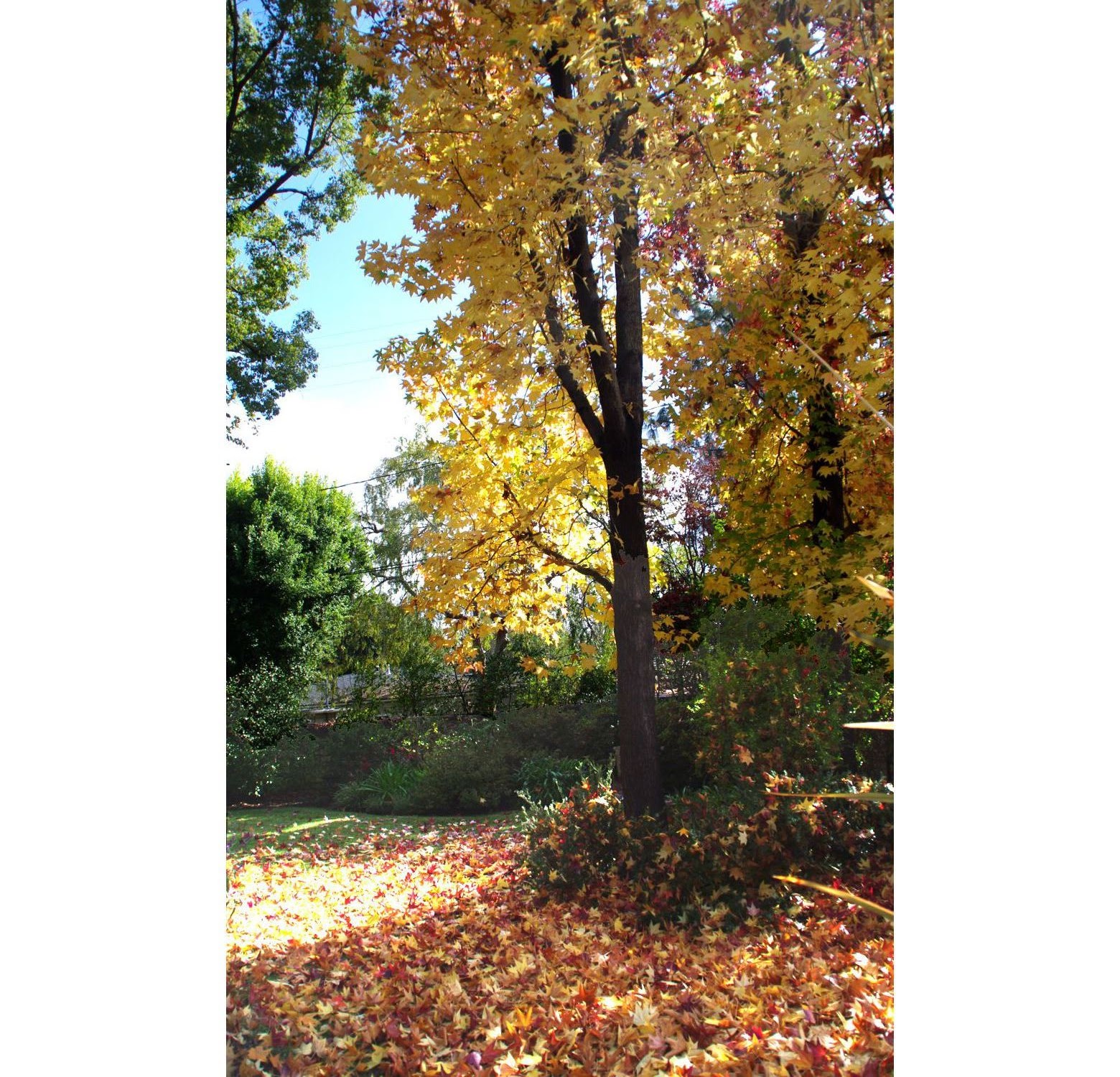
Again, after a fall rainstorm, the golden leaves are swept away in the wind. We're having a stormy period this time, interspersed with record-breaking high temperatures. This decade is the hottest on record, and the progression keeps slowly moving on, with increasing fires in the foothills. Our local disastrous Station Fire of August of last year has left us with denuded hillsides above the foothill cities in the San Gabriel valley, so those places are expecting rain and mudslides again. Recovery will take years. In the meantime, we're hoping that the US Forest Service will take further responsibility for the management of the remaining forest lands and begin the restoration process in areas that need them.

Restoration and enhancement of viable natural habitat in the mountains and forest lands is crucial to regaining the ecological balance of the woodland habitat, as well as water management issues that arise with the debris basins during the winter. Lately, the County of Los Angeles has attempted to catch up with lack of maintenance in these dams by proposing to truck out large amounts of sediment and dump it into what little riparian area remains. This is happening at the Santa Anita Reservoir and at the Hahamongna Watershed Park near JPL in Pasadena, creating a huge backlash by the local residents. Of course the problem is exacerbated by the debris flows from the fire, but a comprehensive and rational management approach is needed. One that allows the water and sediment to flow downstream and recharge the aquifer in a more natural fashion without destruction of the mature trees and habitat that currently exists.

Friday, December 18, 2009

A Year Later

Exactly a year to the day, another rainstorm, another morning, the trees glowing gold and shedding their leaves. Christmas season here in the Pasadena area is cool and sunny, with the occasional downpour, famously on Jan. 2, 2006 when our Rose Parade got rained out but kept on going anyway. But our rain is going away as the decades pass and the temperature rises...

This is the kind of garden to keep building on, replacing the water-intensive plants with those that are hardier, opening up paved areas and using stone and gravel beds, each year is an experiment with its rewards and casualties, as any gardener knows.

But the shade is a huge relief in the summer, the strategic tree planting has paid off. I'm ten degrees cooler than unshaded yards, the tradeoff being that I now need to water the trees themselves about once a month in the spring and early summer except for the oak tree.

Thursday, December 18, 2008

Morning: After a fall rainstorm


Even in Southern California there are delightful, crisp days when the sun comes pouring in the south windows to take off the chill. The trellis overhang allows the winter sun to come in, and in the hot summer it blooms with trumpet vine flowers to provide shade and keep out the heat.

The trees and plants temper the environment when they're planted strategically, and the fruit-bearing trees and shrubs (Pomegranite!) are drought tolerant, too. Nothing like the right kind of garden to spend the long summer afternoons in, watching our local wildlife darting around in the mulch and through the branches.