Showing posts with label technology. Show all posts

Wednesday, August 31, 2022

Climate Change: New Risks


Our warming planet is impacting the built environment as well as the natural systems, which are beginning to disintegrate. It's not just the increasing impact of burning forests and major flooding on structures that result in ongoing severe damage to entire communities now. It means that structures and traffic infrastructure will necessarily reduce their carbon content in the larger efforts to combat the increasing "forcing" of carbon emissions globally. The American Institute of Architects has taken an aggressive position on this with its 2030 Challenge, which changes how building types and construction materials are used in new construction.

This involves revising the building codes to raise the bar for decarbonization of the entire supply chain for construction and development. California is currently in the process of doing this. The insurance industry is also looking at increased risks for climate change damages, which will only increase. On the proactive side of this action is a shift in the professional liabilities involved with the design of building projects and infrastructure development. This is known as the "standard of care" that applies to licensed professionals. 

"A new report released by the Scalable Climate Action Group within the institute’s Strategic Council looks at levers of change that can potentially bring about widespread climate-change actions. These levers include climate literacy; environmental, social, and governance (ESG) investments; and policy changes. Also on the list is professional liability associated with neglecting climate concerns during design."

This reflects a changing policy environment which is leading the manufacturing and supply chains to provide electrified buildings and electric cars, as well as power generation with wind turbines and solar panels. This is a necessarily massive shift, which will take decades to completely implement, but that can be an achievable effort by the first world countries to shut down their historically excessive carbon emissions. We're twenty years behind in this necessary effort, so it has become more difficult to accomplish. But it's still achievable if it's done as a rapid global effort to repair the damage that human civilization has done.

Saturday, December 18, 2021

A Thirteenth Year - We Dig In


The decade-long drought that impacted water supplies and fueled massive forest fires is still with us, although we've been seeing the rain again, a positive development for water storage in our parched land. Our forests have gone up in flames all summer, and the local urban forests and wildlands are dangerously dry. This has made climate change an urgent priority, and our state government in Sacramento is trying to push ahead with progressive policies that will mitigate carbon emissions by 2050. Even though we know that's not even half of what we'll ultimately have to do.

Our state policies have been informed by the UNFCCC COP deliberations, via former Governor Brown and now Governor Newsom. The architecture profession is moving ahead with educating its members and providing resources to bring emissions down from the construction sector.

CarbonPositive: Architecture’s Critical Role at COP26 - a formulation of strategy for the profession."COP is three parallel events. Of course, there are intergovernmental negotiations taking place in areas inaccessible to the public. Next, is the Blue Zone open to UN accredited delegations. Architecture 2030 is admitted as an “observer” organization with access to the Blue Zone. Finally, the Green Zone is open to the public. The Venn diagram of these three events has some overlap, but not much."

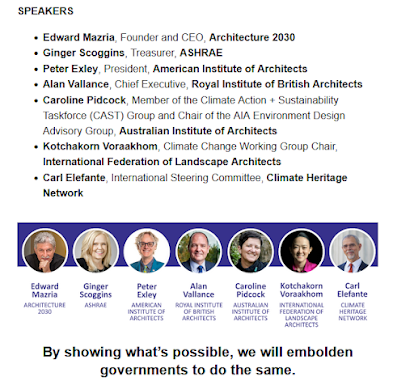
65% by 2030 / ZERO by 2040: Top 200 Global Firms and Organizations Lead With 1.5°C Climate Actions. By showing what's possible, we’ll embolden governments to do the same. The top 200 firms responsible for a significant portion of construction worldwide will present the bold actions they are taking to decarbonize the built world in order to meet the Paris Agreement’s 1.5°C carbon budget. It's one of the best discussions about the urgency of climate action presented to the public.

Carl Elefante FAIA, FAPT LEED AP a representative of the AIA at COP26, provides a summary of their dialogue over 10 days. "After a lifetime practicing architecture, I am hardwired to look for opportunities. Carbon-budgeting building projects and WLCA present many." His new podcast series from the IHBC raises awareness and understanding of how conservation philosophy and practice contributes towards meeting the challenge of climate change.


Thursday, April 22, 2021

Earth Day - US Policy


 VP HARRIS TALKS CLIMATE:  Earth Day 2021 on April 22 was marked by the Biden Administration presentation on streaming platforms as well as broadcast on the Discovery Channel.

This article is part of Covering Climate Now, a global consortium of news outlets strengthening coverage of the climate story. View the video at this link.

Sunday, May 31, 2020

Eye of the Needle


The coronavirus pandemic is reshaping our world. An article by William Rees points out that "clearing skies and cleaner waters should inspire hopeful ingenuity. If we wish to thrive on a finite planet, we have little choice but to see the COVID-19 pandemic as preview and our response as dress rehearsal for the bigger play. Again, the challenge is to engineer a safe, smooth, controlled contraction of the human enterprise. Surely it is within our collective imagination to socially construct a system of globally networked but self-reliant national economies that better serve the needs of a smaller human family. The ultimate goal of economic planning everywhere must now turn to ensuring that humanity can thrive indefinitely and more equitably within the biophysical means of nature."

This is impacting the schedule of the World Climate Foundation summit, as well as the COP26 date. "In 2020, climate action must take on a new format to ensure global momentum is maintained. Short and long-term objectives should aim to overcome the socio-economic disruptions of COVID-19 and kickstart the global economy through resilient and ambitious green agendas, prioritizing net-zero commitments and low carbon investments now and throughout the next ten years.

With the postponement of the COP26 to 2021, World Climate Foundation is equally postponing its annual World Climate Summit to 2021, and now offers an exciting new series of digital, regional World Climate Forums. At these Forums, governments can transform climate ambitions into successful markets for climate business and market players in major regions of the world and instigate collaboration on policy, innovation, and investments."For decades, scientists have been demanding that climate crisis be taken this seriously. But despite numerous international agreements, governments have been slow to take action to reduce carbon emissions."

The coronavirus pandemic may have one silver lining: the potential collapse of big oil. "As Fatih Birol, the executive director of the International Energy Agency, recently pointed out,  the drop in oil prices also offers an opportunity for countries around the world to lower or remove subsidies for fossil fuel consumption,  which disproportionally line the pockets of wealthy individuals and  corporations with money that could go to education, health care or clean  energy projects."

Optimists are encouraged by people such as the director of the Paris-based International Energy Agency, Fatih Birol, who last April called the crisis an “historic opportunity today to steer [energy] investments onto a more sustainable path.” With G20 governments already pledging around $5 trillion to stimulate their economies in the wake of the shutdown, Birol called on them to “put clean energy at the heart of stimulus plans to counter the coronavirus crisis.” Birol said he had urged political and global financial leaders to design “sustainable stimulus packages” that focus on investing in clean energy technologies and accelerate the transition away from fossil fuels. In its latest short-term projections, the US EIA says that it expects the biggest hit to oil demand in the second quarter of 2020, but that the reduction will only “gradually dissipat[e] over the course of the next 18 months”

The Rocky Mountain Institute is issuing a series of stimulus white papers to respond to the climate crisis, the economic shifts and provide guidance to governments and industry for rapid decarbonization."As the effects of the COVID-19 crisis ripple across the globe, strategic stimulus and recovery investments can get world economies back on track now and help us build back in a way that ensures greater resilience to the disruptions and crises we will inevitably face in the future. The current pandemic shows many parallels to, and interconnections with, a looming climate crisis. A response that addresses both crises at once will advance a low-carbon economy that is more resilient and helps mitigate the worst impacts of climate change, while improving the economy, the environment, and our health and communities."

In response to the impact of the pandemic, the RMI's recommended programs aim to catalyze industries, technologies, and practices shown to improve public health, decrease costs, create enduring job opportunities, and reduce greenhouse gas emissions. The four programs are:
  • Build Back Better Buildings: A building retrofit program to catalyze residential and commercial building improvements at an unprecedented scale.
  • Enhance Access and Electrify Mobility: Investment to prioritize pedestrians, cyclists, and public transit over the automobile, while also supporting the growth of the electric vehicle market.
  • Debt Forgiveness for a Sustainable Recovery: A financial incentive program to provide companies with debt relief based on verifiable emissions reductions.
  • Economic Recovery Facility for Financing Low- and Zero-Carbon Activities: A federal entity dedicated to facilitating the financing of clean energy and infrastructure projects.
A simple debt forgiveness approach can help industries and workers feeling economic pain now and build toward a more sustainable, low-emissions future.

Update 6/26/20: Degrowth: A Call for Radical Abundance

Update 7/23/20: Tom Steyer - Clean Energy as a job generator

Update 7/30/20:  Some Earth system tipping points may be linked together


Update 8/9/20: Observing recovery through a climate 'magnifying glass'

Update 8/16/20: Exponential growth bias: why most people don't understand the risk of runaway climate change.


Tuesday, September 17, 2019

Belt and Road


Architect's Newspaper Sept. 2019: "For this year’s international practice issue we looked at China’s massive Belt and Road Initiative (BRI), the trillion-dollar project aimed at tying the world to Beijing, and slavery’s role in the global construction industry. The Belt and Road initiative set up by Xi Jinping in 2013 includes hundreds of infrastructure projects financed or constructed in part or in whole by Chinese entities far beyond its borders. "Belt" refers to roads and railways, while "roads" refers to sea lanes, all of which unifies almost the entirely of Asia and Africa. The number and physical size of these infrastructure projects promises to remake urban landscapes - alter, and destroy - natural landscapes and consume untold millions of tons of natural resources, building materials and fossil fuels. The BRI is as much a geopolitcal experiment as it is an economic development strategy."

And it is definitely NOT a "green vision".  An analysis shows that China's BRI is loaded with coal power.

China is by far the biggest player in Asia, having supplied or pledged $36 billion for coal plants in 23 countries, according to the IEEFA. The Chinese government has provided financing from state-run banks and included many of the projects in its colossal Belt and Road Initiative, which is designed to expand Beijing’s influence through investments in strategic foreign infrastructure projects.

China has modernized their one-party dictatorship with market oriented reforms, i.e., its own version of authoritarian capitalism since Deng Xiaoping's rise to power after Mao's Cultural Revolution.His violent suppression of society and the government resulted in primarily military and police state power. This has led to an economic expansion and more wealth for a few Chinese connected to the right party officials and the Bank of China. It's this monolithic structure that Xi Jinping has inherited and continues to expand using economic levers in many countries with BRI as its mechanism.

A new study uncovers China's massive hidden lending to poor countries. Over 50 developing countries' Chinese debt accounts for on average 15 percent of their individual GDP. An example of their methodology is the way China isolates Taiwan with projects in poorer countries; the price of the development is breaking official ties with Taiwan. In this manner, China magnifies its influence over Taiwan without a direct confrontation with the US, which continues to sell weapons to Taipei. Beijing is withholding the $4.9 billion needed to finish the road project in Kenya, once a flagship for Xi Jinping’s Belt and Road initiative. But with concerns rising globally that BRI was loading poorer nations with unsustainable debt, Xi signaled in April that Beijing would exert more control over projects and tighten oversight. Chinese influence in Myanmar is growing. One of China’s biggest projects is the construction of a deep-sea port on the coast of Rakhine State. China’s ambitions for Myanmar also feature oil and gas pipelines to feed its insatiable energy needs. One of the pipelines cuts right through Rakhine State—suggesting an incentive for the Burmese military’s aggressiveness against the people living there. In Belarus, activists are protesting the massive industrial park development, the Great Stone Industrial Park outside Minsk. To quote one activist, "America and Europe won't give money for dirty factories like this, but China doesn't care and wants business for Chinese companies."

Earlier in 2018, the New York Times did an extensive examination of this topic: "We examined nearly 600 projects that China helped finance in the last decade, through billions of dollars in grants, loans and investments. Taken together, they show the scope and motivation of China’s strategy.41 pipelines and other oil and gas infrastructure help China secure valuable resources. We found 112 countries where China has financed projects. While most fall under its infrastructure plan known as the Belt and Road Initiative, Beijing has pushed beyond those boundaries.South Africa turned to China for $1.5 billion for a coal-fired power plant. It is one of at least 63 such plants financed by China around the world, which collectively pollute more than Spain." The Times has recently produced a longer investigation of projects in Kazakhstan, in an inaccessible area on the steppes of Central Asia, "The Trillion Dollar Nowhere".

 It's not too late to "green" that Belt and Road project. A couple of years ago, China even issued its own $2.15 billion Green Climate Bond to finance renewables and energy efficiency. But when it comes to that Belt and Road Initiative, China is not big enough. Although the Party centralized authority in Xi Jinping’s hands, those infrastructure projects come from a variety of sources in China, including different government agencies, provinces competing with each other, and the business sector. It’s hard enough for the Chinese state, even with a new and more powerful Ministry of Ecology and Environment and a cadre of environmental police officers, to impose stringent standards within the country. More to the point, China has shown little interest or capacity when it comes to imposing them outside its borders.

While the Chinese initiative initially received an overwhelmingly positive reception, since mid-2017 the democratic Quad—Australia, India, Japan, and the U.S.—and several European countries have begun to signal major reservations about the BRI. A new multi-country survey found that there is little public support for coal projects in key countries for China's ambitious BRI, knowing that country's penchant for leveraging its investments into control, such as has been experienced lately with Hong Kong.

There is rightful international concern about the agenda behind China's development push, particularly since it imposes its own culture and only honors contracts it sees fit. However, some scholars counter that there is no evidence that China’s plan is to entrap developing countries. Deborah Brautigam, director of the Africa-China Research Initiative at Johns Hopkins University, said the Sri Lanka port is the only one out of more than 3,000 Belt and Road projects that has ended in a 99-year lease. “We’ve not seen a pattern of deliberate entrapment in order to get some strategic advantage,” Brautigam said.

Update 9/23/19: Belt and Road propels Chinese contractors to top of global ranks

Update 9/24/19: China’s BRI: a Marshall Plan in reverse

Update 9/25/19: China’s BRI cargo to Europe under scrutiny as operator admits to moving empty containers

Update 10/3/19: 'Coal is still king' in Southeast Asia even as countries work toward cleaner energy

Update 10/29/19: In Laos, A Chinese-Funded Railway Sparks Hope For Growth — And Fears Of Debt

Update 12/2/19: China’s Renewed Coal Boom - Including India

Update 12/4/19: James Hansen - China's coal emissions

Update 12/14/19: China has invested heavily in the Mediterranean region as part of its Belt and Road initiative and controls a string of major eastern Mediterranean ports, including Piraeus.

Update 12/19/19: Syria plans to join China's Belt and Road Initiative

Update 3/4/20: One of China’s Most Ambitious Projects Becomes a Corridor to Nowhere.

Update 4/29/20: Is China’s 2013 Belt and Road Initiative (BRI) a debt trap?

Update 4/30/20: Belt and Road Tracker.

Update 10/3/20: China's Imperial Overreach

Update 9/12/21  China's transcontinental grid of railroads, oil pipelines

Update 10/2/21: The Winner in Afghanistan: China

Update 5/8/22: China's Belt and Road is so enormous that its impacts could accelerate climate change.


Monday, April 22, 2019

Bending the Arc of Justice


From the inspiration of Earth Day in the writings and activism of Rachel Carson in her epic Silent Spring documentation to the present-day confrontational actions between the corporate power of profit versus the Extinction Rebellion - portrayed in the graphic above from FT - we have seen Earth Day evolve extensively from its first recognition in 1970. During that time, we have seen 24 COP's come and go; the first COP was held in Berlin in 1995.

The 25th session of the Conference of the Parties (COP 25) to the UNFCCC was to take place from 11-22 November 2019 in Brazil. Upon election as President of Brazil, Jair Bolsonaro pulled Brazil out of hosting the event. So now the Santiago Climate Change Conference, which will feature the 25th session of the Conference of the Parties (COP 25) to the UNFCCC and meetings of the UNFCCC subsidiary bodies, is expected to take place from 2-13 December 2019.

This reflects the global turbulence among countries, governments and corporate powers that are all staking a claim on planet earth, resulting in a human-induced crisis of resources, humanity and the very life systems of our environment. In the last few hundred years we've gone beyond our natural limits and show no signs of stopping carbon emissions in spite of all the agreements and discussions to date. Hence, the increasing tragedy of future environmental collapse, and the resistance personified by children like Greta and the powerful counter movements emerging as the alarms are set off by more and more people seeing an unfolding terrible, dark future.

According to a NYTimes report, more carbon has been released into the atmosphere since the final day of the Noordwijk conference, Nov. 7, 1989, than in the entire history of civilization preceding it. In 1990, humankind emitted more than 20 billion metric tons of carbon dioxide. By 2017, the figure had risen to 32.5 billion metric tons, a record. Despite every action taken since the Charney report — the billions of dollars invested in research, the nonbinding treaties, the investments in renewable energy — the only number that counts, the total quantity of global greenhouse gas emitted per year, has continued its inexorable rise.

Like the scientific story, the political story hasn’t changed greatly, except in its particulars. Even some of the nations that pushed hardest for climate policy have failed to honor their own commitments. When it comes to our own nation, which has failed to make any binding commitments whatsoever, the dominant narrative for the last quarter century has concerned the efforts of the fossil-fuel industries to suppress science, confuse public knowledge and bribe politicians.

Because our destructive, profit-focused economic system demands a fiction called GDP that requires physical consumption to increase the ledger sheet balance, the system inherently grows out of control as the markets are expanded. Destroying the environment that provides our life support is a form of insanity that leads to collapse, and that is increasingly recognized now by people all over the world, as well as by governments and the insurance industry. A view delineating this is: Collapse of Industrial Civilization ~ Finding the Truth behind the American Hologram Concerning Humanity’s Future: Interview with Nick Humphrey, Climatologist and Geoscientist. Nick makes the critical point that Nature is in control, not humans. Even our current catastrophes which were sparked by humanity’s activities were ultimately governed by the laws of Nature (physics, thermodynamics, chemistry, etc). We never were separate from it all, but a part of it. We should be telling ourselves to do what we feel is right to respect Nature and its unbreakable laws, accepting our place in the Universe as just one of many species which have a finite existence on this planet.

The enormous effort that it will take for the all the civilizations of the world to stop the self-destruction and change the entire system in time to stave off the worst impacts appear to be unachievable at this point, especially given the rise of demagogues and rampant corruption in many countries, including the US, that block even the efforts by corporations and individuals to change this systemic self-destruction. We have reached our day of reckoning, which was actually five years ago with the issuance of the IPCC's AR5 fifth assessment report, Part 2, ahead of the Paris Climate Summit.

As Chris Hays put it, Martin Luther King's idea that the moral universe inherently bends towards justice is inspiring. ... "The arc of the moral universe is long, but it bends towards justice." It means that all of us together will have to bend it with revolutionary fervor, not just foster incremental steps. The time has come, even as the natural world inflicts its wrath upon our efforts to salvage a future for ourselves and our kids.

Update 4/23/19: It’s Not Coming, It’s Here: Bill McKibben on Our New Climate Reality

Update 4/24/19: Club of Rome Climate Emergency Plan (pdf file)

Update 6/29/19: Bonn wrap-up: Shifting the levers of power toward climate justice.

Update 9/24/19: Former Governor Jerry Brown launches California-China Climate Institute.  More on that here.


Sunday, November 11, 2018

A Systems Approach To It


The article,"Systems Thinking and How It Can Help Build a Sustainable World", makes an important point about looking at the bigger global climate picture and identifying all the parts of a problem in order to solve it:

"Rather than asking why one should think in systems, perhaps the more piercing question is: why has holistic thinking been stamped out of us again and again over time, most vigorously so during the modern industrial age? The simple answer is that power and control are not compatible with a well-educated citizenry that sees the big picture. Modern industrial civilization is built upon the mechanization and commodification of society and nature, with those at the top benefiting from the enormous outputs generated by the “cogs in the wheel” toiling at the bottom. If we become aware of this vast, complex machine and start to understand how it works, we might want to break or change it! We might want to create a different system in which all parts of society and nature can flourish, not just those in power."

This kind of a conversation must involve everyone who is affected by it. A dialogue about the Sustainable Development Goals has to be undertaken at a global level. "The important and widespread understanding that was reached at COP22 in Marrakech is that climate change needs to be addressed systemically and not with carbon-myopia...We are facing a planetary emergency at the species level and we do need all nations — and what’s more all people — of this Earth to unite in a shared vision to redesign the human impact on Earth from destruction to regeneration."

This problem of tackling climate change requires a multivalent, systems approach to its solution, not a linear one. The primary concern is how to tackle the carbon-to-zero issue in our energy systems and our land use approaches. A framework focused on worldwide decarbonization is a first, major step that relies on economic system changes and global agreement. Then there's the rest of it, which involves fundamental changes in our society, its economics, and our culture.

I would outline the systems approach as a multiple-front strategy that focuses on key parts of the big problem: human population, intelligent organization, technology, human expansion and the methodology of this expansion. One thing I've always advocated since completing my graduate architecture thesis in 1979 on an Orbiting Space Base is that extractive industries should be exiled to on-orbit and lunar industry operations because humans will never stop exploring and reaching out for resources. Same process the animal kingdom employs, but there are natural ecological balance mechanisms for that, and unfortunately we've managed to escape those with technology. Animal populations crash in natural environments repeatedly, that's part of how the systems work when a population gets out of whack, with its checks and balances on resources driven by planetary cycles. This also applies to human civilizations across history, as well.

Humans must commit to a simultaneous ecological footprint and population reduction, with the economics grounded in making environmental restoration the most profitable industry. In other words, impose our own "smart crash" that does the least amount of harm. And it's not like we don't know how to do that. (birth control, limits to growth, restore the environment) It's a fairly socialist approach, think Sweden, but that's just fine. I've been to Scandinavia and they're happier than we are. Here's my specific points:

Human Population

But how do you achieve this preservation of the common global resources with a population that has already exceeded earth's carrying capacity since 1980? An interview with Bill Ryerson, founder of the Population Media Center, outlines how groups of people can be taught through stories to change their behavior. These stories are entertainment, soap opera, and educational documentaries. What this could do is help populations of people become self-limiting by choice, and thus diminish the demands on ecosystems that use up all available resources and diminish the critical diversity of species that is necessary for functioning ecosystems.

The fiscal reality check that we're currently experiencing on a worldwide basis has its parallel in natural system collapse, which is something that can be averted by the development of a steady-state system that produces a livable environment without consuming the world's common resources. That's the tragedy of the commons. Everyone's self-interests ends up devouring more than the planet can bear.

Intelligent Organization

The idea that human habitation can be used as a tool to regenerate ecology is finally coming into its own after experimentation with projects all over the world. It's not a zero-sum game, it's a way of bringing together all the environmental and engineering factors together in a place such that it renews natural processes instead of destroying them. It takes a great deal of skill, knowledge and experience to work out the systems that result in the creation of place that interconnects all these factors. Many major corporate engineering, design and development firms are investing in think tanks to take this to the next level, such as Arup, a global design, planning and engineering firm.

Technology

The building demonstrates how closed loop systems developed by space-based technologies can be applied to structures on this planet to bring their energy and carbon impact down to zero. Ideas such as the structural exoskeleton, use of natural light and processes, as well as a "bare-bones" approach to materials use can reduce human habitation demands on ecosystems as well as assist in the restoration of the natural world.

The planets we imagined exploring turns out to be the one we're living on.

Human Expansion

What about using a salvage yard in low earth orbit? It could provide a low-earth orbit platform for recycling and materials supply for providing industry outside of the atmospheric envelope, as well as conserving the metals used in the satellite construction which are already very highly processed. This is the essence of sustainability. We don't burn our trash in the back yard any more, why keep doing it out in the outer biosphere? Here's the online presentation of my low earth orbit base concept which could be used to develop industry and establish a foothold outside of earth's deep gravity well for interplanetary robotic launches and lunar mining processes.

Systems Design for Expansion

Key to this concept is understanding that to achieve this vision, there must be some major on-orbit infrastructure to support construction, development and launch of these exploration initiatives. My 1979 thesis outlines this strategy in a Relevance Tree and shows how a Low Earth Orbit platform, working in concert with lunar mining and large vehicle production outside of earth's gravity well allows for effective use of labor and materials, as well as providing "many futures" rather than just one projection line (dotted).

Update 11/12/18: A good climate policy rises above politics.

Update 11/16/18: Industrial agriculture and extractive industries must cease and be transformed.

Update 1/17/19: This systemic crisis is complex and requires new approaches


Monday, October 8, 2018

Keep It Simple


The IPCC Special Report is here from the UN. It documents the immediate impacts on the environment that 1.5C will likely have. It warns that strong efforts would be required to prevent disastrous consequences from dangerous levels of climate change. This means that World War II was a cakewalk compared to this, all hands on deck. An analysis of the report: "The best time to start reducing emissions was 25 years ago. The second best time is today."

Johan Rockström, chief scientist at Conservation International speaks about it.“Climate change is occurring earlier and more rapidly than expected. Even at the current level of 1C warming, it is painful,” he told the Guardian. “This report is really important. It has a scientific robustness that shows 1.5C is not just a political concession. There is a growing recognition that 2C is dangerous.” In order to blunt the coming climate change at that level, it's necessary to abandon coal and other fossil fuels in the next decade or two.

Having said all that, there's immediate, large-magnitude things that can happen right away to drastically reduce emissions. Such as protecting, preserving and restoring our great forests. Such as elimination of fossil fuel subsidies by governments across the globe. Such as rapid technology advancement in wind and solar, along with the upgrading of the electrical grids and establishing many stand-alone power sources at its periphery. Transportation in all areas, such as auto, truck, rail, airlines, and especially port traffic from overseas, will need to become electrified and supplied with renewable fuels. These strategies are not difficult, and can be widely employed in all countries, which need to develop the revenue for this. Decarbonization also has possibilities in the future with the nascent carbon capture industry that's progressing now.

There are many other things that can be done by private industry and by municipalities that can contribute to the lowering of carbon emissions in the very near future. But we don't have much time, and we need to mobilize. All of us.

Update 10/8/18: Nobel Prizes are awarded and given to economists referencing ways to adapt growth to climate change.

Update 10/9/18: 2C is nowhere near safe from a climate impacts perspective; now it's 1.5C

Update 11/2/18: Absurd for society to kneel before the dictates of the marketplace and that its primacy should determine how you structure government.

Update 11/12/18: The IPCC report tells us that climate breakdown is inevitable if we continue with growth-based neo-liberal economics.

Update 12/17/18: A new IPCC report says we’re looking at climate catastrophe as early as 2040.

Update 1/14/19: Silent Spring - Why it’s time to think about human extinction  Dr David Suzuki on economic growth

Update 7/1/19:  Scientists are calling for an end to capitalism as we know it.

Sunday, September 2, 2018

Down and Dirty


NASA has been mapping underground water reservoirs with its Gravity Recovery and Climate Experiment (GRACE) satellite, which has been operational since 2002. This gives us a picture of the state of the underground aquifers that have been tapped by agriculture. It's used to determine the extent of water resources and how much has been drawn down by pumping and extraction. Quite a lot, it turns out, and the aquifers in the western United States are becoming badly overdrafted.

Jay Famiglietti, head of the UC Center for Hydrologic Modeling, and member of the Santa Ana Regional Water Quality Control Board, has been using these maps to point out the need for management of this groundwater depletion. In 2014, he made the point that "In the future we're going to see big inequities. As the water table drops, it becomes more expensive to pump. You may have to dig a deeper well, which is very expensive. As you get to lower levels of groundwater, the quality degrades so there's that treatment cost. Smaller farmers may go out of business. That's the future."

Well, now it's 2018 and the future has arrived. A major investigation of the impact of dwindling aquifers in Arizona by the New York Times has made it abundantly clear that the overdraft of these aquifers is unsustainable and possibly unrecoverable. It's a long story that's critically important, and it's unfolding all over the planet.

This overdraft is the direct result of industrial farming that has grown in Arizona, which is causing local wells to go dry for residents and small farmers. The big industrial farms can afford to build deep wells with large pumps to supply their crops - generally very water-intensive crops. This is known as "groundwater mining", which is going on in all of the western states that are extracting groundwater to the point that the ground has sunk by many feet in Arizona, but especially in California's San Joaquin valley which is the vast agricultural central valley that grows thirteen percent of the nation's produce.

"Dr. Jay Famiglietti and his team noticed that many of the most significant sites of water loss were actually below ground. Of the planet’s 37 major aquifer systems, they discovered, 21 were on the verge of collapse. In the Great Plains, farmers had exhausted a third of Ogallala’s potable water in just 30 years. In California, the Central Valley aquifer was showing signs that it could drop beyond human reach by the middle of this century. But the worst declines were in Asia and the Middle East, where some of the planet’s oldest aquifers were already running out of water. “While we are so busy worrying about the water that we can see,” Famiglietti told me, “the water that we can’t see, the groundwater, is quietly disappearing.”

This has resulted in the loss of many small family farms, to the extent that some of them are now facing the prospect of being turned into residential developments, which use far less water, but demand tremendous amounts of energy and fuel use. And land that is paved over no longer absorbs the water necessary to replenish the aquifer. So the problem isn't getting solved, but merely kicked down the road. Multiply this scenario all across the planet, and we can now see that water is becoming more and more scarce as these aquifers dry up, along with the shrinking lakes, rivers and glaciers due to climate change.

As the water disappears, the ecosystem disintegrates and fades into dirt. And that's when our human existence faces its inevitable trajectory, which no amount of energy can reverse.

Update 9/3/18: Most ecosystems risk ‘major transformation’ due to climate change

Update 9/4/18: California water wars face Federal intransigence

Update 9/7/18: The sinking of California - subsidence in the central valley

Update 9/21/18: Groundwater Sustainability Agencies (GSAs) will need to avoid six specified “undesirable results”

Update 9/25/18: Oil industry threatening the state's limited groundwater.

Update 11/23/18: The Central Valley is sinking: drought forces farmers to ponder the abyss

Update 11/29/18: U.S. groundwater supply is smaller than originally thought

Update 12/1/18: Scientists reveal substantial water loss in global landlocked regions.

Update 12/10/18:  Dry wells and sinking ground as California struggles with groundwater crisis

Update 12/21/18: The Central Valley Tulare Lake Basin has dried out and sunk 30 feet due to over pumping (pg. 7)

Update 12/24/18:  The Colorado River is drying up, and 40 million Americans depend upon it.

Update 2/11/19:  California’s Groundwater Library Resources

Update 4/24/19: Can Sensor Data Save California's Aquifers?

Update 5/20/19:  Sinking land, poisoned water: the dark side of California's mega farms

Update 6/9/19: California's Central Valley has one of the worst subsidence crises in the country.

Update 6/12/19:  Can California Better Use Winter Storms to Refill its Aquifers?

Update 6/14/19: With floods and droughts increasing, communities take a new look at storing water underground

Update 6/17/19: THE DREAMT LAND Chasing Water and Dust Across California  By Mark Arax

Update 7/25/19: Sustainable groundwater management is inherently connected to the long-term survival of the Bay Delta

Update 8/25/19: We ate ourselves alive until the system collapsed, thus California's Sustainable Groundwater Management Act goes into effect in 2020.

Update 9/20/19: Subsidence worries the California Department of Water Resources. Think of shutting down water for 30 million Californians.

Update 9/23/19: California's chronic water overuse leads to sinking towns, arsenic pollution

Update 10/5/19: Almost 20 percent of the catchments areas where groundwater is pumped suffer from a flow that is too low to sustain freshwater ecosystems.

Update 1/9/20: Extreme ag pumping threatens California’s main water artery

Update 2/19/20:  Subsidence of the California Aqueduct in the San Joaquin Valley - MWD findings

Update 3/9/20: California’s 'Salad Bowl' Recharges Depleted Aquifer

Update 4/1/20: As temperatures rise, Arizona sinks

Update 4/2/20: WESTERN GROUNDWATER CONGRESS: Quantifying surface water depletion from groundwater pumping. Western supply is decreasing and demand is increasing.

Update 4/16/20: California has launched a landmark effort to save its groundwater.

Update 5/14/20: Groundwater: The charge to recharge needs to be data driven

Update 8/21/20:  State Must Analyze Practice of Dumping Billions of Gallons of Wastewater Into Sea

Update 9/3/20: California has started to implement its Sustainable Groundwater Management Act (SGMA) with a goal of reaching groundwater sustainability in over-pumped basins by 2040 or 2042.

Update 9/4/20: Groundwater over-pumping is breaking and sinking the land on which thousands of people and families farm, work, and play.

 Update 9/14/20: What Does Groundwater Have to Do with the Delta? A Lot.

Update 9/15/20:  GROUNDWATER 101: The basics

Update 5/19/21: Groundwater Supply News

Update 6/29/21: Aquifers in California are so depleted that farmers are now investing millions of dollars to put water back into the ground.

Update 8/26/21: The Well Fixer's Warning 

Update 10/2/21: Along with hurricanes and wildfires, there’s another important, but seldom-discussed effect of climate change — toxic water and sinking land made worse by groundwater drought.

Update 12/16/21: How we drained California dry

Update 12/18/21: Despite California groundwater law, aquifers keep dropping in a ‘race to the bottom’

Update 6/28/22: DWR collecting airborne electromagnetic (AEM) groundwater data across California

Update 6/29/22: AEM Data Viewer

Update 8/19/22: California Groundwater Project


Friday, August 24, 2018

We Are Not Alone


"I don't think we're going to make it," John Doerr proclaims, in an emotional talk about climate change and investment in 2007. Spurred on by his daughter, who demanded he fix the mess the world is heading for, he has made a commitment to solving the environmental and climate change issues via technology and green investing. He is chair of Kleiner Perkins Caufield & Byers, an American venture capital firm headquartered in Silicon Valley that has backed early investors in many significant companies, including Amazon, AOL, Compaq, Electronic Arts, Google, Intuit, Macromedia, Netscape, Segway, and Sun Microsystems, with his focus on greentech.

In 2011, he was part of a group that met with President Obama, including Stanford University president John Hennessy, former Genentech CEO Art Levinson, and Steve Westly, founder of the Westly Group. This group backed the environmental policies of the Obama administration and advocated climate change action.

So there is a serious concern by some of the corporate leadership about directly dealing with the climate change issues. In addition, the US military and the Department of Defense have defined climate change as a national security issue and are moving forward with implementing strategies. In 2016, members of the U.S. national security community - The Center for Climate and Security Advisory Board - signed an agreement concluding that the effects of climate change present a strategically-significant risk to U.S. national security and international security, and that the U.S. must advance a comprehensive policy for addressing this risk:

"Climate Security Consensus Project: Our determinations above are based on the impacts of the most likely case.  There is a small chance that the impacts will be less than expected.  There is a greater chance that the impacts will be even worse. It is therefore of critical importance that the United States addresses climate change in a way that is commensurate with this risk profile. In this context, the United States will need to “manage the unavoidable and avoid the unmanageable.” This requires a robust agenda to both prevent and prepare for climate change risks, and avoid potentially unmanageable climate-driven scenarios. Failing to do so will magnify and amplify risks to existing and future U.S. national security objectives."

They cite a quote from Joe Kaeser,  CEO of Siemens:

“A NUMBER of major companies — from PepsiCo to Walmart to U.P.S. — have recognized that corporations have a responsibility to address the causes of climate change before it is too late. We do not have to wait for an international treaty or new regulations to act..”

This group issued a letter to former Secretary of Defense James Mattis on May 8, 2017. The Department of Defense (DoD) and the intelligence community have been aware of this “threatmultiplier,”and taking actions to address it, since the early years of the George W. Bush Administration. By many measures, DoD has been leading in this area, driven naturally by its mission to protect the United States from harm. More recently they issued a press release: A Responsibility to Prepare – Military and National Security Leaders Release New Reports on Climate Change.

The United States Navy operates on the front lines of climate change. It manages tens of billions of dollars of assets on every continent and on every ocean. Those assets—ships, submarines, aircraft, naval bases, and the technology that links everything together—take many years to design and build and then have decades of useful life. This means that the navy needs to understand now what sorts of missions it may be required to perform in 10, 20, or 30 years and what assets and infrastructure it will need to carry out those missions. Put another way, it needs to plan for the world that will exist at that time.

Scientists and researchers have become far more vocal and insistent upon politically forcing governments to make actual progress in drastically reducing carbon emissions. Nathan Lewis - a chemistry professor from Caltech, Pasadena, CA - describes how he's working with Bill Gates to provide solar fuel technology to power transportation systems. In a similar vein, research organizations such as Climate CoLab and the Rocky Mountain Institute are pushing ahead on developing low-carbon energy sources and distribution systems.

They are taking the initiative to act on providing a low-carbon future, and clearly some of the corporate leadership is providing the funding to make this happen even if they're not making a lot of public statements about it right now, particularly in the face of a US administration that is trying to revive the coal industry. To the people deeply concerned and frightened about the climate change that's happening right now, it would appear that all is lost and the situation is hopeless as our planet continues to disintegrate under rapidly increasing global temperatures. But there's an underlying structure of progress that's evident, and it has the embedded potential for rapidly addressing the carbon emissions issues.

We must unleash these energies around climate change immediately, and undertake the enormous effort that will be required to move off of fossil fuels. It's there and we can all do something about this, but we've got to find the will to deal with these at such point that it makes a difference in the time that's left!

Update 10/22/18: Leaders move past Trump to protect world from climate change.

Update 11/1/18: Hansjörg Wyss is a philanthropist and conservationist who is donating $1B for biodiversity

Update 11/9/18: Paul Allen's quest to save the planet

Update 11/ 11/18:  A coalition of investors has written corporations asking for transparency.

Update 11/29/18:  50 CEOs urge world leaders for ambitious climate policy

Update 11/30/18:  Wyoming billionaire pledges to protect 30% of the planet by 2030.

Update 12/10/18:  Tackle climate or face financial crash, say world's biggest investors


Monday, May 23, 2016

California May Day!


"Attempts to encourage journeys to be switched to rail from the more carbon dioxide emitting air and car forms of travel have largely failed as the characteristics and attractions of all carbon-based modes – including those claimed to be justified on the grounds that per passenger-kilometre they are more energy efficient – have simply led to more travel, especially in long-distance journeys."

- Mayer Hillman, Senior Fellow Emeritus since 1992 at the Policy Studies Institute, University of Westminster, UK

The traffic planners all understand this problem of adding highway capacity to existing networks - they simply add to traffic problems because more traffic shows up to clog the network. So planning has started to focus on becoming more efficient with automobile transit design and highway expansions. But it hasn't solved the underlying problem of traffic jams and increased pollution; same story. And sadly that's the fundamental, unidentified problem: carbon emissions. Tinkering around the edges with electric engines and trains doesn't solve it.

By the same token, the switching of the physical issue of transport from air travel to rail, or highway to rail, avoids solving the problem itself, which is that moving bodies and cargo around are the basic drivers of energy consumption. This, of course creates more "value" attributable on accounting spreadsheets as an increase in GDP. But it's obviously a false metric if the environmental damages of this human behavior aren't accounted for. Once all the factors are examined vs. the amounts of money required to build and maintain these massive systems, it doesn't actually pay back or even make much sense. Its only "advantage" is that public dollars are used to offset and conceal the actual impact of these systems. It's the equivalent to the old factory stacks that dumped pollution into the air without accounting for its effects because "the commons" was assumed to be free to all for use. And that's the Tragedy. This problem could use some good economists.

"Impressive though recent efficiency gains are, switching to energy renewables and low-carbon developments makesno contribution to reducing the concentrationof emissions. It can only reduce the rate at which the concentration continues to rise." - Mayer Hillman

Part of the UN-level discussion on GHG emissions includes the analysis by Mayer Hillman, which is a very strong position that supposedly more efficient travel systems leads to MORE travel and more emissions, not less. Especially considering that something like the proposed California High Speed Rail (HSR) is in *ADDITION TO* all the other existing systems of travel, all of which continue to dump GHG's into the atmosphere. It's an appeal to the engineering and large infrastructure industry. Hence the discussion of California's completely inadequate HSR concept which spends billions of dollars to basically no effect, except to create more emissions and higher populations and makes the whole problem worse. The concept was politically designed (not engineered) over a decade ago on outdated policy information, as was cap-and-trade.

We're seeing this in California with Governor Brown's pet project, the HSR, a boondoggle if there ever was one. It doesn't even work at a basic engineering level, but the massive AEC firm (Parsons Brinkerhoff) that is running the project has to "feed the monster" to stay in business. It doesn't actually work as High Speed Rail anymore because of this configuration wandering around the Central Valley instead of directly connecting SF and LA. Its inception was a political deal to link together the small cities in the Central Valley to feed growth, of course, and get millions of "housing units" built in the hottest area of California that is currently agricultural. Its water supplies are diminishing, the aquifers are collapsing from overdrafting, and large areas are ruined for agriculture because irrigation and fertilization has rendered the soil unusable from the accumulated salts, particularly on the west side of the Central Valley. Not to mention that the crops are now almond trees and the product is shipped to China in heavily polluting tankers.

It gets better. Governor Brown is using a good portion of the funds from the Cap and Trade program (!!!) to try to pay for this HSR project, since the Federal Government and private industry won't step up to the plate. It doesn't pencil out, and there is massive public objection to this whole thing (for good reason). The fact that this whole HSR doesn't actually have any demand for travel - we have several highways, a metro train and LOTS of air travel between LA and SF - seems to be irrelevant to the politicos who planned this whole fiasco. It's just about populating the Central Valley and getting more GDP out of it now that agriculture seems to have maxed out. Everybody wants revenue and the real estate industry has always been the answer to that in this state, it's very nineteenth century. California is only about 150 years old in terms of its settlement history; it's not like Europe. The plumbing that makes the Central Valley possible is only about 50 years old, it's all imported from the northern part of the state with giant pumps and aqueducts built since about 1960, and we're seeing the immense problems created by only a half century of re-engineering the state. It's becoming increasingly apparent that the "solutions" to the population explosion in the cities of southern California has drastically amplified the potential damages to the environment and to the huge population of people living here; setting itself up for disaster because none of this is really sustainable in a warming planet that's cutting off the rain.

Now let's add the ports of Los Angeles, San Pedro, San Diego and San Francisco, which are the biggest emitters of pollution from cargo transit on the west coast. Air quality in LA is the worst in the nation because of the shipping which depends on oil, and the dirty trucks that are used on the highways to get the stuff to inland warehouses before it's put on rail to the midwest and east coast. Naturally, China has the dirtiest shipping industry on the planet and a big chunk of it comes here, along with all that stuff that's no longer manufactured in this country but ends up in our landfills. Or actually the cars end up in Mexico and South America for the last third of their useful life; Mexico City is swarming with old Volkswagens and used Japanese Hondas.

So the whole thing feeds on itself because more transit and shipping begats more GDP, and therefore the "demand" is the quantifiable metric but not the energy consumption and pollution because its impact is hidden in "the commons". That's why this emissions framework has got to be tied to the equity of the commons, because that's the only benchmark that accounts for the impacts. The political assumptions driving this destructive development and expansion are actually quite delusional, yet it's the basis for public policy in this country, as well as in China, which has been building empty cities connected with high speed rail (which is counted by China as GDP even though nobody's bought the stuff yet).

We're going to drive ourselves to extinction because of our collective insanity, that's all there is to it. We could stop it tomorrow if we could just wake up and recognize the problem we're creating. So a framework for dramatic change has to be implemented, using the carbon tax as a tool. It's the only way we're going to be able to deal with the reality that carbon emissions must stop almost immediately. By itself a carbon tax doesn't work fast enough, it's just a lever. This approach is now under serious discussion at the World Bank and IMF, so there is yet hope that the world can take the steps needed to address climate change, in spite of our proclivity for "growth" at all cost.

Update 5/24/16: A projection of land-use change in California - urbanization will be the primary cause of greater water demand in the state. Precisely what the HSR is designed to do.

Update 1/3/17:  The entire supply on the Colorado River has become less reliable, threatening the water supply


Tuesday, August 5, 2014

Lead or Follow?


Our profession holds an annual conference, this year in June at the AIA National Convention in Chicago. Ed Mazria, Founder and CEO of Architecture 2030, delivered the keynote address 'Design! Life Depends on It'. The 20-minute video lays out the blueprint for a carbon-free and just built environment by 2050, reviews the progress made in the building sector since issuing the 2030 Challenge in 2006, and outlines the critical role architects and designers must play in securing a livable future.

His organization, Architecture 2030, has the full support and endorsement of the National AIA. His challenge amounts to saying that the buidling industry must assert leadership in rapidly reducing carbon emissions. This position is important because the building and construction industry represents about 70% of urban emissions.This includes the emissions related to building these structures as well as the shipping, hauling, service delivery and maintenance involved in maintaining them, in other words, the local transportation sector and the building management industry.

As one of the myriad strategies available to reduce carbon emissions, it can represent a critical means of moving early and swiftly to make the transition to a clean economy, implementing carbon reduction ahead of global emissions agreements.

Update 8/14/14: From Architecture 2030 - Architects to phase out carbon by 2050 as declared at the 2014 UIA  General Assembly in Durban

Monday, February 10, 2014

Zero in 2050


Feldman Architecture
A 2005 Governor's Executive Order and 2006 statute establish GHG reduction goals and mandates for California. The Climate Action Initiative (Executive Order S-3-05, June 2005) set the following GHG emission reduction targets for California: by 2020, reduce GHG emissions to 1990 levels, and by 2050, reduce GHG emissions to 80 percent below 1990 levels.

This is in general alignment with the evolving global GHG emissions reductions currently being negotiated at the international level, with an agreement expected in January of 2015. In so doing this, California is at the forefront of dealing with US emissions reductions strategies and implementation.

California's new energy code - Title 24 - is requiring that all new residential buildings be net-zero in terms of emissions by 2020 and all new commercial buildings be net-zero by 2030. Fifty percent of existing state-owned buildings will be zero net energy by 2030. Other states are enacting tax credits to create incentives for similar building techniques. In coordination with these code revisions, the California Public Utility Commission (CPUC) is revising the financial incentives offered through utilities to encourage energy efficiency investments by building owners. The CPUC is reducing or eliminating past financial incentives for energy efficiency investments that are now mandated by Title 24. This year a new set of financial incentives will be launched that support comprehensive building solutions.

What is a net zero structure? Basically it's one that creates no emissions in its materials assembly and uses solar panels to offset electrical use. No natural gas is envisioned for new construction. California is aware that a steep increase in renewable energy must come with an investment in a smart electricity grid — and energy storage is a key part of the equation. Storage is intended to help address the intermittency of renewable energy generation, and can also improve the resilience of the electricity grid overall. This and other major impacts are anticipated on the physical infrastructure of our cities as well as industry codes and practices.

A case study and good example of the kind of things that will need to be done in residential construction, for example, are here at Treehugger. But the impact of these practices go far beyond simply designing in the traditional manner; this will radically change because of the real-time analysis in the design environment, enabling design decisions like form, orientation and facade design with real-time feedback using BIM program software. Integrated performance analysis lets designers understand the impacts of design options and allows for faster, more efficient design decisions with an audited design trail exported as clear reports. This represents a major shift for the architecture and construction fields, particularly since the construction product supply chain will be tracked in the design models as well, in order to comply with LEED-type standards.

This is the cutting edge of design and construction practice, being driven by the requirements of the GHG emissions reductions. Once in place, it will move rapidly on a technological learning curve which will outpace the old fossil fueled mechanics to embrace a flexible, dynamic and living environment.

Update: Emerging trends transforming the digital design and building production process. This is an approaching gamechanger for the built environment and compliance with extreme energy conservation design.

Tuesday, June 19, 2012

The Basics - Water


Inextricably linked, water and power are the fundamental utility systems of every city in the country. Virtually every source of electricity in a typical American home or manufacturing plant - whether it comes from hydroelectricity, coal, natural gas, nuclear, biofuels, or even concentrated solar -- also requires lots of water. City utilities are the foundation of urban infrastructure, which is aging and in need of serious maintenance and repair in order to supply the built environment we already have. This points to a critical need for new kinds of models, both for providing energy and financing these new projects.

In California, we're in a bit of a trap because the existing water supplies are already overtapped, which means we're limited in power production and supplies. Our changing climate is increasing the drought conditions which reduce the previously reliable water supplies, so there's no reserve water supplies with which to produce additional power if the state's population continues to grow (map here). A renewed urban infrastructure is one approach to capturing the natural processes in our habitation areas that were previously driven by city water and power departments. Technologies like permeable pavements and rain gardens can capture, naturally treat and filter stormwater back into the ground, preventing overflows and reducing reliance on treatment centers. This can be done for far less cost than the old existing infrastructure. This involves UnPaving a lot of concrete and asphalt, as well as restoring landscape in industrial infill areas, known as "brownsfields".

Alternative energy supply development in the western United States is another viable option that's already underway. Solar power supply is a natural for the hot, dry desert areas that were previously degraded by wartime military operations. Geothermal sources are an additional well-established means of generating power from existing natural processes.

The water equation is crucial, so planning for natural system restoration provides about the only option in the balance of water and power. Hopefully this approach will take place as the State of California plans its future strategies aligned with a natural capital approach.

Tuesday, April 17, 2012

Coherence is Intelligence


Dealing with the many aspects of climate change and at the same time drastically reducing carbon emissions into the biosphere may seem absolutely daunting. It has certainly eclipsed the ability of the global community to agree on carbon reduction strategies, particularly the Contraction and Convergence model that is necessarily an appropriate course.

Yet, the momentum is building to not only use technology to produce clean energy, but also a shift in the way that human habitation systems are built as well as how they are integrated into coherent systems. This kind of intelligence creates a synergy (greater than the sum of its parts) from interlinked hubs. There are many kinds of linked systems - nature is the biggest one - but in our built habitat there are many of them, such as: watershed, dams and pumps of the water companies; regional and local transportation systems; and in particular, distributed power systems known as "smart grid" infrastructure. An excellent example of this kind of infrastructure development is found in Denmark.

The flexibility of this kind of an approach allows the system to shift and respond to environmental conditions as well as document it over time. This reduces the demand, consumption and waste that are found in static transported utilites, in much the same way that computer systems have increased in power and miniaturized in accordance with Moore's Law. This kind of coherence, thus intelligence, is key to implementing the many strategies that are available right now to reduce our human demand on global resources. While many things can be undertaken immediately to address local climate issues, it's necessary to integrate these strategies into a coherent whole. The potential climate agreement by the global community will necessarily impact a tremendous number of human systems, as I've outlined here.

But it's the only way forward for the common survival of our living systems.