Showing posts with label earth science. Show all posts

Tuesday, January 31, 2023

Restoring Nature


Peter Fiekowsky, an MIT-educated physicist and engineer, has written "Climate Restoration: The Only Future That Will Sustain the Human Race" to address the problem of the shortfall of the Paris Accords (COP21) which will not reduce emissions sufficiently to keep global temperatures at or below 1.5C. This will necessitate removing a trillion tons of excess CO2 from the atmosphere by 2050, and he proceeds to lay out the technologies for achieving this. He identifies four major technologies for greenhouse gas removal and storage: Ocean iron fertilization; synthetic limestone manufacture; seaweed permaculture; and methane oxidation.These technologies are existing practices and they require little if any government funding, since they can be financed largely through existing markets. These are necessary approaches because mechanical systems for removing carbon don't even come close, and building out these systems has a significant carbon footprint.

COP26 in 2021 did not improve on the emissions reduction quotas, but "Adaptation and Loss and Damage" was incorporated as another dimension of the accords. Philanthropies and country governments pledged funds for loss and damage. These efforts could be scaled up considering the mounting challenges of the most vulnerable communities. Last year's COP27 held in Egypt further incorporated the impact of climate change on water, food security and forests because of the increasing aridification around the globe that threatens the natural resources that we rely upon for life.

So there's a significant amount of work needed for policy development among the world's countries, which Fiekowsky has been instrumental in establishing. The Foundation for Climate Restoration (FCR), which works with scientists, innovators, policymakers, citizens, faith leaders, activists, and students to create the understanding and policy needed to further climate restoration. The Foundation has been instrumental in the adoption of climate restoration as a goal by both the Vatican and the United Nations.


Ecosystem restoration offers the opportunity to effectively halt and reverse degradation, improve ecosystem services and recover biodiversity. One interesting thought problem about natures' ability to reconstruct itself in the absence of humans is offered up by Emma Bryce. Her article, "What would happen to Earth if humans went extinct?". But this process would take millions of years to restore the earth to establish the original wilderness that existed before humans migrated out of Africa. It might behoove us to retain just a few million humans to get back to some semblance of balance in the ecosphere, and significantly reduce the human carbon footprint.

Friday, September 30, 2022

Building Industry Climate Action


The building industry is currently leading its climate action by developing standards and practices that decarbonize the physical construction of new and existing structures and infrastructure, as well as electrifying all energy use. The American Institute of Architects (AIA) is currently developing its national design criteria via the Committee on The Environment (COTE).

The basis for this approach is a published study done by the Worthen Foundation, for use by the industry: 

"Reducing and eliminating carbon emissions from the built environment — building decarbonization — is one of the best opportunities to combat climate change today. The built environment contributes approximately 40% of overall climate emissions, and the technologies necessary to decarbonize buildings are already proven. The William J. Worthen Foundation's Building Decarbonization Practice Guide is a free resource for design professionals, developers, funders, and policymakers, showing the steps that are required today to create a zero carbon future."

The AIA is developing the framework for building decarbonization and electrification for use by the profession, in concert with Architecture 2030.

"To support the 2030 Challenge, the American Institute of Architects created the 2030 Commitment Program, aimed at transforming the practice of architecture to respond to the climate crisis in a way that is holistic, firm-wide, project-based, and data-driven. Over 400 A/E/P firms have adopted the 2030 Commitment, and firms from all over the country have been tracking and reporting projects since 2010, with over 2.7 billion ft2 of project work reported in 2016 alone."

The architecture profession isn't waiting around for the US to adopt a formal framework along with the other countries around the globe, it's been underway for years now. The AIA is developing coursework for professionals that provide the resources and training necessary to meet the framework objectives.AIA California is leading this charge with developing coursework and Building Code revisions so that adoption is rapid and comprehensive.

"According to the latest Intergovernmental Panel on Climate Change (IPCC) report, the time for climate action is now. Architects play a crucial role in mitigating and adapting to climate change through sustainable and resilient design. Energy efficiency and renewable energy, materials transparency, the protection of water resources, and other sustainability strategies support mitigation by conserving resources and reducing carbon emissions."

The AIA was in attendance at COP26 and will also be present at COP27 in Egypt this November.

Sunday, July 31, 2022

Into the Furnace


The screenshot above comes from a video in April of 2019. It's a screen capture of a massive fire in Los Angeles, California near the Getty Center. This video record is documenting the opening of the International Rebellion in London with Jem Bendell leading the protest. "Europe has been experiencing unprecedented heat waves, particularly in the summer of 2018. It has resulted in a drop in food production of 20% and is now getting worse. The video shows a diagram of how these energy emissions are interacting to produce the global heating that we're experiencing. The future of our climate is not now under our control." This rebellion did not produce any policy changes in the UK government, but it became a precursor to the events following, as heat waves began to propagate across the planet in the following years.

Greta Thunberg and Al Gore, two of the world's leading voices in the fight against climate change, publicly reacted to the record-setting heat wave and wildfires gripping Europe in July of this year (2022). "With temperature records being smashed in parts of the United Kingdom and France, Thunberg, the Swedish environmental activist, warned that the worst is yet to come. As of Tuesday, at least 1,346 people had died in Spain and Portugal due to the current heat wave, and experts say that figure is expected to rise over the coming days as extreme heat continues to broil places like the U.K., where air conditioning is not common."

Alarm is rising as the fastest growing US cities risk becoming unlivable from the climate crisis. Cities that sprawl in the south-western US have in recent years experienced population booms, with people moving in droves for cheap yet expansive properties, warm winters and plentiful jobs. Large corporations are shifting their bases to states with low taxes and cheaper cost of living.This has been upended with the reality of the climate emergency, with parts of the southwest suffering the worst drought in more than 1,000 years, with record wildfires and extreme heat that is triggering some medical conditions, as well as deaths from heat exposure.

George Monbiot writes that this heatwave has eviscerated the idea that small changes can tackle extreme weather. "We have seen nothing yet. The dangerous heat England is suffering at the moment is already becoming normal in southern Europe, and would be counted among the cooler days during hot periods in parts of the Middle East, Africa and South Asia, where heat is becoming a regular threat to life. It cannot now be long, unless immediate and comprehensive measures are taken, before these days of rage become the norm even in our once-temperate climatic zone."

 "The world is burning once again". In another article by Monbiot, he emphasizes that mainstream climate advocates have adapted an approach of incrementalism in climate change which has been wiped out by corporate resistance and the focus on profit above all else. "I feel clearer about what effective political action looks like than I have ever done. But a major question remains. Given that we have left it so late, can we reach the social tipping point before we hit the environmental tipping point?"

It's late in the day, but it's imperative for us and our kids to force our governments and the corporations to take serious measures to stop carbon emissions and ditch the fossil fuel energy immediately. Our survival, and that of the biosphere, depends on our immediate and effective actions.


Update 8/13/22: The World Needs ‘Rapid Climate Cooling’ as 2℃ Overshoot Now Likely

Thursday, June 30, 2022

Great Bear Rainforest


The climate-related conservation and resilience policies of many wealthy countries are beginning to emerge. As part of their 2016 Royal Tour, their Royal Highnesses the Duke and Duchess of Cambridge officially endorsed Canada's Great Bear Rainforest under the Queen’s Commonwealth Canopy initiative. This initiative is the environmental protection of natural resources across the globe that are made up of countries that are part of the British Commonwealth.

This park encompasses the world’s largest intact coastal temperate rainforest. This unique rainforest has old-growth trees over 800 years old. The Kitlope valley is an important habitat for marbled murrelets, bald eagles, moose, grizzly, black bear, wolf and waterfowl. The Kitlope valley lies within the traditional territory of the Haisla First Nation, based out of Kitamaat Village. It was established in Canada on February 20, 1996, as part of a commitment to reconciliation with Indigenous peoples, operated via the Kitlope Heritage Conservancy.

Back in 1791-1795, the Vancouver Expedition explored Canada's western coast under the auspices of the British Royal Navy. In 1793, the explorer Mr. Whidbey discovered the Gardner inlet, and in a verbal description of the shoreline, described it as "a barren waste" that was "nearly destitute of wood and verdure", with only the solid granite mountains in view. Which means that the young trees were not there. Possibly in the intervening 200 years, the temperatures warmed enough that the trees grew rapidly from seed further inland and established a toehold on the steep granite slopes. This item was taken from "British Columbia Coast Names 1592-1906", a very interesting book loaded with excerpts from old manuscripts. (This could be the source of fossil-fuel pushback on climate change using the proliferation of pine forests to show that northern latitudes will benefit from global warming?)


I spent a week in the park last month, with a trip into Kitlope aboard a sailing ship. It's a stunning ecology with incredible snowcapped granite mountains covered in forests. There's nothing else like it, the wildlife is abundant in the clear, cold waters and the myriad waterfalls. It reminded me of the Norwegian fijords; there are a few scattered aging structures near the water's edge, without many habitable areas since there's no longer access to these areas except by boat. An account and photos of this experience by Valeria Vergara was published in June of this year. She points out that "in 2020, Raincoast, working closely with First Nations partners, secured the 5300 km2 Kitlope commercial hunting tenure in the Haisla and Xenaksiala homeland. This is part of a bold move initiated in 2005 to end commercial trophy hunting of bears, wolves and other coastal carnivores for entertainment and profit, and to help respect the stewardship of First Nation communities that view trophy hunting as profoundly inconsistent with their teachings and values."

Earlier, in 2015, "as old-growth forest remains an indeterminate definition in forestry regulation, forest companies have arguably continued to log old-growth according to arbitrary discretion. Deforestation, road construction and other operations have changed the local ecological landscape, altering wildlife habitat and affecting the livelihood of local communities. As a result, First Nations, united with environmentalists and NGOs, have been aggressively advocating for forest sustainability while calling governments to determine clearer objectives and improve logging practices." The map above shows how the various areas of the forest are laid out with restrictions on commercial activity as a result of environmental regulations, along with an extensive discussion of the adopted management strategy.

 It's critical for Canada to protect the biodiversity and pristine wilderness that still exists and to push back against several hundred years of exploitation of resources in this forest. By the late 1990's, ancient trees from this forest were being logged to make household items. The eventual agreement between  the First Nations, the forest industry, the government of British Columbia, and partner environmental groups announced a groundbreaking agreement to permanently protect 85% of the forests of the Great Bear from industrial logging in 2016.

This includes the existing Kitasoo Hydropower Project that services the Kitasoo-Xai’xais First Nation community of Klemtu in the heart of the Great Bear Rainforest.  Upgrades to existing infrastructure, including active storage at Baron Lake, will allow for greater power output from the facility. This project is a heavily greenwashed upgrade that will transition the plant off of diesel fuel. Further detail from coastal First Nations involves a $4.6 million contribution from BC’s Renewable Energy for Remote Communities program is funding the upgrade that will reduce carbon emissions by an estimated 11,160 tonnes over the facility’s operating life. "The Kitasoo hydroelectric facility – 100 per cent owned by the Nation – has supplied clean power to Klemtu for 40 years, helping it transition from a dependency on dirty diesel fuel. The planned upgrade is the latest step in the Kitasoo/Xai’xais efforts over the past four decades to build energy sovereignty and support community growth." A detailed examination of how this pact resulted from the “War in the Woods” includes a period that saw some of the largest environmental protests in Canada’s history: "What began in the early 1990s as a large-scale mobilization to protect the Clayoquot Sound region of Vancouver morphed into a movement to save all of the Central and North Coast forests of British Columbia, dubbed the “Great Bear Rainforest” in 1997 by environmentalists."

In the article, "The Great Bear loophole: why old growth is still logged in B.C.’s iconic protected rainforest", Jody Holmes, a biologist and project director with the Rainforest Solutions Project, spent years negotiating with the provincial government, forest companies, First Nations and others to help put in place new conservation areas and a different type of logging in the region. She says it is no accident that the iconic tree of the coastal temperate rainforest continues to be targeted.The 2016 agreement, Holmes now laments, “opened up an enormous loophole” that allowed the logging companies “to harvest every last stick of big, older trees,” while simultaneously claiming that they were meeting their conservation targets. “We’ve been pushing back on that for four years with the industry to absolutely no avail. In fact, they are fighting us tooth and claw on this one,” Holmes said. Other aspects of the Great Bear Rainforest agreement have opened up additional loopholes.The biggest of those are allowances that grant companies permission to build roads through nominally protected old-growth forests.


Thursday, March 31, 2022

Pandora


First it was the Panama Papers. Then we saw the Paradise Papers leak in 2017. Now we have a massive leak, the Pandora Papers, revealing the secret assets of some of the world's most powerful figures. The so-called Pandora Papers consist of millions of leaked financial documents that were reviewed and analyzed for two years by more than a hundred news outlets, including The Washington Post and the BBC, that are part of the International Consortium of Investigative Journalists (ICIJ).

"In terms of raw size, the Pandora Papers leak, at 2.94 terabytes, is bigger than both Panama Papers (2.6 terabytes) and Paradise Papers (1.4 terabytes). If you go by the number of files, the Paradise Papers had more — 13.4 million files, compared to Pandora’s 11.9 million.

But there’s more to this leak than just size. The scope of Pandora Papers is far broader than anything ICIJ and its partners have seen before. The leak comes from 14 different offshore service providers and  includes far more beneficial ownership information and politicians and public officials than any previous leak."

This latest trove of data provides a takeaway revealing these secret tax havens in the United States, no longer just "Offshore". South Dakota was spotlighted in the investigation as a leading offshore tax haven that’s been used by current and former world leaders over the years.There were 81 trusts uncovered in South Dakota in the sweeping investigation as well 37 in Florida, 35 in Delaware, 24 in Texas and 14 in Nevada.

The ICIJ reported that state legislation in South Dakota over the years has helped allow for more more secretive investments.Lauren Kohr, senior director of anti-money laundering, Americas, at the Association of Certified Anti-Money Laundering Specialists, said South Dakota, Nevada, Delaware, Arkansas and Wyoming have a reputation as “onshore-offshore states.”

“The Pandora Papers provide details about tens of millions of dollars moved from offshore havens in the Caribbean and Europe into South Dakota,” the ICIJ said.The probe found that the family of Carlos Morales Troncoso, the former vice president of the Dominican Republic, began tucking away its assets in trusts in the Midwest state in 2019.

The family of Ecuador’s newly elected president, Guillermo Lasso, also shifted two offshore companies from Panama to trusts in South Dakota in 2017 after lawmakers passed legislation in Ecuador that made it illegal for public officials to use tax havens for shielding their assets. Lasso told the ICIJ that his previous offshore financial activity was been “legal and legitimate.”

Why is this relevant to the accelerating impact of climate change?  The impact of this corruption, legal and extralegal, is to undermine the living systems of this planet by the ownership of the vast majority of its resources by the global one percent of wealthy individuals. It's the vision of unlimited growth that drains the resources from people and the planet with expanding extractive, manufacturing and distribution activities. The scale of this situation is just absolutely monstrous, and is a lethal threat to the entire biosphere.


Monday, January 31, 2022

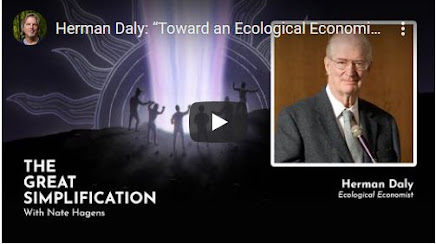
Herman Daly


Herman Daly was a Senior Economist in the Environment Department of the World Bank, where he helped to develop policy guidelines related to sustainable development. While there, he was engaged in environmental operations work in Latin America. He is closely associated with theories of a steady-state economy. He was a co-founder and associate editor of the journal, Ecological Economics.In 1989 Daly and John B. Cobb developed the Index of Sustainable Economic Welfare (ISEW), which they proposed as a more valid measure of socio-economic progress than gross domestic product.

The "Mobilization of the Human Family" symposium set up by John Cobb explored a land tax in early 2001 for a discussion a different form of taxation. The intent was to create a white paper for a system of taxes that would balance the needs of the common good with a fair tax system, and new taxes on pollution and depletion of resources. This was triggered by the regressive taxation policies of the Bush administration that began to grow the divide between the wealthy and the middle class. Discussion of this issue was moving apace, until the land value tax existing in Pittsburgh at that time was repealed in the spring. John has since moved on with larger visions of a theology of ecology and the writings of Alfred North Whitehead and Charles Hartshorne. His many books, articles and symposiums framing "new economics" have also been included in the series, "An Introduction to Ecological Economics".

Daly and Cobb co-published a book, "For the Common Good", which talks about redirecting the economy towards community and the environment. Currently, Daly's podcast, The Great Simplification, outlines a way to reform our economic systems to become integrated with the way natural systems work, to formulate a cooperative economic system that works with the energy flows in nature. In what he calls super organism economics, he proposes reforming national accounts. Separate GDP into a cost account and a benefits account so that throughput growth can be stopped when the marginal costs and the marginal benefits get out of sync.

Earlier articles that I've posted about the need to revise the GDP metric, or replace it, are "The GDP Chimera"  (2012) and subsequently, "Gross Domestic Product"  (2014). Scientific American has recently published "GDP Is the Wrong Tool for Measuring What Matters". It’s time to replace gross domestic product with real metrics of well-being and sustainability.

The development of the value assigned to natural systems has been evolving for a long time, with the current thinking laid out in books, two of which are "Value of the Earth" and "Valuing the Earth: Economics, Ecology, Ethic".


Update 7/30/22: Back in 2019, in his book “Growth,” Smil called on the world to abandon growth to ensure the habitability of the biosphere

Update 8/2/22:  Herman Daly says GDP metric isn't sustainable

Update 8/3/22:  Economics in a Full World by Herman Daly


Saturday, December 18, 2021

A Thirteenth Year - We Dig In


The decade-long drought that impacted water supplies and fueled massive forest fires is still with us, although we've been seeing the rain again, a positive development for water storage in our parched land. Our forests have gone up in flames all summer, and the local urban forests and wildlands are dangerously dry. This has made climate change an urgent priority, and our state government in Sacramento is trying to push ahead with progressive policies that will mitigate carbon emissions by 2050. Even though we know that's not even half of what we'll ultimately have to do.

Our state policies have been informed by the UNFCCC COP deliberations, via former Governor Brown and now Governor Newsom. The architecture profession is moving ahead with educating its members and providing resources to bring emissions down from the construction sector.

CarbonPositive: Architecture’s Critical Role at COP26 - a formulation of strategy for the profession."COP is three parallel events. Of course, there are intergovernmental negotiations taking place in areas inaccessible to the public. Next, is the Blue Zone open to UN accredited delegations. Architecture 2030 is admitted as an “observer” organization with access to the Blue Zone. Finally, the Green Zone is open to the public. The Venn diagram of these three events has some overlap, but not much."

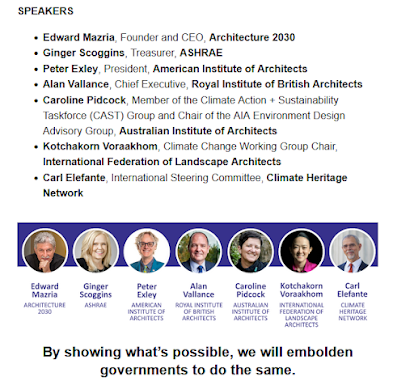
65% by 2030 / ZERO by 2040: Top 200 Global Firms and Organizations Lead With 1.5°C Climate Actions. By showing what's possible, we’ll embolden governments to do the same. The top 200 firms responsible for a significant portion of construction worldwide will present the bold actions they are taking to decarbonize the built world in order to meet the Paris Agreement’s 1.5°C carbon budget. It's one of the best discussions about the urgency of climate action presented to the public.

Carl Elefante FAIA, FAPT LEED AP a representative of the AIA at COP26, provides a summary of their dialogue over 10 days. "After a lifetime practicing architecture, I am hardwired to look for opportunities. Carbon-budgeting building projects and WLCA present many." His new podcast series from the IHBC raises awareness and understanding of how conservation philosophy and practice contributes towards meeting the challenge of climate change.


Thursday, November 25, 2021

Contradiction at COP26


Advent is a time of reflection, remorse, and the preparation to move into a necessary future. As our world increasingly faces extreme climate events, we've got to cut emissions drastically within the next few years in order to keep from experiencing the worst impacts of our continuing carbon emissions. 

The biggest disappointment people have after COP26 in Glasgow is that it kept the world on track to blow past 1.5 and possibly even two degrees Celsius of warming, which is not what the Paris Agreement calls for. Given that we are now experiencing environmental collapse at 1C, the future appears dire, and demands increasingly strong countermeasures of resilience. These measures have been published by Ed Mazria FAIA, forty years ago, and was the beginning of the effort to bring the strategies to the construction industry. He has worked with the American Institute of Architecture to move the industry into the forefront of policies and recommendations necessary to forestall the impacts of climate change.

David Attenborough's opening speech at COP26 Glasgow was a clear challenge to the COP26 participants and delegates. He poignantly describes the unraveling processes that are causing destructive climate change. At a 60 minutes interview with Attenborough in 2020, he states: "Our generation has failed. We've allowed climate change to happen".

The UNFCCC provides a review of the processes at COP26 on their website. "A top priority for the UK Presidency and many countries was to finalise the ‘Paris Rulebook’ to fully operationalise the Paris Agreement. The Paris Rulebook sets out the detailed rules and systems to underpin delivery of the Paris Agreement, many of which were agreed at COP24in Poland. However, there were several issues where Parties held such strongly held different views that they had been unable to agree on these at previous COPs."

The Sierra Club has published "Prove Us Wrong": A Roundup of Some of the Best Speeches at COP26.

The Los Angeles Times presented a different view in their editorial. "The Glasgow climate summit brought only incremental progress." The London Greenleft was far more pessimistic about the summit on their blog:

"We saw an insurmountable contradiction and a source of chaos when China and the United States issued a joint statement at the COP. It will be of no use in breaking the deadlock. It is mainly a statement for the sake of appearances. The two great powers have an interest in posing together as the guarantors of the world’s stability and its climate. Perhaps they will try to collaborate on a partial aspect of climate policy (methane emissions?). But the underlying tensions are very strong and tend to deepen the conflicts. In the US, the Democratic majority is hanging by a thread with senior US Senator Joe Manchin (D) being the loyal friend of coal."

"The failure at Glasgow and what needs to happen next", by Peter Kalmus. Peter is a climate scientist at NASA's JPL in Pasadena and the author of “Being the Change: Live Well and Spark a Climate Revolution.” And this from Greenpeace -“Scientists have found that governments’ current action plans would cause global temperatures to increase to 2.4 C, which would bring absolute devastation to hundreds of millions of people and ecosystems around the world,” Jennifer Morgan, the executive director of Greenpeace International, said in an interview at COP26. “So waiting five years to come back to the table is not an option.”

Climate activist Vanessa Nakate of Uganda had this to say near the end of the sessions: "One of the deepest disappointments for the climate-justice movement was the almost total failure to deal with fossil fuels. Negotiators had flirted with confronting the fossil fuel industry head-on — a key issue previous COPs had dodged — only to back off at the last minute. Whereas an early draft had straightforwardly called for a phaseout of coal power and fuel subsidies, the final version suggested only a phasedown of “unabated coal power and inefficient fossil fuel subsidies,” draining the statement of any meaning.

The many voices did not come to a resolution, but the hope is that next year's COP27 will develop some definitive positions.


Thursday, September 30, 2021

Realpolitic


The politics of dealing with climate change solutions and the implementation of carbon reduction in various industries around the world has been so difficult that our global emissions have continued to climb, putting the entire world in serious danger. The COP meetings via the UNFCCC have so far failed to produce quantifiable results in the negotiations of the parties, largely due to intransigence by the major nations - US, China, the UK and Russia. The real work to implement these policies hasn't been undertaken as policy. Some groups have begun to put out policy frameworks to move climate change implementation into the real world.


The Wilson Center, is an independent think tank based in Washington, DC that examines specific topics and their global impacts for review by policymakers and organizations and the public. Topics they cover are listed on their website, which are extensive and relevant, such as
Foreign Policy is Climate Policy - a report from the Wilson Center. Published September 2020, Updated March 2021. A part of their report relates to the emergency of carbon reduction in the immediate future.

"A strong warning of the immediate urgency of implementing climate change policies is a call from UN Chief Antonio Guterrez that the planet is heating more quickly than current models have predicted: "Speaking at the launch of a U.N.-backed report summarizing current efforts to tackle climate change, Guterres said recent extreme weather — from Hurricane Ida in the United States to floods in western Europe and the deadly heatwave in the Pacific Northwest — showed no country is safe from climate-related disasters.

“These changes are just the beginning of worse to come,” he said, appealing to governments to meet the goals of the 2015 Paris climate accord.“Unless there are immediate, rapid and large-scale reductions in greenhouse gas emissions, we will be unable to limit global heating to 1.5 degrees Celsius (2.7 Fahrenheit),” said Guterres. “The consequences will be catastrophic.”

A very specific topic development in another report that has just been issued is the massive threat of climate change.Geostrategic Competition and Climate Change: Avoiding the Unmanageable by Robert S. Litwak on September 15, 2021. "Humanity is at an inflection point as it faces the twin threats of climate change and nuclear war. An historical vignette offers perspective. During the 1985 Geneva summit, President Ronald Reagan privately asked Soviet leader Mikhail Gorbachev if the two superpowers could suspend their Cold War differences and unite if the Earth was invaded by aliens. Today the world faces the functional equivalent in climate change. The most vital issue in international relations is whether the great powers can take concerted action to avert climate catastrophe—or will allow unconstrained geostrategic competition to undermine that urgent necessity."

Taylor & Francis Online has some comprehensive articles on Environmental Politics. This is an organization that is a reputable international publisher which publishes hundreds of journals and thousands of books. They publish and host some of the top-cited journals in different scientific fields. Their research on sources used by the US congress in their history of climate change debates is outlined in a recent article published on August 25, 2021: Weaponizing economics: Big Oil, economic consultants, and climate policy delay.

"For decades, the fossil fuel industry has hired economic consultants to help weaken and delay US and international climate policy. Among them, the economic consultants of Charles River Associates played a key role, helping to undermine carbon pricing, international climate agreements, and other climate policies from the early 1990s onward. The work of these economists was often portrayed to the public as independent, when in fact it was funded by the fossil fuel industry, and their models were incomplete and biased in favor of continued fossil fuel use. Yet their conclusions often passed without challenge and eventually came to represent a significant part of conventional economic wisdom.

Research on the climate change counter-movement has traditionally focused on documenting the promotion of disinformation regarding climate science (Brulle 2014, Franta 2021). While such disinformation has played a crucial role in delaying effective climate policy, the fossil fuel industry and broader climate change counter-movement have also made frequent use of economic arguments to justify inaction. At the same time, the fossil fuel industry has made substantial investments in influential climate economics programs across the US. Further attention is needed on the role of economists and particular economic paradigms, doctrines, and models within climate politics and the perpetuation of fossil fuels."

The political diplomacy which needs to be carried out by the US is tasked to John Kerry, the US  Special Presidential Envoy for Climate. Key workstreams and focus areas for the Special Presidential Envoy’s team include: constructive engagement in the Paris Agreement and related agreements and processes; driving global greenhouse gas emission reductions so as to keep a 1.5 degree Celsius limit on temperature rise within reach; enhancing adaptation and resilience to climate impacts; climate-aligning financial flows; driving overseas clean energy innovation and competitiveness; and better integrating climate and other areas, including the ocean, biodiversity, the Arctic, and international shipping and aviation activities. This is an extensive policy on the climate crisis which has specific urgent measures for getting to zero carbon. So we shall have to measure the outcomes of COP26 in Glasgow by the implementation of the US policies in the real world.


Friday, July 30, 2021

New Sheriff in Town


The new Biden administration has awakened the Federal beast, which is stirring with new life on the carbon issue. Biden’s pledge on Earth Day 2021 is in line with what environmental groups and hundreds of executives at major companies have pushed for. The president announced the target at the closely watched global leaders’ climate summit on April 22, during which he hopes to urge global cooperation to address the climate crisis.


“This is the decisive decade,” Biden said at the summit on Thursday morning. “This is the decade that we must make decisions to avoid the worst consequences of the climate crisis.”

“This is a moral imperative. An economic imperative. A moment of peril, but also a moment of extraordinary possibilities,” the president said.

At the state level, California is setting policies in concert with many organizations that are moving ahead with their goals and solutions to the carbon emission emergency that has been declared. The architects and contractors are already developing their methods for reducing not only emissions, but are also the decarbonization strategies that drastically reduce the impact of construction in cities and towns. This is being done in concert with the American Institute of Architects California (AIACA) and Architecture 2030 leadership by Ed Mazria FAIA.

Rocky Mountain Institute, headed up by Amory Lovins, is working with industry to transform the global energy system to secure a clean, prosperous, zero-carbon future for all. They are developing zero-carbon roadmaps for harder-to-abate sectors; accelerate development and deployment of breakthrough technologies; cultivate zero-carbon industries and ecosystems. These are some of the goals of their China program.

The response to the climate change issue has several major policy supporters that share similar climate goals. Recognizing that buildings account for nearly half of global CO2 emissions, the Carbon Leadership Forum, a non-profit organization at the University of Washington, is dedicated to accelerating the transformation of the building sector to radically reduce the embodied carbon in building materials and construction through collective action. This group's document was published in March 2021. To learn more about different policy initiatives related to embodied carbon or track updates on the policy initiatives in this document, visit the Carbon Leadership Forum’s Policy Toolkit.

The goals of the UNFCCC policies of 1.5C established in Paris are facing some serious pushback by the fossil fuel industry. It's not just a disinformation campaign, but steering governments to implement actions that will keep the oil flowing. For example, a human rights lawyer is facing prison for holding an oil giant to account talks about his Kafkaesque case.

"One of the critical facts is it’s not an accident. It’s a deliberately designed pollution event where Texaco decided to do it this way, essentially to play God with the people of Ecuador in order to save $2 or $3 a barrel of oil produced. The net result today, 50 years after this started, is you have the world’s worst oil disaster. You have thousands of people dead or dying from exposure. You have virtually no medical care. You have indigenous groups decimated, on the way to extinction because the forest is now poisoned by these deliberate acts of destruction. It can no longer sustain the culture, so it’s a disaster from every angle."

And at the same time, cities face new roadblocks in their quest to decarbonize buildings with policies that cripple efforts by local governments to establish sustainable policies.

The International Code Council (ICC) — an organization that manages building codes for much of the U.S. — this month removed the rights of local governments to vote on future energy efficiency building regulations, a move that could have major implications for cities as they seek to reduce their greenhouse gas (GHG) emissions within building sectors, according to industry experts.

So we're looking to Biden's leadership to help untangle these issues and policies that are colliding in the US as well as the global community acting under the United Nations oversight.

Update 10/8/21: Take three steps to begin designing zero carbon buildings today

Update 10/9/21:  CarbonPositive: COP26 


Wednesday, June 30, 2021

Approaching the Endgame


The World Meteorological Organization maps out the heat of climate change in June. An exceptional and dangerous heatwave is baking the Northwestern USA and Western Canada in areas which are more synonymous with the cold. Temperatures have reached more than 45.0°C on consecutive days, with extremely warm nights in between. The destructive impacts of climate change have been anticipated by climate scientists for decades. The accelerating damages from overheating the biosphere have been shown to be even worse than we've expected, and it's happening faster and faster. The ClimateReanalyzer map above shows the massive heat that's currently sitting in a dome over western Canada and the United States. 

We may already be in a global heat state that's irreversible because of the feedback emissions from melting permafrost, the burning forests and emerging global droughts due to the heat already absorbed in the ocean and on the land over the last 150 years. It's a runaway climate scenario that has started with a vengeance. The challenge now is for the global communities to come to a resolution to reduce carbon emissions to zero by 2030. Of course we're not going to be able to hit this benchmark, and the resulting decimation of our planet will mean that human civilization will not be able to survive.

The details of the Endgame are summarized in this blog which traces the work of the Global Commons Institute and the efforts by Aubrey Meyer to develop a framework for the global climate agreement which includes the necessary emission reductions required to keep the planet from heating up past 1.5C. Over the past 30 years we have not been able to accomplish this agreement primarily due to the intransigence of the US, China and Europe. This is due to the immense interference and obfuscation by the fossil fuel industry, which has leverage in all the major governments of the world.


Update 7/18/21: Is This the Beginning of Runaway Global Warming?

Update 7/19/21: The Amazon is Burning and the Earth is Dying Slowly

Update 7/20/21:  An Open Letter to All Climate Scientists

Update 7/22/21: Global Warming: From Scientific Warning to Corporate Casualty

Update 7/23/21: Forward to the Past


Monday, May 31, 2021

Road to Glasgow


2021 United Nations Climate Change Conference (COP26) will begin on Nov 1 and end on Friday Nov 12 in the Scottish Event Campus (SEC) in Glasgow. As of right now in May, the preliminary Sessions of the subsidiary bodies are underway in a virtual platform. This continues the process of meetings and negotiations by the different representatives of countries that are trying to reach a commitment to the 1.5C scenario of the Paris Agreement in 2015. There was no formal framework agreed to in 2015, just an agreement to the cap of carbon emissions that would keep the global ecosystem from exceeding 1.5C by the immediate reduction of green house gas emissions.

The Paris Agreement was an exercise in coming to grips with the enormity of defining the scale of the global emissions reductions and the rapid shift required to get the world to zero carbon.

President Obama was able to formally enter the United States into the agreement under international law through executive authority, since it imposed no new legal obligations on the country. Trump disastrously pulled the US out of the treaty the minute he got into office, on June 1, 2017, and President Biden reinstated US participation on January 20 of this year.

The website for the May-June UNFCCC conference is here. Its purpose is to begin negotiations and hammer out agreements on key aspects of the talks in Glasgow. The United Nations Framework Convention on Climate Change is an international environmental treaty against climate change, negotiated and signed by 154 states at the United Nations Conference on Environment and Development, informally known as the Earth Summit, held in Rio de Janeiro from 3 to 14 June 1992.


Wednesday, March 31, 2021

Science/Technology


The largest database on earth, Google, has now trained its sights on our planet, using its developed Google Earth platform to integrate information across time and place to show how we have RADICALLY changed this planet in a few centuries, and not for the better. The Google maps are now integrated with satellite databases to render the changes in our planet over a timescape of 35 years or so. Its very simple to jump to the navigation dashboard and view the resulting videos.

From Google: 

"As far as we know, Timelapse in Google Earth is the largest video on the planet, of our planet. And creating it required out-of-this-world collaboration. This work was possible because of the U.S. government and European Union’s commitments to open and accessible data. Not to mention their herculean efforts to launch rockets, rovers, satellites and astronauts into space in the spirit of knowledge and exploration. Timelapse in Google Earth simply wouldn’t have been possible without NASA and the United States Geological Survey’s Landsat program, the world’s first (and longest-running) civilian Earth observation program, and the European Union’s Copernicus program with its Sentinel satellites."

 From Tom's Guide:

"Try it for yourself, and you may not like what you see. Watching the Timelapse unfold is a pretty shocking experience, especially in areas such as the Amazon rainforest, where untold devastation is happening as land is deforested and repurposed for farming. Seeing just much the ice is melting in places like Antarctica and Alaska is similarly depressing.

Naturally, Google will be updating Timelapse every year from now on, and it promises to keep it updated for at least another decade. That way, we’ll be able to continue to see how our planet is changing, and what human beings are doing to continually mess the whole place up."

This new time-based planetary exploration takes the standard NASA time lapse to a new dimension, which shows the changes in nature as well as the expansion of urban sprawl. Previously, this time-lapse video crammed 20 years of Earth into just a few minutes. Google helped scientists learn a lot more about global warming and how the earth is changing.

Fortunately, with the new Biden administration preparing to address the climate issues with tremendous reserves of science analysis and highly structured data, there's a ray of hope that capitalist "business as usual" is no longer the prevailing norm. There's now hope for a livable future, with a focus on competent solutions to the horrific global problems that threaten the planet's existence.


Friday, December 18, 2020

A Twelfth Year - Bone Dry


Typically Southern California's wet winter weather sets in during the month of November. This year, there has been NO RAIN. It's an ugly portent for our future, with an ominous potential for even worse wildfires than we have seen this past year. Visions of water rationing and massive rate increases are now in the offing.

It's imperative for global cooperation to happen right now for potentially getting to zero carbon emissions. ""This decade is a moment of choice unlike any we have ever lived," says  Christiana Figueres, the architect of the historic 2015 Paris Agreement.  The daughter of Costa Rica's beloved President José Figueres Ferrer,  she shares how her father's unwillingness to lose the country he loved  taught her how stubborn optimism can catalyze action and change. With an  unshakeable determination to fight for the generations that will come  after us, Figueres describes what stubborn optimism is (and isn't) --  and urges everyone to envision and work for the future they want for  humanity."

The United Nations, United Kingdom and France were proud to co-host the Climate Ambition Summit 2020 on Nov. 1 - 12, in partnership with Chile and Italy. This is a monumental step on the road to the UK-hosted COP26 next November in Glasgow. The COP26 summit brought parties together to accelerate action towards the goals of the Paris Agreement and the UN Framework Convention on Climate Change. The COP26 Presidency will demonstrate the urgency and the opportunities of the journey towards a zero carbon economy and the power of international cooperation to address the gravest challenges the world faces.

Many countries are also still pouring money into high-CO2 activities as they strive to recover from the coronavirus crisis and recession. Guterres noted that G20 countries were spending 50% more in their stimulus packages on fossil fuels and CO2-intensive sectors than they were on low-CO2 energy.


The UK will stop funding overseas fossil fuel projects.“This is unacceptable,” Guterres told the online Climate Ambition Summit, co-hosted by the UN, the UK and France. “The trillions of dollars needed for Covid recovery is money that we are borrowing from future generations. This is a moral test. We cannot use these resources to lock in policies that burden future generations with a mountain of debt on a broken planet.”

More than 70 world leaders, civil society activists, business chiefs and city mayors attended the Climate Ambition Summit, which marks five years since the landmark Paris climate agreement.
 

The US awaits the re-entry to the Paris Climate Agreement in January, when the Biden administration plans to officially align its climate policies with the global agreement. Although California is not waiting for federal policy to take effect. It has positioned itself for leadership in climate policy. Other states are beginning to implement different aspects of getting off of fossil fuels. New York State Comptroller Thomas DiNapoli announced that over the next five years, the state’s $226 billion employee pension fund would divest fossil fuel stocks and shares of other companies that do not meet the fund’s new target of net-zero greenhouse gas emissions by 2040. This is a huge win in the divestment space.

Thursday, August 13, 2020

Deforestation


Carbon sequestration is an important part of the equation for reducing the level of CO2 in the atmosphere in accordance with the Paris Agreement. One aspect of this agreement has just been addressed by California Governor Gavin Newsom. One of the main causes of global climate change is the destruction of natural ecosystems — for example, deforestation and unsustainable land conversion for agriculture. Deforestation destroys 13 million hectares (32 million acres) of forest every year — an area the size of North Carolina — adding more carbon to the atmosphere than the sum total of all the cars and trucks in the world.

California and the U.S. Forest Service have established a shared long-term strategy to manage forests and rangelands, Office of the Governor Reports. This agreement will improve coordination to reduce wildfire risks on federal and state lands. Funding is included in the federal Great American Outdoors Act recently signed on August 4 by the President of the United States. A summary is here.

The press release is as follows:

A historical transition toward unnaturally dense forests, a century of fire suppression and climate change resulting in warmer, hotter and drier conditions have left the majority of California’s forestland highly vulnerable to catastrophic wildfire and in need of active, science-based management. Since the federal government owns nearly 58 percent of California’s 33 million acres of forestlands, while the state owns 3 percent, joint state-federal management is crucial to California’s overall forest health and wildfire resilience.

Improved coordination also is key since nearly half of the state dollars invested in fuels management in recent years was spent on federal land. 

“Wildfires don’t stop at jurisdictional boundaries. As we respond to wildfires in real-time this summer, improving coordination between the major stewards of California’s forested land will help us protect communities and restore forest health across California,” Governor Gavin Newsom said. “We are grateful to secure the U.S. Forest Service’s commitment to help us more effectively address the scale of California’s current wildfire crisis.”

“Collaboration between state and federal agencies on issues of forest health and resiliency is critical,” said U.S. Forest Service Chief Vicki Christiansen. “The Forest Service is fortunate to collaborate on restoration projects across the state and share science and research to address issues to help care for the land and serve people. We are excited to expand our partnership with California to enhance our collaboration though this Shared Stewardship agreement with California.”

The Shared Stewardship Agreement builds on existing coordination between state and federal agencies, and outlines six core principles and nine specific actions that will drive improved state-federal collaboration.

“In a key step to improve stewardship of California’s forests, the Newsom Administration and the U.S. Forest Service today announced a new joint state-federal initiative to reduce wildfire risks, restore watersheds, protect habitat and biological diversity, and help the state meet its climate objectives.  The Agreement for Shared Stewardship of California’s Forest and Rangelands includes a commitment by the federal government to match California’s goal of reducing wildfire risks on 500,000 acres of forest land per year. To protect public safety and ecology, experts agree that at least one million acres of California forest and wildlands must be treated annually across jurisdictions.

Monday, June 29, 2020

Pandemic Carbon Timeline


The Ted Talk Countdown on Climate series is underway with Al Gore's video presentation,  hosted by Chris Anderson.

The coronavirus brought much of the world to a standstill, dropping carbon emissions by five percent. Al Gore says keeping those rates down is now up to us. In this illuminating interview, he discusses how the steadily declining cost of wind and solar energy will transform manufacturing, transportation and agriculture, offer a cheaper alternative to fossil fuels and nuclear energy and create millions of new jobs. Stay tuned for a lively debate about geoengineering and hear Gore's thoughts about how humanity can create a clean, prosperous future through a focused global effort and a generation of young people committed to change. (This virtual conversation, hosted by head of TED Chris Anderson, was recorded June 23, 2020.)


Update 7/8/20: Netting Zero. A virtual event series on climate change from the NY Times


Friday, April 24, 2020

Earth Day 50th

https://www.nasa.gov/content/earth-day-2020


It's discouraging to look back at 50 years of environmental activism (an entire lifetime!) and see how little has been accomplished in spite of the overwhelming emergency that we're faced with in ecological destruction. The result of endless growth vectors in human culture and economics carried out in trade, the industrial carbon emissions over the last 200 years has finally impacted our planet in devastating ways. With no constraints on growth, a violation of natural processes and structures, human civilization has overrun the natural checks and balances that kept the planetary cycles in balance. But in the end there's always a reckoning because, well, physics.

Sierra Club recaps these issues in an interview with Dennis Hayes. "Fifty years later, we have different environmental challenges, some much larger, most notably global climate change. Despite the existential threat of climate change, today countries are rolling back environmental protections, failing to live up to the Paris Agreement and dragging their feet on climate action. Meanwhile, the environmental movement has gained momentum, thanks in no small part to an infusion of energy and outrage from the youth climate movement."

As described in Nature magazine, a new synthesis shows what a wasted decade means for the climate pact made in Paris. "In global climate projections, no single model can predict the future, and such analyses by necessity exclude the most recent developments. Nevertheless, it is clear that, collectively, current policies will not limit global warming to well below 2 °C, let alone 1.5 °C, as agreed in Paris. Clearly, the annual audit of the emissions gap has not altered poor performance. The gap concept has nonetheless proved useful. The reports and numbers have continuously informed the UN climate summits and the emissions gap was noted as a serious concern when parties were adopting the Paris agreement." This article includes a chart demonstrating the impact of this process.

Aubrey Meyer of GCI has continually emphasized that the global rate of the rise of temperature & CO2 concentrations is determined by the global contraction rate/weight/date of the future global CO2 emissions budget. An international carbon-sharing strategy is essential for UNFCCC-compliance if we are seriously risk-averse. "A lot of valuable time has been completely wasted over the last 25 years when total annual CO2 output was around 7Gt C/year. As it is now ~14 Gt C & temperature looks likely to be taken over the 2° C threshold, the situation is now obviously urgent." Insufficient climate action during the past decade means that transformational development pathways are now required to reduce greenhouse gas emissions on time to meet the 1.5C Paris target.

Strategies for addressing this have been put forth. For example, Rocky Mountain Institute has proposed Decarbonization and Debt Forgiveness: A Path Forward. "A simple debt forgiveness approach can help industries and workers feeling economic pain now and build toward a more sustainable, low-emissions future."

Important legal precedents are being set in UK and US courts. The recent UK decision against allowing another runway to be constructed at Heathrow is a moment of truth. "That’s why the ruling sets such a powerful precedent, both in the UK and beyond. The message has gone out loud and clear that governments can no longer do what they’ve been doing for decades: claiming to be serious about tackling the climate crisis while marching us headlong towards disaster."

The recent impact of the coronavirus pandemic as well as a trade war in oil has produced an enormous shock to the fossil fuel industry. It has completely changed future projections for the industry, and has had had an immediate impact on its viability as an investment vehicle, as outlined in the article, The Beginning of the End for Oil?

It appears that the entire global population is facing a pivot point in which the need for serious, drastic climate action is clear to most people and governments now. One can only hope that this opportunity is not wasted as well.

Sunday, March 22, 2020

AIA Carbon Positive Report


The American Institute of Architects, in cooperation with Architecture 2030, put on a very important conference in Los Angeles on March 2 - 4, 2020. Ed Mazria of Architecture 2030 was a great keynote at the conference kickoff, and his slide presentation is here. An additional video of a 2010 presentation of his is here. The sessions are presented as a very, very urgent timeline for the building profession to engage and get to net zero by 2030. This is based upon the adoption of the Intergovernmental Panel on Climate Change (IPCC) Special Report, Global Warming of 1.5°C, promoted by Mazria's organization.

UN | Report of the Secretary-General  Dec. 2019:

September’s Climate Action Summit delivered important new actions, a surge in climate momentum, and a clear destination: 45% emissions cuts by 2030 on the way to a carbon neutral world by 2050. The Secretary-General’s report on the outcomes of the Summit highlights the way forward in 2020, and outlines ten priority areas of action. We are seeing unprecedented changes in the earth’s environmental and physical processes. Climate change, air pollution, reduced availability of clean water, and persistent toxic chemicals threaten human, animal, and environmental health and well-being.

A special guest presentation was made by Farhana Yamin, who is an internationally renowned environmental lawyer and Extinction Rebellion activist with more than two decades of experience advising nations and NGOs on climate change and development policy. An interview with her is here. As well as authoring numerous books and IPCC reports, she has played a key role in drawing up international treaties, including the landmark Paris Agreement on climate change in 2015. Farhana is also an associate fellow at Chatham House and visiting professor at UCL. In April she glued herself to Shell's London headquarters in protest at the oil firm's climate impact.


This has resulted in a formal challenge to the profession which was presented to the architects attending the conference. Some conference notes are here from Michael Malinowski. Ed Mazria provides further background from the conference in his message to AIA: "The numbers may be abstract, but the implications are firm: we must reduce global CO2 emissions 50% to 65% by 2030, and reach full decarbonization by 2040." A little more of the story is here on how this conference came to be through Mazria's efforts over the decades.

The targets, roadmap and vision for the systemic change needed to address climate change are clear. They were recently discussed at CarbonPositive’20, with a video library here. At this milestone event, current actions and opportunities were presented, the latest tools, technologies and advanced materials were exhibited, experiences and expertise were shared, and the future was imagined. CarbonPositive’20 focused on the actions necessary to avert dangerous climate change and limit planetary warming to 1.5 degrees Celsius above pre-industrial levels.

Additional resources shared at the conference:
Climate Positive Design Challenge
https://climatepositivedesign.com/
 
Design with Climate: form follows performance explained with a psychrometric chart analysis.

Environmental Product Declarations (EPD) present transparent, verified and comparable information about the life-cycle environmental impact of products.
https://www.environdec.com/

Beyond Net Zero
https://massdesigngroup.org/
http://www.rocagallery.com/cats/views-on-architecture

ARUP BioBuild is the world’s first self-supporting façade panel for building construction made of biocomposite materials.
https://www.arup.com/projects/biobuild-facade-system

Living Algae Buildings  Australia
https://mysteriousuniverse.org/2016/06/living-algae-buildings-are-a-growing-concept/

World Green Building Council  Net Zero
https://www.worldgbc.org/advancing-net-zero

International Living Future Institute  Zero Carbon Certification
https://living-future.org/zero-carbon-certification/

Skanska Embodied Carbon Calculation Tool
https://www.usa.skanska.com/who-we-are/media/press-releases/238250/Skanska-Conceives-Solution-for-Calculating-Embodied-Carbon-in-Construction-Materials%2C-Announces-Transition-to-OpenSource-Tool


Update 4/7/20: The AIA 2030 Commitment to transform the practice of architecture has resources for professionals.

Update 4/8/20: Architect Magazine has provided climate action resources to the profession.

Update 4/23/20: Buildings are responsible for 40 percent of carbon dioxide emissions.


Tuesday, January 28, 2020

Deep Adaptation


Jem Bendell's  Deep Adaptation video (above) was posted a year ago on Jan. 27th, 2019. He talks about Resilience,Relinquishment, Restoration. His summary of "After Climate Despair" is here, dated April 12, 2019. His earlier paper of Dec. 2018, Deep Adaptation:A Map for Navigating Climate Tragedy, is here.

His discussion of an inevitable near-term social collapse due to climate change is the result of the input and dialogue by scientists and climatologists for over 30 years now, with an increasingly clear picture forming of the near-term impacts of the destruction of the ecosystem. The UN has issued serious alarms in its IPCC report of August of 2018, declaring that carbon emissions must rapidly go to zero. It's not just the increasingly obvious climate devastation that's happening right now, for example the massive fires in Australia that are dumping huge amounts of carbon into the atmosphere, and the deepening global droughts that threaten water and food supplies in every country. The global heating is also responsible for the increasing acidity of the oceans and the destruction of life in its waters throughout the planet. The oceans have been storing the heat for several hundred years, and the impact of this is increasing rapidly.

Of greatest concern is the melting polar ice caps which are experiencing their hottest days on record. The issue going forward is the massive methane emissions that will occur as this process unfolds, which is a process that feeds upon itself as the emissions rise, leading to a runaway climate heating that could well lead to an extinction event.

“First, the probability of this pulse happening is high, at least 50 per cent according to the analysis of sediment composition by those best placed to know what is going on, Natalia Shakhova and Igor Semiletov. Moreover, if it happens, the detrimental effects are gigantic. . .the risk of an Arctic seabed methane pulse is one of the greatest immediate risks facing the human race. . .Why then are we doing nothing about it? Why is this risk ignored by climate scientists, and scarcely mentioned in the latest IPCC assessment? It seems to be not just climate change deniers who wish to conceal the Arctic methane threat, but also many Arctic scientists, including so-called ‘methane experts.” (Wadhams, pg. 127-28)

We have a clear responsibility to get emissions to zero from the human activities on our planet no later than 2040. However, the realities of this endeavor are daunting because we've delayed any action for over 50 years now, from the first Earth Day in 1970. This is our last decade to get it right. Our kids deserve a life, not the destruction of the only home we have.

Update 2/24/19: It doesn’t help matters that a feedback loop kicks in as the poles warm.

Update 2/25/19: “Doomsday Glacier,” is melting much faster than previously known.


Wednesday, December 18, 2019

An Eleventh Year - Showers


We've had a recent winter rainstorm now in Southern California, similar to the pattern we saw last year, which is drier. Finally a series of cool days but not like there used to be. The changing climate continues to evolve into dry and warm weather with much less rainfall, and this will evidently progress as our carbon emissions heat up the planet. The global attempts to deal with this have not succeeded in any kind of significant change in human behavior around this. COP 25 in Madrid was a severe disappointment in the face of a climate emergency.

Swedish climate activist Greta Thunberg, on Dec. 11, denounced the pledges of wealthy countries and businesses to curb climate change as hollow and deceptive, calling them "clever accounting and creative PR" in a speech before world leaders at the United Nations' annual COP 25 climate meeting in Madrid. The talks are aimed at finalizing guidelines for implementing the 2015 Paris Agreement, which called for measures to prevent global temperatures from rising more than 3.6 degrees Fahrenheit and mitigate the consequences of climate change. She says that business and political leaders are misleading the public by holding negotiations that are not leading to real action against warming temperatures, which she referred to as a climate "emergency."

Subsequent to the panel presentations, climate activist Dr. Peter Carter (video here) , Director of the Climate Emergency Institute spoke up with a summary of the proceedings: "It is missing the most important document, the 2018 IPCC report of 1.5 degrees C. It showed that 2 degrees C, the old target since 1996 is total catastrophe and that 1.5 degree C is still disastrous but that is where we must aim. All of the scientists are now agreed that they support the 1.5 degrees C. We are already there now. We must reduce global emissions 50% by the year 2030. Every year matters. Even as every COP has been set up to fail due to the requirement that major decisions will be made by consensus, for which there is no definition of "consensus". So we know that the US, Russia, Kuwait, Saudi Arabia are blocking science from the negotiations."

A reporter in attendance at COP 25 wrote: "The U.S., along with Australia, Brazil, Japan, and Saudi Arabia, has helped create a gridlock in this year’s negotiations. The vacuum left by the U.S. has led countries interested in maintaining the status quo — including Australia, a major coal exporter, and Brazil, led by a right-wing government promoting deforestation of the Amazon — to block stronger rules for a global carbon-emissions trading system that are supposed to go in effect next year"

Carbon dioxide emissions continue to grow amidst slowly emerging climate policies A failure to recognize the factors behind continued emissions growth could limit the world’s ability to shift to a pathway consistent with 1.5 °C or 2 °C of global warming. Continued support for low-carbon technologies needs to be combined with policies directed at phasing out the use of fossil fuels. This paper lays it out.

James Hansen has just issued a position paper called "Climate Change in a Nutshell: The Gathering Storm" as a summary of the issues involved in climate change and a warning to the world. It's part of the support for his Juliana v. United States lawsuit which is on behalf of the young people of the world.

"More sinister still is the growing power of the fossil fuels lobby over the world media and also over governments – not only the floundering western democracies, but also states like Russia, China, Brazil, India and Saudi Arabia. Media organisations such as the Murdoch News Corporation serve as an unofficial propaganda front for fossil fuels, brainwashing an unquestioning audience with a round-the-clock thunder of deceit, half-truths and misdirection."

The centuries-long history of extractive greed continues to subvert attempts to reduce carbon emissions, in the name of profit. Two years after spilling 407,000 gallons of oil in South Dakota, the Keystone Pipeline erupted again. In November, a North Dakota portion of the pipeline leaked another 380,000 gallons – adding to the millions of gallons of crude oil that have spilled from pipelines over the last decade, as Undark has reported. As the climate crisis worsens, the fossil fuel industry has clearly messaged its apathy by continuing to pollute the planet. But these horrific leaks aren’t simply one-off “incidents.” They reveal a long history of oppression on communities of color and the planet.

The results of the unabated carbon emissions are now a frightening climate emergency for this planet. The hope for change now rings hollow.

Update 12/19/19: Oil companies and their trade associations have since gone all in pushing carbon markets, and they’ve been all over COP25.