skip to main |
skip to sidebar
 My foray into one of the more important sacred places in Europe took place after some exploration of the powerful spaces of the Grand Canyon and the ruins left behind by its indigenous peoples. A vast monumental effort, clearly tied to the visions of the skies and stars, is standing on the plain of Salisbury in England. A short history of the development of Stonehenge as we know it is here.
It is an established fact that Stonehenge was an astronomical observatory for both solar and lunar observations. One of its functions was the determination of the summer solstice date using the summer solstice sunrise. At the 21st of June the rising sun in the North East shines its light in between the Heel Stone onto the Alter Stone at the center of the Trilithons or horseshoe of Stonehenge. A more comprehensive study of its astronomical alignment and structure is here.
What struck me about this place was the strong presence of a mindfulness of 5000 years ago; the structure and scale of something that has left no imprint in history, yet has a resonance that strikes me as did the ruins of Tihuanaco in Bolivia, the Aztec pyramids of Teotihuacan in Mexico, and the ruins of Mesa Verde in Colorado . Human presence and intent, lost in the abandonment of a historic place because of famine or drought. Yet the patterns remain, giving up their secrets reluctantly, if at all.
Ancient folk worked with what they had in their technology and resources, but had no lack of comprehension about their ecology, their environment or its resources. While they lived more or less in concert with natural forces, there were times of extremes of weather - mostly drought - that forced them to relocate to other lands. This would tend to indicate that there is a set of boundaries within which human consumption and sustainable existence can coexist. Going past that involves the costs of technology - energy needs and its attendant pollution and carbon dump - that are now threatening the global balance of climate and biology.
I'm just hoping that we can readjust our priorities while we can.
 What is it that makes certain buildings and places so evocative and powerful? It's not so much the style and scale of new structures as how the new structures fit into the context-defined "anchor points" on a site, remain open to urban open space and view corridors, and address existing significant structures and public gardens, etc. that provide the whole site context.
In "plannerspeak" that means to maintain the edges and connections that exist, but perhaps even reinforce them with a startling new form that sees what's there in a way that nobody saw before. Renzo Piano and Steven Holl can do it with entirely new vocabularies (that they've spent decades refining), it's not magic. FLLW did it - in his own inimitable style - with the Fallingwater design after about 3 hours' notice by the client that he was on the way (after studying the site in detail for months, every tree! - context is supreme again)
It's NOT about copying previous examples of style/form/scale, which most folks misunderstand. It's about using some kind of consistent vocabulary in a way that makes it a place you want to be in and inhabit, and express its intent and program clearly.
What most architects understand is that the key to a place is its focus and expression, just as in the remarkable Salk Institute by Louis Kahn in La Jolla. This place is stunning, yet pragmatic. It is designed for expansion (currently underway). But its siting, with that runnel that heads out to sea and is centered on the Summer Solstice sunset, goes far beyond the mundane with a Vision Statement that embodies a key representation of historic scientific innovation & research. The angle of the sun, the line out to sea, create a triangular structure of space out to an infinite horizon that speaks to the euclidean understanding of geometry and science. All the labs and offices are angled along this plaza towards the same view. You see how this works?
That's the driving Vision.
The deeper inspiration in the case of the building for this institute for Salk is that it emerged from his experience of a monastery in Assisi as he was trying to reach for the clarifying insight that resulted in production of the polio vaccine. All of these elements come together in an incredible fusion by Kahn.
The details of the structure and site's programmatic solutions and materials, structure and systems emerge from this initial response. For example, twelve principal ingredients are outlined on this site, and are the things that must be quantified and laid out in order to complete the design. If these elements are consistently applied and fully carried out, it can result in a very successful experience. Sometimes even an iconic presence.
 The tragedy of the BP platform blowup in the Gulf of Mexico gives lie to the assertions that oil drilling is an acceptable risk in offshore waters. A very comprehensive action is being taken by the Nature Conservancy in response to the blowup and oil spill in the protected marine areas. Their complete first-hand response and report is here. More complete local coverage is at nola.com, a New Orleans publication.
There's no way to really make amends to natural systems when this inevitably happens, in particular the Exxon-Valdez destruction which is ongoing in Prince William Sound decades after the incident. Some information about oil spills, their frequency and amounts, are here.
Our economy is simply going to have to shift very quickly to disconnect from these poisonous energy sources before the destruction wipes out ecosystems that provide us with life, food and our deep connection to natural processes at the shorelines. Millions of years ago these interstices and tidepools saw the emergence of life from the sea onto the land, a crucible driven by the tides created in the dance between the earth and the moon.
 Architects are the Fashionistas of the building industry, mavens of culture to the Architectural Digest crowd. Nice lambaste of a hard-working profession.
The creative process of architecture has pushed cultural understanding of space since the days of Roman engineering expanding outward to the empire, the development of the barrel vault and arch, on to the Gothic flying buttresses to prop up cathedrals built over many lifetimes, to the domes of St. Paul and Brunelleschi dome at the Cathedral of Florence. Architectural space married to the mystical experience, as it were. Not to mention the Greek temples, the ground of government houses of parliament and bank buildings as memorialized in the Four Books of Architecture by Palladio.
For the rest of architecture history evolution, get out your "History of Architecture", by Sir Bannister Fletcher, otherwise known as "the bible". Many hours of slide lectures in architecture history class only begin to scratch the surface...
Which brings us to some cultural commentary, such as Tom Wolfe's missive on the drawbacks of modern architecture - well written but omits key historical facts. Parody, in essence. Then there's a very cogent dissertation on the deeper workings of the Fashionista line, "American Architects and the Mechanics of Fame" which examines the contemporary system of getting one's name out there in this crazy design business. That doesn't always play out well even for those who gain a reputation during their professional lifetimes.
A friend and mentor of mine, Don Hensman FAIA, was a local architect of note. While his career had its ups and downs, the homes he designed appreciated in value immensely. Shortly before he passed away, I asked him how he felt about that. His wide-eyed retort was that he felt like a starving artist, since like all architects he was paid about 9 percent of its construction value for the design and construction documents services, as well as advice during construction - a period of several years. Subsequently, the Realtors were making 6 percent on the entire appreciated value of the property each time it sold - usually about a 6 month process - far more than an architectural commission.
Nonetheless, there are good and noteworthy architectural accomplishments that are not necessarily by the "names". Architectural Record has an online library of photo galleries of architectural designs around the world, submitted by folks who have captured something unique about buildings and the urban environment.
 Sometimes a structure becomes the exemplar of all that doesn't work; the architecture profession deals with this constantly. It generally reflects budgetary and programmatic shortfalls as well as multiple conflicting user demands. Many times it's due to politics, and the need for a physical symbol of an entity or corporation, which most architects are well acquainted with by virtue of experience in many design competitions that are little more than cover for a deal already in place.
A Planetizen article explores all of these issues surrounding the US Pavilion structure at the Shanghai 2010 World Expo, which opened this weekend. US reporter Adam Minter also covers this situation in his post on the Pavilion and on the IRS issues it has created.
The end result is a lackluster corporate building that doesn't exude any energy; it's all grounded in the capitalist formulae for pasting commercial structures together as pure mass marketing schemes. No sensibilities about human scale, connecting to ideas, or even minimal green standards, let alone any kind of radical regenerative design.This will not be one of those memorable pavilion designs that endures as a portent of things to come. The hugely controversial Eiffel Tower comes to mind, but there have been many more.
A rather broader picture involves the question about architects and the practice itself; there's some criticism coming out of the design schools and in the online architect news sources about whether the profession itself is corrupt. Much of the commentary centers on the lack of influence that architects have in the way the built environment is developed, although the folks in the driver's seat are actually State and Federal governments, the bankers and institutions. It's all a rather nasty tangle.
 This is not a happy post. While I try to stay on the positive and constructive side with respect to the needs for environmental reform and urban planning that incorporates natural processes rather than their destruction, I'm seeing larger forces playing out towards an endgame where everything stops. The whole ship goes down. Unless a game-changer comes along.
All of us are increasingly disenchanted with the system as it exists in our country today; the polarization of the political parties are a symptom of the corporate takeover of what used to be government administration for the common good. Both parties have necessarily sold out and headed towards opposite poles, and none of the big problems are addressed or solved. It's all about who gets the money. Particularly now that budgets are imploding in the US across states and cities, and also in the European Union. The whole house of cards seems to be coming down.
The Goldman-Sachs ponzi scheme built upon CDO's and affordable housing mortgages has played out globablly, Spain being a prime example of what happens when homes are built upon sand - and bubbles. An excellent article in Alternet lays out the basics of the dysfunctional financial empire that was built around things that had no real value: debt.
This has created a deep disconnect with the American public, and a deep alienation with government. This is a very dangerous situation, especially during a recession when people are losing their homes and jobs because of the antics of Wall Street, unfettered by regulation or even common sense.
I can only hope that balance is brought into play across the globe, but that will involve a leveling of the playing field, as Thomas Freidman has pointed out in "The World is Flat" such that the first world living standards will necessarily drift down to approximate those of the third world. We can no longer pollute the planet and consume its resources as if the rest of the world didn't matter.
It matters tremendously.
 "There is now little doubt that the collective actions of people are affecting the earth's climate."
There's been a tremendous amount of science developed behind climate change research, and the exact calculations and projections are always subject to debate. But really seeing the changes and experiencing the climate change can help us understand the urgency of changing the course of our civilization from consumption to stewardship and intelligent coexistence with natural forces. Humans have responded to natural forces since the beginning of civilization, and we need to develop ways to curtail the human impact on our planet.
A vivid portrayal, very painstakingly and accurately done, has been produced by photojournalist David Arnold. He rephotographed some astonishing pictographic views taken by Bradford Washington in the 1930's and has assembled them into a traveling museum show. It's written up in Sierra magazine, and the photos are also on Arnold's website, Doublexposure. There's a page up on that site for solutions that must be pursued to avert disastrous climate impact: - Demand that your local, state and national governments take actions immediately to mitigate global warming and to make policies to adapt to the realities of our changing climate. We recommend strongly a carbon, instead of a payroll tax that penalizes harmful output and rewards work.
- Demand that your government lead, support and comply with international treaties regarding climate change.
- Support an urgent transition to a clean renewable energy future.

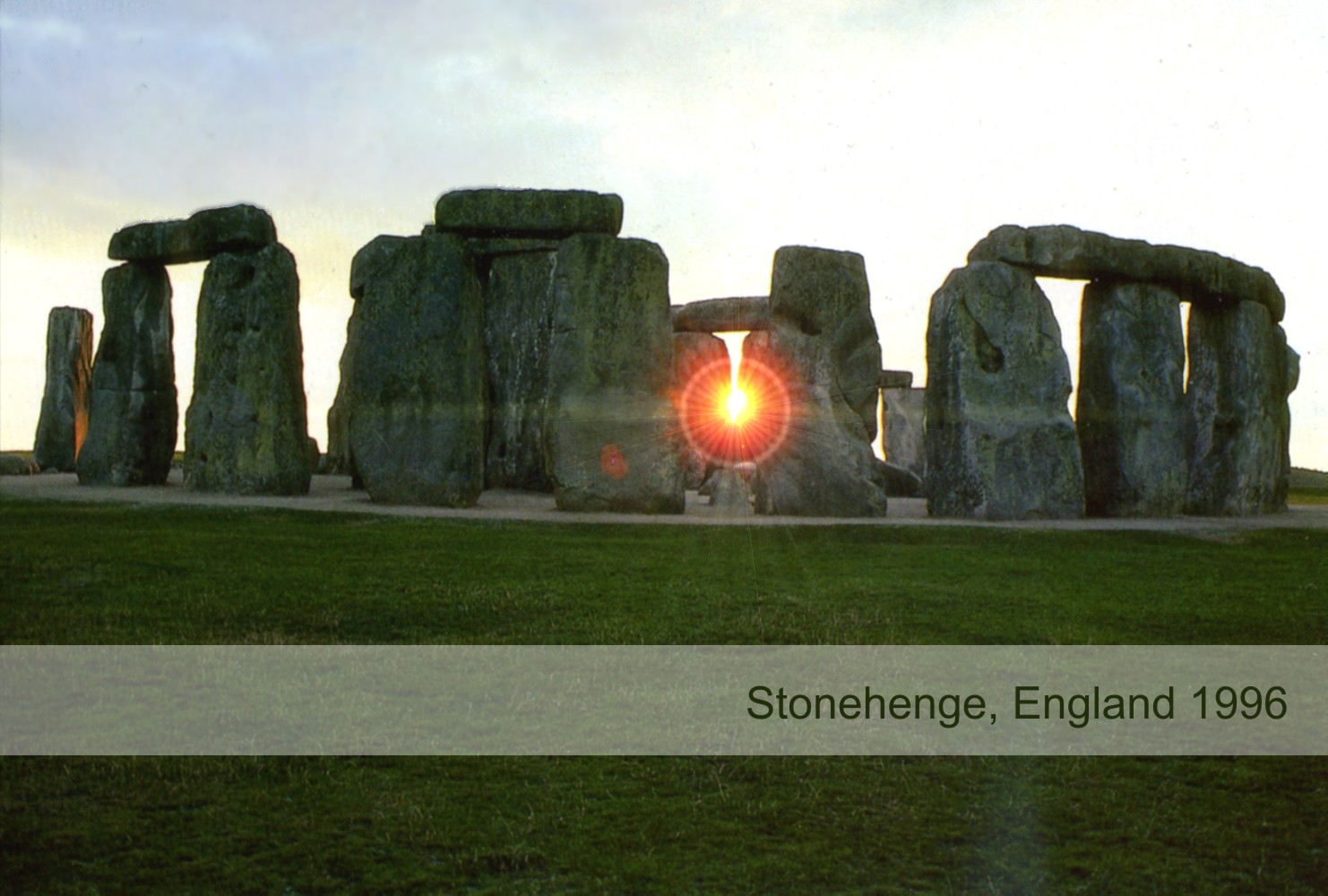 My foray into one of the more important sacred places in Europe took place after some exploration of the powerful spaces of the Grand Canyon and the ruins left behind by its indigenous peoples. A vast monumental effort, clearly tied to the visions of the skies and stars, is standing on the plain of Salisbury in England. A short history of the development of Stonehenge as we know it is here.


 Posts