Tuesday, May 31, 2022

Deep Adaptation


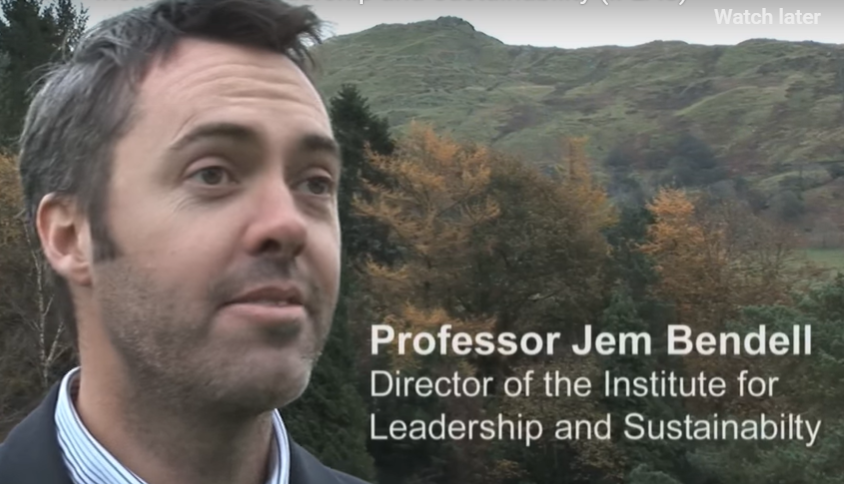
Jem Bendell is a British professor of sustainability leadership and founder of the Institute for Leadership and Sustainability (IFLAS) at the University of Cumbria. In 2018, a climate paper by Professor Bendell went viral, being downloaded over a million times. It helped to launch a worldwide movement of people seeking to reduce harm in the face of societal disruption and collapse. Jem explains the concept of Deep Adaptation, how he developed the idea, what it means in practice, what he says to critics, and what his new book on the topic is about.

A published rebuttal to Bendell's original paper, from Jeremy Lent, disputes that collapse is inevitable and that other scenarios should be considered. Bendell's subsequent reply to Jeremy Lent emphasizes that the scale of the necessary changes are more than we can manage:"The wider destruction of the biosphere is itself a horror, is exacerbated by rapid climate change and drives species extinctions. The term “climate breakdown” has become popular in activist rhetoric but is not clear. A climate does not really “breakdown” – it changes. Sometimes it changes so fast that it leads to a breakdown in ecosystems. By which I mean a complex living system such as a forest, wetland, or hillside, shifts from one state to another, with a major change in the wildlife as well as nutrient and water cycling. To say rapid climate change “is merely a symptom of a larger crisis” misrepresents the specific existential threat involved."

Two years after the original 2018 Deep Adaptation paper was released, an updated version is now available, Revised 2nd Edition Released July 27th 2020:

"The approach of the paper is to analyse recent studies on climate change and its implications for our ecosystems, economies and societies, as provided by academic journals and publications direct from research institutes.That synthesis leads to my conclusion there will be a near-term collapse in society with serious ramifications for the lives of readers. The paper does not prove the inevitability of such collapse, which would involve further discussion of social, economic, political and cultural factors, but it proves that such a topic is of urgent importance. The paper reviews some of the reasons why collapse-denial may exist, in particular, in the professions of sustainability research and practice, therefore leading to these arguments having been absent from these reviews."

"It is a truism that we do not know what the future will be. But we can see trends. We do not know if the power of human ingenuity will help sufficiently to change the environmental trajectory we are on. Unfortunately, the recent years of innovation, investment and patenting indicate how human ingenuity has increasingly been channelled into consumerism and financial engineering. We might pray for time. But the evidence before us suggests that we are set for disruptive and probably uncontrollable levels of climate change, bringing starvation, destruction, migration, disease and war (Servigne and Stevens, 2020)."

The Deep Adaptation Forum is here.


Update 8/5/22: Don’t be a climate user – an essay on climate science communication

Saturday, April 30, 2022

Horror Show


UN Secretary General Antonio Guterres has announced a new flagship UN report on climate change, indicating that harmful carbon emissions from 2010-2019 have never been higher in human history. This is proof that the world is on a “fast track” to disaster, António Guterres has warned, with scientists arguing that it’s ‘now or never’ to limit global warming to 1.5 degrees.

His latest statement opens with:

"We are on a pathway to global warming of more than double the 1.5-degree limit agreed in Paris.
Some government and business leaders are saying one thing – but doing another.
Simply put, they are lying.
And the results will be catastrophic.
This is a climate emergency." 

In an op-ed article penned for the Washington Post, Mr. Guterres described the latest IPCC report as "a litany of broken climate promises", which revealed a "yawning gap between climate pledges, and reality." This is a major wakeup call for the governments of the world, which need to begin immediate actions on carbon emissions because many current carbon sources are not accounted for. The collective pledges so far would mean a 14 percent increase in emissions.

This plea to the world sets the stage for more urgency of action on carbon emissions, and a political imperative to look at the issue of how all countries of the globe must make drastic reductions in fossil fuel use. There are also questions as to whether the analysis of carbon emissions is accurate, because many of the revised scenarios are projecting more emissions when the models are analyzed, using more data and accounting for a more complete synthesis of elements not previously considered. We are beginning to see that we have actually surpassed the carbon budgets already, and it will bring about massive destructive events in the ecosystem in the coming years. The veil has been lifted, and we must now deal with those realities. "First and foremost, we must triple the speed of the shift to renewable energy. That means moving investments and subsidies from fossil fuels to renewables, now." 

Update 8/5/22: António Guterres is backing windfall taxes on “immoral” oil

Thursday, March 31, 2022

Pandora


First it was the Panama Papers. Then we saw the Paradise Papers leak in 2017. Now we have a massive leak, the Pandora Papers, revealing the secret assets of some of the world's most powerful figures. The so-called Pandora Papers consist of millions of leaked financial documents that were reviewed and analyzed for two years by more than a hundred news outlets, including The Washington Post and the BBC, that are part of the International Consortium of Investigative Journalists (ICIJ).

"In terms of raw size, the Pandora Papers leak, at 2.94 terabytes, is bigger than both Panama Papers (2.6 terabytes) and Paradise Papers (1.4 terabytes). If you go by the number of files, the Paradise Papers had more — 13.4 million files, compared to Pandora’s 11.9 million.

But there’s more to this leak than just size. The scope of Pandora Papers is far broader than anything ICIJ and its partners have seen before. The leak comes from 14 different offshore service providers and  includes far more beneficial ownership information and politicians and public officials than any previous leak."

This latest trove of data provides a takeaway revealing these secret tax havens in the United States, no longer just "Offshore". South Dakota was spotlighted in the investigation as a leading offshore tax haven that’s been used by current and former world leaders over the years.There were 81 trusts uncovered in South Dakota in the sweeping investigation as well 37 in Florida, 35 in Delaware, 24 in Texas and 14 in Nevada.

The ICIJ reported that state legislation in South Dakota over the years has helped allow for more more secretive investments.Lauren Kohr, senior director of anti-money laundering, Americas, at the Association of Certified Anti-Money Laundering Specialists, said South Dakota, Nevada, Delaware, Arkansas and Wyoming have a reputation as “onshore-offshore states.”

“The Pandora Papers provide details about tens of millions of dollars moved from offshore havens in the Caribbean and Europe into South Dakota,” the ICIJ said.The probe found that the family of Carlos Morales Troncoso, the former vice president of the Dominican Republic, began tucking away its assets in trusts in the Midwest state in 2019.

The family of Ecuador’s newly elected president, Guillermo Lasso, also shifted two offshore companies from Panama to trusts in South Dakota in 2017 after lawmakers passed legislation in Ecuador that made it illegal for public officials to use tax havens for shielding their assets. Lasso told the ICIJ that his previous offshore financial activity was been “legal and legitimate.”

Why is this relevant to the accelerating impact of climate change?  The impact of this corruption, legal and extralegal, is to undermine the living systems of this planet by the ownership of the vast majority of its resources by the global one percent of wealthy individuals. It's the vision of unlimited growth that drains the resources from people and the planet with expanding extractive, manufacturing and distribution activities. The scale of this situation is just absolutely monstrous, and is a lethal threat to the entire biosphere.


Monday, February 28, 2022

Code Red


Code Red means that we have an extreme climate emergency all over the planet. This has now been verified with science inputs comprising the latest UN report on the state of climate change and its impacts.

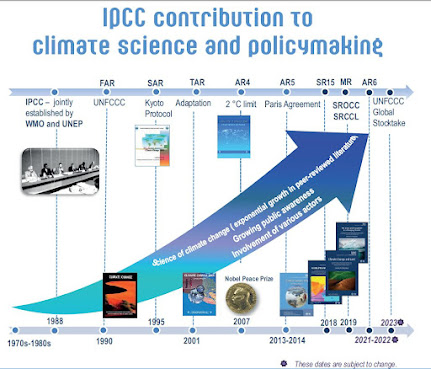
The Intergovernmental Panel on Climate Change (IPCC) is the UN body for assessing the science related to climate change. It was set up in 1988 by the World Meteorological Organization and United Nations Environment Programme to provide policymakers with regular assessments of the scientific basis of climate change, its impacts and future risks, and options for adaptation and mitigation.

The IPCC does not conduct its own research. It identifies where there is agreement in the scientific community, where there are differences of opinion and where further research is needed. It is a partnership between scientists and policymakers and it is this that makes its work a credible source of information for policymakers. IPCC assessments are produced according to procedures that ensure integrity, in line with the IPCC’s overarching principles of objectivity, openness and transparency. IPCC reports are policy-relevant, but not policy-prescriptive.

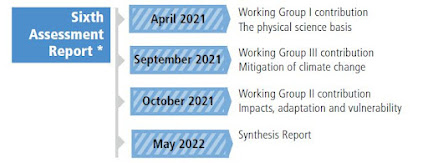
The Sixth Assessment is now released, and the UN calls the IPCC issues ‘bleakest warning yet’ on the impacts of climate breakdown. It's Code Red for human driven global heating, warns the UN chief. The New Climate Change Report has come out with far more detail than previously laid out, because there's no avoiding the obvious current disintegration of the climate and our environment. It's ultimately the problem identification that we require to take immediate action to mitigate the most drastic impacts of our degraded planet.


The Guardian, a UK news site, has issued many articles on the alarming trends that are now being documented. Their summary of the IPCC climate change report and its significance is comprehensive, as well as bleak when it comes to the sheer urgency of addressing the massive build up of carbon in our ecosystem. The report noted that each additional fraction of warming had serious implications for life on Earth. The report laid out 127 of these threats, including the growing loss of usable farmland and increasing drought, which will threaten the global food supply, rising sea levels and floods, which are already driving tens of thousand of people from their homes, growing numbers of punishing deadly heat waves, and increasing extinction of plant and animal species.

The world faces unavoidable multiple climate hazards over the next two decades with global warming of 1.5°C (2.7°F). Even temporarily exceeding this warming level will result in additional severe impacts, some of which will be irreversible. Risks for society will increase, including to infrastructure and low-lying coastal settlements. This report has highlighted the extreme urgency with which fossil fuel must be brought to zero emissions; the current deadline is dated approximately by 2030 to preserve the natural world and its processes. 

It doesn't appear at this time that humans can make the 1.5C limit due to the disinformation propagated by the fossil fuel industry that has fatally slowed down human climate action.


Update 4/2/22: It’s now or never, if we want to limit global warming to 1.5°C

Update 4/4/22:  Earth hurtling toward a dangerous temperature limit, major climate report warns

Update 4/5/22: Climate Code Red


Monday, January 31, 2022

Herman Daly


Herman Daly was a Senior Economist in the Environment Department of the World Bank, where he helped to develop policy guidelines related to sustainable development. While there, he was engaged in environmental operations work in Latin America. He is closely associated with theories of a steady-state economy. He was a co-founder and associate editor of the journal, Ecological Economics.In 1989 Daly and John B. Cobb developed the Index of Sustainable Economic Welfare (ISEW), which they proposed as a more valid measure of socio-economic progress than gross domestic product.

The "Mobilization of the Human Family" symposium set up by John Cobb explored a land tax in early 2001 for a discussion a different form of taxation. The intent was to create a white paper for a system of taxes that would balance the needs of the common good with a fair tax system, and new taxes on pollution and depletion of resources. This was triggered by the regressive taxation policies of the Bush administration that began to grow the divide between the wealthy and the middle class. Discussion of this issue was moving apace, until the land value tax existing in Pittsburgh at that time was repealed in the spring. John has since moved on with larger visions of a theology of ecology and the writings of Alfred North Whitehead and Charles Hartshorne. His many books, articles and symposiums framing "new economics" have also been included in the series, "An Introduction to Ecological Economics".

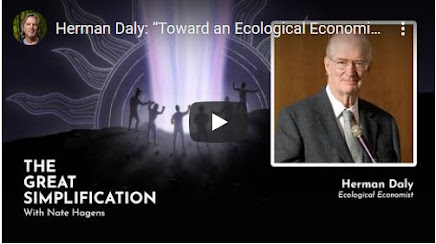
Daly and Cobb co-published a book, "For the Common Good", which talks about redirecting the economy towards community and the environment. Currently, Daly's podcast, The Great Simplification, outlines a way to reform our economic systems to become integrated with the way natural systems work, to formulate a cooperative economic system that works with the energy flows in nature. In what he calls super organism economics, he proposes reforming national accounts. Separate GDP into a cost account and a benefits account so that throughput growth can be stopped when the marginal costs and the marginal benefits get out of sync.

Earlier articles that I've posted about the need to revise the GDP metric, or replace it, are "The GDP Chimera"  (2012) and subsequently, "Gross Domestic Product"  (2014). Scientific American has recently published "GDP Is the Wrong Tool for Measuring What Matters". It’s time to replace gross domestic product with real metrics of well-being and sustainability.

The development of the value assigned to natural systems has been evolving for a long time, with the current thinking laid out in books, two of which are "Value of the Earth" and "Valuing the Earth: Economics, Ecology, Ethic".


Update 7/30/22: Back in 2019, in his book “Growth,” Smil called on the world to abandon growth to ensure the habitability of the biosphere

Update 8/2/22:  Herman Daly says GDP metric isn't sustainable

Update 8/3/22:  Economics in a Full World by Herman Daly


Saturday, December 18, 2021

A Thirteenth Year - We Dig In


The decade-long drought that impacted water supplies and fueled massive forest fires is still with us, although we've been seeing the rain again, a positive development for water storage in our parched land. Our forests have gone up in flames all summer, and the local urban forests and wildlands are dangerously dry. This has made climate change an urgent priority, and our state government in Sacramento is trying to push ahead with progressive policies that will mitigate carbon emissions by 2050. Even though we know that's not even half of what we'll ultimately have to do.

Our state policies have been informed by the UNFCCC COP deliberations, via former Governor Brown and now Governor Newsom. The architecture profession is moving ahead with educating its members and providing resources to bring emissions down from the construction sector.

CarbonPositive: Architecture’s Critical Role at COP26 - a formulation of strategy for the profession."COP is three parallel events. Of course, there are intergovernmental negotiations taking place in areas inaccessible to the public. Next, is the Blue Zone open to UN accredited delegations. Architecture 2030 is admitted as an “observer” organization with access to the Blue Zone. Finally, the Green Zone is open to the public. The Venn diagram of these three events has some overlap, but not much."

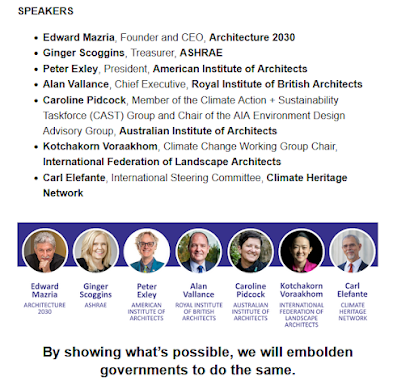
65% by 2030 / ZERO by 2040: Top 200 Global Firms and Organizations Lead With 1.5°C Climate Actions. By showing what's possible, we’ll embolden governments to do the same. The top 200 firms responsible for a significant portion of construction worldwide will present the bold actions they are taking to decarbonize the built world in order to meet the Paris Agreement’s 1.5°C carbon budget. It's one of the best discussions about the urgency of climate action presented to the public.

Carl Elefante FAIA, FAPT LEED AP a representative of the AIA at COP26, provides a summary of their dialogue over 10 days. "After a lifetime practicing architecture, I am hardwired to look for opportunities. Carbon-budgeting building projects and WLCA present many." His new podcast series from the IHBC raises awareness and understanding of how conservation philosophy and practice contributes towards meeting the challenge of climate change.


Thursday, November 25, 2021

Contradiction at COP26


Advent is a time of reflection, remorse, and the preparation to move into a necessary future. As our world increasingly faces extreme climate events, we've got to cut emissions drastically within the next few years in order to keep from experiencing the worst impacts of our continuing carbon emissions. 

The biggest disappointment people have after COP26 in Glasgow is that it kept the world on track to blow past 1.5 and possibly even two degrees Celsius of warming, which is not what the Paris Agreement calls for. Given that we are now experiencing environmental collapse at 1C, the future appears dire, and demands increasingly strong countermeasures of resilience. These measures have been published by Ed Mazria FAIA, forty years ago, and was the beginning of the effort to bring the strategies to the construction industry. He has worked with the American Institute of Architecture to move the industry into the forefront of policies and recommendations necessary to forestall the impacts of climate change.

David Attenborough's opening speech at COP26 Glasgow was a clear challenge to the COP26 participants and delegates. He poignantly describes the unraveling processes that are causing destructive climate change. At a 60 minutes interview with Attenborough in 2020, he states: "Our generation has failed. We've allowed climate change to happen".

The UNFCCC provides a review of the processes at COP26 on their website. "A top priority for the UK Presidency and many countries was to finalise the ‘Paris Rulebook’ to fully operationalise the Paris Agreement. The Paris Rulebook sets out the detailed rules and systems to underpin delivery of the Paris Agreement, many of which were agreed at COP24in Poland. However, there were several issues where Parties held such strongly held different views that they had been unable to agree on these at previous COPs."

The Sierra Club has published "Prove Us Wrong": A Roundup of Some of the Best Speeches at COP26.

The Los Angeles Times presented a different view in their editorial. "The Glasgow climate summit brought only incremental progress." The London Greenleft was far more pessimistic about the summit on their blog:

"We saw an insurmountable contradiction and a source of chaos when China and the United States issued a joint statement at the COP. It will be of no use in breaking the deadlock. It is mainly a statement for the sake of appearances. The two great powers have an interest in posing together as the guarantors of the world’s stability and its climate. Perhaps they will try to collaborate on a partial aspect of climate policy (methane emissions?). But the underlying tensions are very strong and tend to deepen the conflicts. In the US, the Democratic majority is hanging by a thread with senior US Senator Joe Manchin (D) being the loyal friend of coal."

"The failure at Glasgow and what needs to happen next", by Peter Kalmus. Peter is a climate scientist at NASA's JPL in Pasadena and the author of “Being the Change: Live Well and Spark a Climate Revolution.” And this from Greenpeace -“Scientists have found that governments’ current action plans would cause global temperatures to increase to 2.4 C, which would bring absolute devastation to hundreds of millions of people and ecosystems around the world,” Jennifer Morgan, the executive director of Greenpeace International, said in an interview at COP26. “So waiting five years to come back to the table is not an option.”

Climate activist Vanessa Nakate of Uganda had this to say near the end of the sessions: "One of the deepest disappointments for the climate-justice movement was the almost total failure to deal with fossil fuels. Negotiators had flirted with confronting the fossil fuel industry head-on — a key issue previous COPs had dodged — only to back off at the last minute. Whereas an early draft had straightforwardly called for a phaseout of coal power and fuel subsidies, the final version suggested only a phasedown of “unabated coal power and inefficient fossil fuel subsidies,” draining the statement of any meaning.

The many voices did not come to a resolution, but the hope is that next year's COP27 will develop some definitive positions.