Friday, August 10, 2018

What's the problem?


Climate change is rapidly accelerating around the globe, with unprecedented warming that is creating the conditions for enormous arctic methane releases that will intensify the problem beyond our ability to mitigate the impact or make up for the lack of food and water that this will create for the nearly eight billion people on this planet. Settled science shows that this rapid change is an amplification of natural variability due to the carbon emissions since the industrial revolution - when the energy technologies became the basis of human expansion, resulting in an exponential increase of the global exchange basis in petrodollars as a gauge of wealth. In summary, three graphs show the problem clearly (click to enlarge).

In the first one, a temperature vs. atmospheric concentration of GHG's chart: At the end of the last Ice Age, the level of carbon dioxide in the atmosphere soared. As the CO2 level rose, so did the temperature. Many graphs are available on the internet, here's a video animation.

The next chart is from James Hansen: the principal follow-ups to the 1992 Rio were the 2008 Kyoto Protocol and the 2015 Paris Agreement — wishful thinking, hoping that countries will make plans to reduce emissions and carry them out. In reality, most countries follow their self-interest, and global carbon emissions continue to climb.

Aubrey Meyer shows in his graph the fundamental correlation of human activity and GHG emissions: "If the problem is the exponential growth of anything, which one of these (if any) is exponential . . . Population Pollution 'Pecunification' (GDP) and therefore is the 'problem". It's pretty clear that the driving factor in emissions is the technology that ramps up carbon emissions and is driven by the GDP expansion as humans chase wealth. This is also why corporate opposition to solving this problem is so acute, despite the rapidly increasing global climate damages that result from it. So population increase is not the driving factor for carbon emissions, but rather represents the increasing impact of environmental degradation from expanding human habitation and energy demand. Our carbon absorption sinks are diminishing very quickly.

Just recently, Naomi Klein talked about underlying systemic distortions like GDP in her article about a major New York Times publication that has outlined the problem we're facing: Capitalism Killed Our Climate Momentum, Not “Human Nature”.

"When I surveyed the climate news from this period, it really did seem like a profound shift was within grasp — and then, tragically, it all slipped away, with the U.S. walking out of international negotiations and the rest of the world settling for nonbinding agreements that relied on dodgy “market mechanisms” like carbon trading and offsets. So it really is worth asking, as Rich does: What the hell happened? What interrupted the urgency and determination that was emanating from all these elite establishments simultaneously by the end of the ’80s?

"I wrote a 500-page book about this collision between capitalism and the planet, and I won’t rehash the details here. This extract, however, goes into the subject in some depth, and I’ll quote a short passage here:

    We have not done the things that are necessary to lower emissions because those things fundamentally conflict with deregulated capitalism, the reigning ideology for the entire period we have been struggling to find a way out of this crisis. We are stuck because the actions that would give us the best chance of averting catastrophe — and would benefit the vast majority — are extremely threatening to an elite minority that has a stranglehold over our economy, our political process, and most of our major media outlets."

And she concludes with:
"We aren’t losing earth — but the earth is getting so hot so fast that it is on a trajectory to lose a great many of us. In the nick of time, a new political path to safety is presenting itself. This is no moment to bemoan our lost decades. It’s the moment to get the hell on that path."

So what's happening as a means to deal with this? Global collaboration on climate change issues are arising through groups such as LEAP, cofounded by Naomi Klein, City By City created by The Climate Mobilization and larger international groups created by 40Cities, ICLEI, the Global Covenant of Mayors for Climate and Energy, and many others. This struggle is built from the bottom up, mobilizing all the people, involving everybody in actions that fight for mitigation, adaptation and sustainable development, with goals to end poverty and hunger; reduce inequalities; ensure health,education; sustainable energy; water and work for all; and foster sustainable cities. Bill McKibben summarizes some of these efforts in his recent article, pointing to grassroots climate action.

So, goodbye to corporate capitalism and sold-out governments. It's our turn now.


Update 1/17/19: Can there be Sustainability in an Economy Rooted in Growth?


Saturday, June 30, 2018

Follow the Money


Grantham Institute: Policies to finance energy efficiency in Europe


The Grantham Institute, part of the London School of Economics and Political Science (LSE), has taken leadership on climate investments since 2008, in a bid to change the economic system that is responsible for the degradation of the planet's ecology and living systems that give life to everything that exists on this earth. LSE's centre for policy-relevant research & training in climate change & the environment is chaired by Lord Nicholas Stern.

Since 2013, the man who made billions by predicting every recent financial crisis has spoken out on climate change. Jeremy Grantham, the environmental philanthropist who is part of the leadership of this group, emphasizes "We're trying to buy time for the world to wake up".  "Capitalism is killing the planet and needs to change. Capitalism and mainstream economics simply cannot deal with these problems. Mainstream economics largely ignore [them]," Grantham says."We deforest the land, we degrade our soils, we pollute and overuse our water and we treat air like an open sewer, and we do it all off the balance sheet," he adds.

They are developing investment tools to assist investors in directing their funds towards ecologically sustainable sectors. Their Transition Pathway Initiative provides an interactive tool that enables the assessment of companies’ carbon management quality and carbon performance, within a selected sector. They also have a research database on Climate legislation for countries, regions and territories. Their most recent public lecture of April 2018, notes that very few investors realise how rapidly the environment is being wounded, not just by climate change but also by overuse and by chemical waste:

"We may have created a world that is simply hostile to most living creatures including us. Contrastingly, very few realise how favourably and dramatically fast the relevant science is progressing and the cost of necessary technologies declining.  These opposite forces will determine whether we can even retain a world with as stable a global society as we have today, a modest definition of success.  The results will certainly transform the entire world of energy, resources and food in a few decades with unprecedented financial consequences." says Grantham.

Other investment managers have also developed policies around climate change and global emissions, primarily in Europe and based in London. They are seeing the path forward in carbon reduction and energy efficiency as the only constructive way for financial investment to be viable. Not only that, some of these companies are targeting the lack of corporate response to these critical issues. Legal & General Investment Management (LGIM), for example, names corporate climate leaders and laggards, and specifically targets climate change laggards with shaming and disinvestment. Of course, that may be like trying to shame Trump.

Louise Dudley, Portfolio Manager for Hermes Global Equities speaks out on a climate for change: matching awareness with action:

"In 2015, Bank of England Governor and Chairman of the Financial Stability Board (FSB) Mark Carney labelled climate change “the tragedy of horizon”. That is, the catastrophic impacts of climate change will be felt beyond the traditional horizons of most actors, imposing a cost on future generations that the current one has no direct incentive to fix. In his capacity as FSB Chairman, he also established the Task Force on Climate-related Financial Disclosures (TCFD) to give investors information to identify companies most at risk and best prepared for climate change.

It is therefore important for investors to understand climate-related financial risk. It can broadly be divided into two major categories – carbon risk, which is related to the transition to a low-carbon economy, and climate impact risk, which is related to the physical impacts of climate change."

In another example, the aim of the Institutional Investors Group on Climate Change (IIGCC)'s Climate Solutions program is to help investors identify, and to the extent possible, quantify the strategic implications of policy measures and physical risks to long-term investments with a view to inform communication with other stakeholders.

It's time to leave behind the old postwar metrics of economic measure and adjust to the realities of those destructive things left off the balance sheet of global investments. The GDP chimera is a measure that has led to massive global destruction and economic inequality in every country. There is no time left now for failure to act.

Update 7/3/18: Climate financing by the world’s six largest Multilateral Development Banks (MDBs) rose 28 per cent on the previous year.

Update 10/22/18: Materialism - a system that eats us from the inside out.


Thursday, May 24, 2018

Growing Up


From Grist magazine in Nov. 2014: We now know, with a pretty high degree of confidence, that we could tackle climate change if wanted to. All that remains is to decide if we want to.

The good news: There is no substantial technical or economic barrier that would prevent the U.S. from reducing its greenhouse gas emissions 80 percent below 1990 levels by 2050, a target that would help put the world on track to limit global average temperature rise to 2 degrees Celsius. In fact, there are multiple pathways to that target, each involving a different mix of technologies. Achieving the goal would cost only around 1 percent of GDP a year out through 2050, and if we started now, we could allow infrastructure to turn over at its natural rate, avoiding stranded assets.

The bad news: Pulling it off would require immediate, intelligent, coordinated, vigorously executed policies that sustain themselves over decades.

A summary of strategies for implementation is listed here.

Another easily digested set of strategies are outlined in the Drawdown website that accompanies the companion published textbook. It's a New York Times bestseller.  More detail about the necessary steps are clearly outlined here, a result of Paul Hawken's environmental activism and implementation, released in April 2016.

Unlike most popular books on climate change, it is not a polemic or a collection of anecdotes and exhortations. In fact, with the exception of a few thoughtful essays scattered throughout, it’s basically a reference book: a list of solutions, ranked by potential carbon impact, each with cost estimates and a short description. A set of scenarios show the cumulative potential.

We're seemingly unable to let go of the glittery fossil fuel baubles, and as Grandpa put it: the only person that likes change is a baby with a wet diaper.

But it's not all that difficult. So simple, a child could do it. But we all can't seem to play together in the sandbox, so we march off into oblivion over a few shiny toys.

Update 6/5/18: Climate Change - Why we are heading for extinction and what to do about it.

Update 6/12/18: James Hansen debunks the carbon capture get-out-of-jail-free card

Update 6/13/18: Future Climate - Engineering Solutions, a global alliance of professional engineering associations

Update 6/27/18: Using aerial imagery to measure climate impacts of selective logging

Update 6/29/18:  Back of the Napkin, easy carbon reduction framework

Update 9/21/18:  Zero Carbon Britain toolbox on the other side of the pond.

Update 10/13/18: We are the adults in this room. We have to save ourselves.


Saturday, May 5, 2018

Externalities


National governments and subregional agencies are beginning to coalesce around strategies to actually implement the necessary steps towards substantially reducing fossil fuel use as an energy source. They are taking these steps, moving from Paris (COP22) in 2016, to Bonn (COP23) in fall of 2017, and then onto Katowice, Poland (COP24). The recognition that fossil fuels have hidden costs in their production - externalities - is driving more comprehensive agreements between governements and industries. This is being done even with the knowledge that the adopted carbon goals are falling short of the necessary reductions to keep temperatures within the limits that have been agreed to as the carbon emissions reduction targets. The UN and climate scientists have been adamant about the excess emissions that are still being allowed by the adopted targets.

Thousands of government representatives, non-Party stakeholders, members of the press and staff of multilateral organizations are now gathering for the 2018 United Nations Climate Change Conference from 30 April to 10 May in Bonn, Germany. The Talanoa Dialogue, launched at the UN Climate Change Conference in Bonn (COP23) last November, invites everyone to engage in finding a solution, first by preparing submissions in response to three questions: Where are we? Where do we want to go? How do we get there? A May 2, 2018 briefing at the global climate action summit in Bonn addressed the participants, showcasing how the real world economy is mobilizing to spur bolder action ahead of the UN Climate Change Conference in Katowice, Poland (COP24) in December 2018.

During this year, governments are charting the road map in Germany's UN Climate Summit for achieving the commitments laid out in the Paris Agreement. The decisions they make will either unlock a sustainable and just future, or they will give Big Polluters free rein to keep polluting and interfering in climate policy. This is a result of the December 2017 meeting of the U.N. climate treaty, when governments agreed to finalize the pathways that will make the Paris Agreement a reality. This agreement came about in spite of the corporate efforts from fossil fuel companies and corporate sponsors that had also descended on Bonn, (COP23) where they were pushing their own agenda behind the scenes, as was reported by Democracy Now! at last years' Climate Change Conference with an interview of "Corporate Accountability" ally Pascoe Sabido (Corporate Europe Observatory, co-author of “Polluting Paris”) and Corporate Accountability Media Director Jesse Bragg. They were interviewed by Amy Goodman.  The interview centered on Corporate Accountability’s most recent report, “Polluting Paris,” the fossil fuel industry’s interference in both EU and U.S. climate policy, and Big Polluters’ fingerprints on this year’s climate talks.

An interview with Patricia Espinosa, Executive Secretary of the UNFCCC by Ryan Heath of Politico in December 2017 lays out the growing sense of urgency around the rapid implementation of emissions reductions. She discusses the way she intends to outreach to governments, businesses and other global stakeholders. In the interim, prior to COP24, a Global Climate Action Summit hosted by Governor Jerry Brown and Patricia Espinoza, will take place on September 12-14, 2018 in San Francisco. State and local leaders, businesses, investors, scientists, students, nonprofits and others (“subnational actors”) are a critical part of the climate solution and can help push the world’s leaders to go further, faster.

Some trade and energy agreements are currently being put into play that reflect the need for substantive emissions reductions.In the Clean Energy Package announcement in Brussels on November of 2017, the European Union will start to phase out coal subsidies and reduce its energy usage by 30% before 2030 pursuant to the terms of a major clean energy package. It has come under criticism from Greenpeace for its shortcomings since it allows money to be spent on further coal power supplies.

New research now urges a rethink on global energy subsidies, particularly pointing at fossil fuels. Environmentally, energy subsidies tend to have "substantial carbon footprints" because they tend to favor fossil fuels, such as coal and petroleum. As subsidies lower the price of electricity and fuel, they generally lead to higher levels of consumption. They also generally diminish efforts to promote energy efficiency or to conserve energy. Clearly, it would be a major move to eliminate these global energy subsidies, but it would allow governments to put their money towards clean technologies and energy sources that would rapidly reduce the carbon emissions that are wreaking havoc on our planet.

May 2018: Carbon Debitor Excess and Creditor Shortfall

May 2018: All Country List of CO2 emissions in a credit/debit format with share of global budget

Update May 7, 2018: Revolving Door between corporate and public sector for lobbyists

Update May 11, 2018: China wishes to renegotiate & forces U.N. to provide a new draft for COP24

Update May 12, 2018: Arctic sea ice low as UN delegates talk climate in a sweltering Bonn.

Update May 31, 2018: IMF tallies up fossil fuel subsidies at $1.9 trillion a year. That’s 2.5 percent of global GDP!

Update June 1, 2018:  Corporate conflicts of interest eclipse key climate negotiations in Bonn.

Update June 12, 2018: Benefits of curbing climate change far outweigh costs


Monday, March 26, 2018

The Measure of It


NASA's space and earth science exploration is based here in Pasadena, CA at the Jet Propulsion Laboratory's facility, which is administered by Caltech. They've launched a satellite in July 2014, Orbiting Carbon Observatory-2, or OCO-2. Scientists are studying how carbon moves through Earth’s atmosphere, land and ocean with an array of tools, including a new dataset of the ebbs and flows of carbon in the air. These datasets are run through massive computer models run by NASA, which examines the data and produces visual graphics that show the dynamics that are measured by the instrumentation. One result is the yearly cycle of the earth's biosphere which is the graphic animation above.

"If it weren’t for satellites, we would have very little understanding of the biological activity of the entire Earth," said Josh Fisher, a climate scientist at JPL. "We know from our field studies about how different ecosystems [vary], but we don’t know how robust or representative our studies are at the global scale."

The Landsat missions and the Moderate Resolution Imaging Spectroradiometer (MODIS) instruments on the Terra and Aqua spacecraft allow researchers to study the greenness of vegetation as a proxy for photosynthesis, and therefore carbon dioxide uptake, across the globe. Scientists are also using OCO-2 to take a big-picture look at these small-scale processes, capturing the faint fluorescence given off by terrestrial plants during photosynthesis, Eldering said. With fluorescence, scientists have a new way to observe how active – or not – these green ecosystems are.
Further visual analyses of the CO2 cycle are available from NASA in their press release, which shows the new model of carbon behavior in our atmosphere from Sept. 1, 2014, to Aug. 31, 2015. Such models can be used to better understand and predict where carbon dioxide concentrations could be especially high or low.

NASA is currently developing the Orbiting Carbon Observatory 3 , or OCO-3, which hopefully will be launched in May of this year and will host the instrument on the International Space Station (ISS) for location on the Japanese Experiment Module Exposed Facility (JEM-EF). Just recently, funding was included in the proposed Federal budget to keep these programs on track, with flat funding for the earth sciences. Lawmakers backed projects that scientists had named as high priorities, but that President Donald Trump’s administration had marked to terminate in 2018. These include four climate-oriented earth science missions: the Plankton, Aerosol, Cloud, ocean Ecosystem satellite; the Orbiting Carbon Observatory 3; the Climate Absolute Radiance and Refractivity Observatory Pathfinder; and an Earth-facing camera on the Deep Space Climate Observatory.

Update 5/12/18:  OCO-2’s specialized orbiting camera offers the scientific community a powerful new tool.

Update 5/13/18: Trump cancels CMS research funding which analyzes CO2 emissions recorded by OCO-3

Update 5/27/18: NASA Snow-Ex program -  an ambitious airborne campaign to test sensors

Update 5/28/18:  NASA’s building new tools to manage water, as climate dangers grow

Update 7/17/18: Satellites are making real improvements in accurately measuring greenhouse gases from space

Update 9/2/18:  NASA: Arctic is warming faster than the globe as a whole


Update 7/21/20: Data from the GRACE Follow On (launched in 2018) allowed researchers to calculate that, on average, these seven regions lost more than 280 billion tons of ice per year.


Sunday, February 25, 2018

Welcome to the Anthropocene


It could be a short epoch.There is no more room for economic growth on this planet, per a conference from  April 29, 2017.  In this presentation at Columbia University's Low Memorial Library, Stuart Scott lays bare the seriousness of climate change, the 'conspiracy of complacency' in which most of society is engaged, and a simple action to shift the paradigm that is leading humanity to the destruction of the global ecology - called Creation by some, called Nature by others - upon which we all depend. Scott emphasizes the realization by economists that the global operating system of our civilization is seriously flawed, and is known by two names: Money and Economics. Per Dr. Herman Daly, former World Bank senior economist, ecology and ethics are not externalities to an economic system. In this presentation, Scott discusses the update to the original book, "Limits to Growth".

In thinking we were ensuring our survival, we have created the conditions for our own destruction, as is now obvious in the actuality of climate change and of unsustainable production and consumption. Elaborated by Pope Francis, in Laudato Si: "Given the insatiable and irresponsible growth produced over many decades, we need also to think of containing growth by setting some reasonable limits and even retracing our steps before it is too late."

Corporate power is now global, and resistance to it cannot be restricted by national boundaries. Corporations have no regard for nation-states. They assert their power to exploit the land and the people everywhere. They play worker off of worker and nation off of nation. They control the political elites in Ottawa as they do in London, Paris and Washington. The Citizens United decision was the ultimate power play in the US, and our judiciary is not independent. Nor is the media. Try to understand the relationship between money laundering, cyber warfare and influence-peddling...disguise sources of money for political action groups that allow Russian influence on targeted US voting districts. These are proven tactics in European democracies as well. Which is why we see the sudden emergence of "conservative" politicians in the Western democracies that are attempting to tear down democratic processes and actively oppose any actions on climate change with authoritarian controls. And corporations are the "Climate Bad Boys"- in the driver's seat.

Each year, the World Economic Forum’s Global Risks Report works with experts and decision-makers across the world to identify and analyse the most pressing risks that we face. The 2018 report from Davos finds that extreme weather events, natural disasters, and failure of climate change mitigation and adaptation are perceived as three of the biggest global risks today. And all of the top risks this year, other than cybersecurity and involuntary migration, are climate or environment related.

To hit the 1.5C optimistic Paris goal, researcher Glenn Peters calculates that—even if emissions flatline now—we’ve used up our quota by 2021. Even if they begin to steeply decline, they’d have to be zero by 2026 for a 66 percent chance of 1.5C of warming. Similar calculations suggest, for a good chance at 2C, we need to be at zero net emissions by 2035. These are not realistic scenarios. Zero carbon emissions by 2026 will only happen if a rogue asteroid wipes out all life on Earth. We are truly up against the wall.

It is worth remembering the results of a government ACD report that leaked in August of 2017. The product of 13 federal agencies, the National Climate Assessment showed that, via their "higher emissions" scenario, the US will experience a stunning 8°F to 10°F warming above where we are now over the interior of the country by 2100.

Update 2/26/18: GDP yardstick is choking us and the planet

Update 2/28/18: A window onto the acquisitive impulses of the jet-posession set, burning resources into the stratosphere

Update 3/3/18: Kevin Anderson: Economics and technology sideline the climate change issues - a failure of honesty (27 min)

Update 3/5/18: Blowback: Humanity Nailed to a Cross of Coal. Exxon knew.

Update 3/9/18: Why economic orthodoxy is a dangerous ideology that is destabilising the planet

Update 3/11/18: Nasa's Goddard Space Flight Center: global industrial civilisation could collapse in coming decades

Saturday, January 20, 2018

Cause and Effect


 The flux of corporeal existence arises from the harmonics of the interactions of everything in the physical world and its energetic structures. The principles of the constructive, anti-entropic processes require that all systems fully account for the energies of mass, motion and light across vast distances that may not actually exist in other dimensions. Living systems operate in this fabric of existence at a scale that reflects the molecular building blocks of DNA strands that emerge as growing organic structures that interact in this system. But a reductionist view is unable to see this.

At its very basic level, "Every action has equal and opposite reaction, acting on two different bodies", which is Isaac Newton's Third Law of Motion in his "Principia Mathematica" of 1686. It describes the physical world very well, and until Einstein came along with his theory of special relativity (1905) along with investigating quantum mechanics, these basic concepts prevailed in the Western world.

This kind of understanding in the conscious, energetic realm is reflected in the Buddhist 12 Laws of Karma, including: "Everything in the universe is connected". This is characteristic of all religions, generally assigning this connection to a higher being or form of consciousness that is fundamental to positive outcomes, such as "the mind of the creator". This takes us beyond the simplistic mechanistic views of our post-industrialist civilization and ironically points us towards the findings of quantum mechanics.

There is a new emphasis on this "unified field" approach to the human responsibilities involved with our habitation in our environment. On Care for Our Common Home (Laudato Si') is the fresh appeal from Pope Francis addressed to "every person living on this planet" for an inclusive dialogue about how we are shaping the future of our planet. Pope Francis calls the Church and the world to acknowledge the urgency of our environmental challenges and to join him in embarking on a new path. He emphasizes that the climate is a common good, belonging to all and meant for all, and not be subject to the destruction driven by capitalism and corporate global commerce. He's in the Peruvian Amazon right now, and has excoriated the “throwaway culture” that wastes lives and despoils the land. “Gold ... can turn into a false god that demands human sacrifices,” the pope said. “False gods, the idols of avarice, money and power, corrupt everything. They corrupt people and institutions, and they ruin the forest.”

From Gary Hall, a former comedy writer and fierce progressive, past Dean of the Washington National Cathedral (Episcopal) - "America's Church" - and now a pastor in Los Angeles: "Our very environment is changing before our eyes. The folly of our human exploitation of nature is finally catching up with us. The climate change we have brought about through our selfish activity turns out to have real consequences for real people and the real world in the here and now."

Among other things, the backlash to environmental destruction is growing, and people of all beliefs across the planet are becoming open to aligning with natural processes and disposing of fossil fuel energy in order to stop burning carbon and quit trashing our planetary ecosystems with plastic refuse.

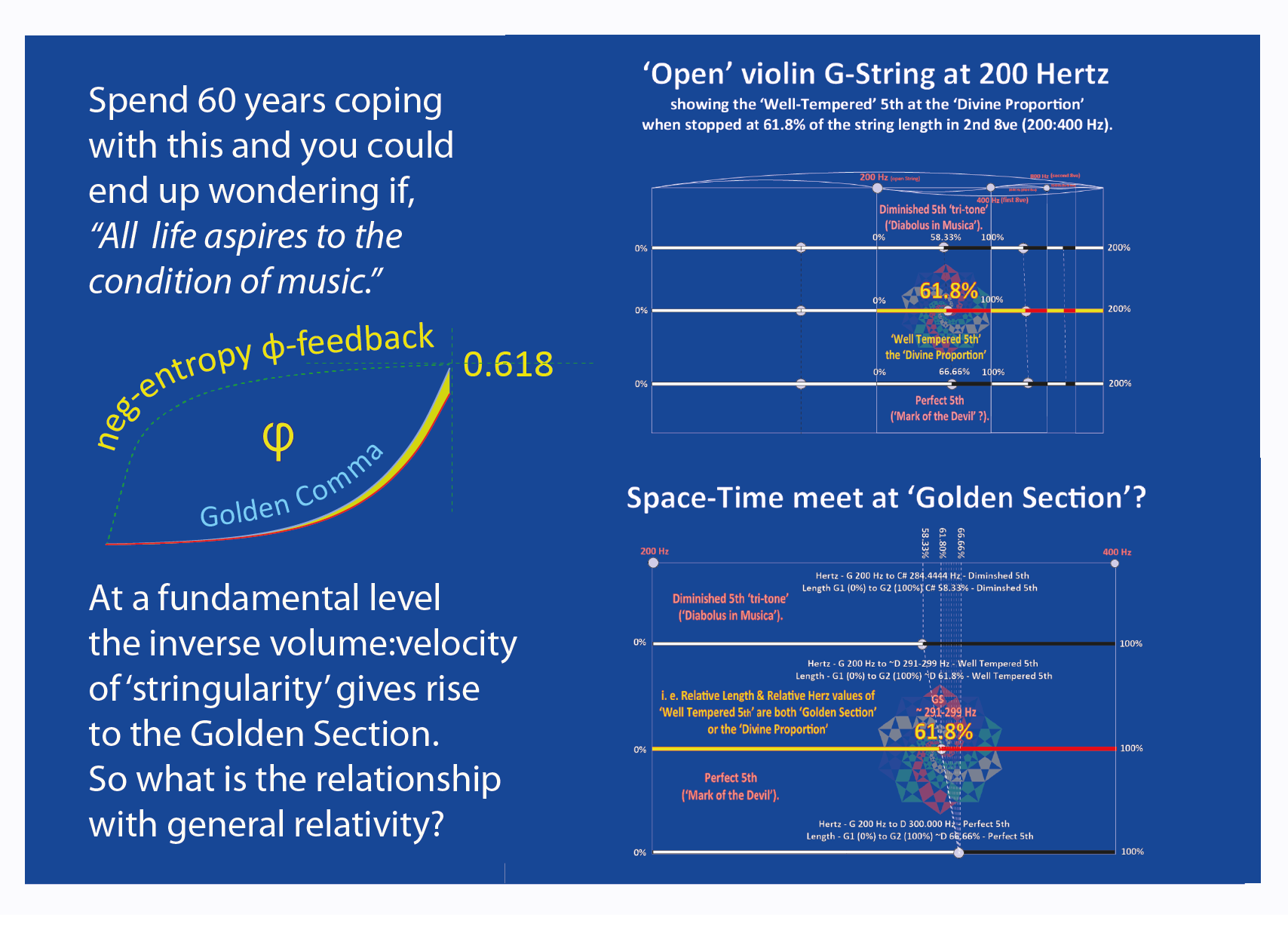
Understanding the necessity for reducing the human impact on nature is widespread now, and its solution is a congruence with organic growth. Aubrey Meyer has discussed this in depth in his developed principles behind the well-tempered framework of Contraction and Convergence. This is a proposed framework for the implementation by the UNFCCC which is grounded in the organic structure of Phi, a fundamental reality of the natural world. Its adoption would be a crucial step in the means by which humanity curtails its destructive characteristics and resonates in tune with sustainable ecology.

Update 1/21/18: That Was Easy: In Just 60 Years, Neoliberal Capitalism Has Nearly Broken Planet Earth

Update 1/22/18: Fossil fuel energy sources are the problem

Update 1/23/18: The unexpected math behind Van Gogh's "Starry Night"

Update 1/25/18:  And so where did it come from? Carl Sagan, in "Cosmos" Episode 10 clip (1980) and Cosmic Calendar: We have a choice. We can enhance life and come to know the universe that made us, or we can squander our 15 billion-year heritage in meaningless self destruction.

Update 2/9/18: Panpsychism: Could the force be with us?

Update 7/7/18:  Pope Francis calls for people power ahead of climate summit in San Francisco on Sept. 12 - 14