Showing posts with label Archeaology. Show all posts

Tuesday, March 6, 2012

Sacred Places

When journeying to places on this earth that establish a powerful sense of meaning and connection to the land, sky and water, one can always observe the intelligence of the structures built there as a response to the place. What we've lost in our modern urban cities and suburbs is a sense of how a place is rooted in its location, how it engages the sun and looks at the sky. Some of these places are sacred sites; some of them have been developed by earlier civilizations as a response to the land and water and also keyed to the constellations and solar and lunar solstices. They are the great mandalas, temples and pyramids that follow celestial patterns and embrace them with cultural meaning and intellectual patterns of response embodied in its form, whether it's the Golden Section of Greece or the mandalas of the far east. The ruins and temples of Peru, Bolivia, Egypt, Greece, Italy, Mexico, and so on are all grounded in an ancient world view that engages the earth with a mystic understanding of its patterns and flows, guided by older yet highly sophisticated observations of the solar and lunar cycles. These structures evolved over hundreds of years, expressing a timeframe that is beyond our comprehension; embedded in generational efforts to construct these massive places is the given culture and expression of mind that is alien to us now.

In Cambodia, Buddhist temples were built between the 9th and the 13th centuries by a succession of 12 Khmer kings. Angkor spreads over 120 square miles in South-East Asia and includes many major architectural sites. In 802, when construction began on Angkor Wat, financed by wealth from rice and trade, Jayavarman II took the throne, initiating an unparalleled period of artistic and architectural achievement, exemplified in the ruins of Angkor, center of the ancient empire. Here Angkor Wat, the world's largest temple, an extraordinarily complex structure filled with iconographic detail and religious symbolism, is sited. It was ultimately abandoned in the 15th century because of internecine rivalries and left to the ravages of time. It does, however, retain its orientation to the stellar axes and markers of the solstices; it's a means of orienting a holy form that serves the continual acknowledgement of deities and the stories of history, most markedly the Mahabharata and the Ramayana. The culture of South India has made its mark here; it's remarkable how the parts of the day are honored with the gods watching over all, prayers wafting to the sky.

Built in the later part of the 12th century by Jayavarman VII (the last king), Ta Prohm has been overtaken by jungle and is only now being slowly restored to its initial form. It has a smaller presence than the other temples, and is not as elaborate. The roots of the invading trees have crawled into the structure to the point that their removal would result in the collapse of the structure, so not all of this temple will be resurrected. It will remain firmly embedded in the Cambodian jungle as a reminder of an old civilization that failed to conquer the natural world for long and then passed into history. As have all the old civilizations. As will ours.

Update 3/24/16: The origins of Angkor Wat

Thursday, May 5, 2011

What's the Buzz?

The built environment is emerging as an amalgam of land forms, existing and historic structures, freeform interventions in urban landscapes, and an immense variety of spatial experiences that are responsive not only in form and space, but in energy applications as well as land and water conservation. These complexities and problem-solving exercises that were formerly too difficult to document, understand and develop have now become more accessible with the emerging tool of laser scanning. This technology is impacting all kinds of human interface with the environment, opening up avenues of design that were formerly too complex to carry out within mid-range budgets.

The technique of using laser scanning to capture very detailed data about existing landscapes and urban forms is relatively simple, generally using available laser scanning equipment in conjunction with aerial mapping data. This creates very accurate documentation of existing forms, but at the same time generates tremendously large files of point clouds that need to be imported into a 3D CAD (BIM) program with the use of extraction software. These are really, really gargantuan amounts of data that have to be manipulated in discrete portions with high-end computers and servers by experienced people in order to generate accurate digital models and specifications.

It's very time-consuming; however the technology is advancing to the point where its cost is coming into line with the detailed surveying and 3D documentation that has traditionally been used with existing structures. For major structures this cost is in the hundreds of thousands of dollars, but expending the time (months) and money to produce accurate 3D documentation of historic structures, especially, gives the designers and engineers an extremely accurate documentation of an existing site and its structures and landscapes. This allows for very fine-tuned design.

The implications of this kind of technology are that very accurate design analysis and engineering is possible at the beginning of the project, which leads to the sort of project concepts that let the structures and landscape integrate seamlessly into the ecosystem and potentially repair ineffective energy and water use issues. The reduction in cost of construction and the lifecycle expense to run and maintain an environment is the ultimate payoff in the new way of viewing the true costs of all structures. The effective, small interventions into the energy flows of a place are now much easier to comprehend, study and respond to with forms that do most of the work in a relatively passive way, capturing the sun, wind and water of its place. The effective miniaturization of the power and water systems can enhance the basic approach established by form and be expressed as small, quiet components of the form itself. People can then interact very flexibly with their public and private spaces; it becomes about choices and things that create positive experiences.

Miniaturization and life cycle strategies are the direction of the future, and this technology, applied in the early research of a place, can bring human habitation back into concert with its ecosystem. It can assist the natural energy and water flows instead of fighting them, and return the natural cycles of place to functional ecosystems. Intelligently applied, it can heal the wounds of earlier, clumsy development that didn't understand the world that existed around it. The flat Cartesian grid and the rigid boundaries can give way to gentler and more sympathetic scale and better engineering that responds to the dynamic forces on a site. The use of technology to increase our understanding and leverage intelligent use of tremendous amounts of data can lead the way to a regenerative process in our human habitats.

Friday, December 31, 2010

Hogmanay

The remains of Boghall Castle at Biggar are emblematic of the Scottish environment LINK, an outline of the new environmental laws put into place this November. It's the turning of a new page in Scottish culture and its burgeoning environmental movement. This movement embraces history and tradition as well as a future that protects biological diversity and plans for a sustainable society going forward. This is outlined in the document, "Scotland's Environmental Laws Since Devolution - From Rhetoric to Reality". It focuses on the protection of the National Parks, Loch Lomond and the Trossachs National Park and emphasizes biodiversity, a core issue. How can these and other parks be protected with a clear strategy while developing river management plans and wind farms? The necessity for public participation in this dialogue are emphasized, for it's people and culture that make Scotland unique.

In Scotland, one of its indigenous customs is among oldest celebrations in human history - the Hogmanay. It's the ancient New Year's winter pagan festival, famously celebrated throughout Scotland's cities and towns. So with that, we'll take a cup o' kindness yet, for auld lang syne. And welcome the earth's renewal in the coming years.

Monday, November 15, 2010

The Traveler

The experience of the authentic and the real is a crucially important aspect of adventuring in other countries, tasting their character, history and ways of seeing. Different places and people can teach one so much about the character and quality of everyday lives and of the culture, and ultimately, the way a country impacts the world in its exercise of policy and its shepherding of resources. In the Old World, these influences come from a timeline of history reaching back thousands of years, unlike our young country of the USA, dominated right now by commercialization and mass marketing. The fundamental synthesis here is that the environment (built and natural) is key to character of place and way of life, and establishes the framework for how a society succeeds or fails in its ability to sustain its existence.

In Croatia and Slovenia, the recovery from their wars of independence is underway with new governments and repaired structures, with a struggle to revive the production of agricultural resources and a marshaling of their ecological heritage. These values come through loud and clear as one travels up the Dalmatian coast, and it's delightful to talk with people about their lives, hopes and dreams.

An excellent series of articles is being published in Stratfor by George Friedman on the Geopolitical Journey, which delves into the exploration of the Eastern European countries around the Black Sea and their bedrock cultures and historical geopolitics. As he says, "Geopolitics teaches us to think in terms of constraints and limits. According to geopolitics, political leaders are trapped by impersonal forces and have few options in the long run." This means that political vision is shaped by culture and the land and its resources. Which hopefully leads us to the conservation of resources to the benefit of each society and its descendants, which is what sustainability is ultimately about. These countries are currently experiencing the consequences of war which drains life and vitality out of these regions, and takes generations to rebuild. Perhaps that makes their way of life so much more dear in the face of limited resources and counterproductive global fiscal structures.

Jared Diamond constructs the same thesis about the availability of resources across the equatorial land mass in his book, "Guns, Germs and Steel", and the impact that has on human history, which is the written record of human migration and conflict. The land and its configuration, resources and character have a direct impact on political structures through the availability of food, water, minerals and energy due to the unique way in each environment that its population has to solve the habitability challenges and food supply needs.

So it's important to experience and understand what these places and their resources are about. It helps us solve the complex problems that seem to be simply ideological or profit-driven, and get to the heart of the resource and land management issues that drive how humans live on their land and experience it, use it, and conserve it for future generations.

Monday, October 4, 2010

Fall Sabbatical


And memories of an old land of wisdom. See you folks later in October!

Monday, September 27, 2010

A Cosmology?


The video clip above from Shift of the Ages, "Tata and Titicaca", features the guide Rose Marie, who led our small group in 2004 on an excursion through the lake, to the Island of the Sun, and to Tiahuanaco which was possibly constructed in 15,000 BC. I wrote earlier about the monumental ruins and excavations, and it turns out that Tiahuanaco is an old port city miles from the lake, and there are more ruins below the surface of the lake itself.

Some of the old ruins and temples are on the Island of the Sun, and Rose Marie took us to many sacred places and taught us the blessings, the use of the flowers and the scattering of pure alcohol into the ground - a version of holy water. Remember that the ancient practitioners had to distill the alcohol using simpler and more primitive methods, so it was comparatively difficult to obtain and relatively expensive.

The Bolivians have ancient Andean legends about the lake, about how it was the birthplace of civilization. Viracocha, the creator deity, lightened a dark world by having the sun, moon, and stars rise from the lake to occupy their places in the sky. Life in the Incan empire was measured by a thousand year cosmic cycle called an Inti, which means 'Sun'. There is also talk of the legend and carved formation known as "Gate of the Gods".

Myriad archaeological, astronomical and NASA satellite earth studies have unearthed some highly unusual theories about how these legends and remnants of ancient history may be linked together in a cosmological fashion to larger structures in the solar system and its consequential impact on planetary systems. It's an expanson of the view of the earth as not in isolation as a planetary system, but as an integral part of a much larger system that is playing out in an unusual fashion at this particular point in time. Hence, the "Shift of the Ages".

Monday, June 21, 2010

The Trees on the Hill

The Panch Rathas at Mamallapuram in the state of Tamil Nadu are monolithic cut-rock shrines from the 7th century. These incredible stones were carved on site to resemble wooden temples and structures that later became influential in South Indian style temple design. The name is from the sanskrit epic Mahabharata, naming the five Pandava brothers and their queen Draupadi.

This epic, supposedly recorded by Ganesha - a deity resembling an elephant, known as a "Remover of Obstacles" - is a rich tapestry of stories and legend that informs Hindu culture. It is also one of the great philosophical tracts of all time, with part of its material comprising the Bhagavad Gita, its verses encompassing Hindu theology. The great value of Hindu philosophy is that life is manifest as a web of energies that interact on material and spiritual levels. This is distinctly different from the western view of things as isolated entities that have only material properties.

This world view is one that has enabled the spiritual leader Sadhguru, acting through his Isha Foundation, to counteract the desertification of Tamil Nadu by claiming land decimated by illegal forest logging and then planting trees. Millions of trees. By the inhabitants of Tamil Nadu that barely touch the land in the way they live. They regenerated their land by returning trees to the hill.

Tree planting and urban forestry are becoming the way to bring nature back, in the face of climate change. It is a regenerative strategy that requires people to make individual efforts to plant trees and conserve water that have a huge aggregate effect on the local climate. So it takes people working with the planet. Many organizations across the globe are putting this strategy into place as the simplest and most effective way for local action to restore bioclimatic cycles and structures. Tree planting and watershed restoration efforts are going on all over the world as alternatives to resource depletion, human habitat expansion and the ecological damage wrought by large dams. It's a strategy that mimics the action of natural processes and networks by linking actions as a "hub" system. The very small seed that becomes exponential growth; once again the metaphor of the mustard seed, exponential growth of all life processes, the mathematics of fractals and the geometries of the spiral.

So this view that life is a web, and that it is possible to repair it exponentially with efforts from all people, is an idea whose time has come. It's not the brute force of machines and the concrete and the industry and the oil and the coal that deplete resources and ultimately come to a dead end. It's a transformative view that can inform the way humans inhabit the earth and enhance its resources.

Friday, May 14, 2010

Volatility

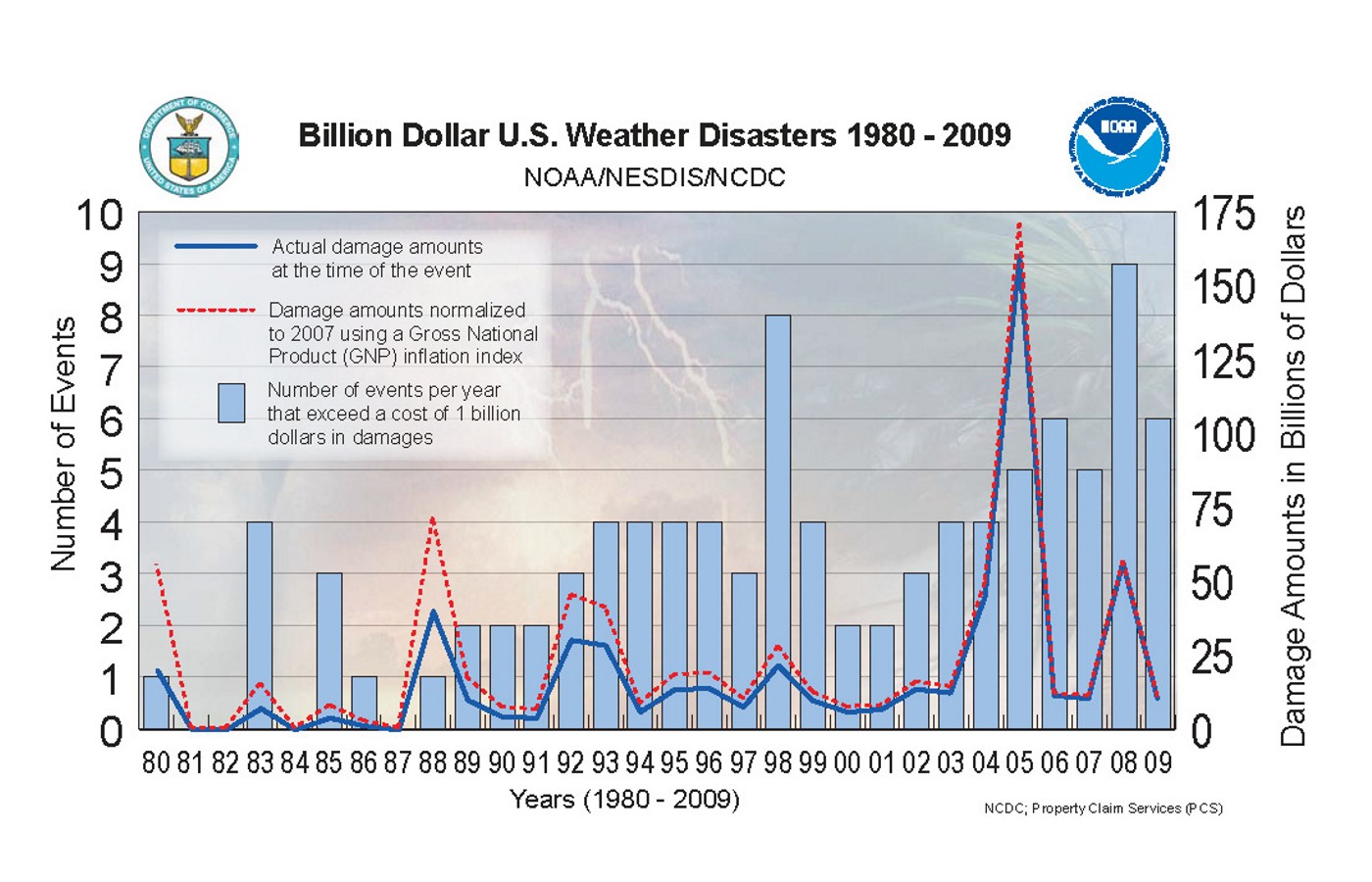
US Government agencies have been keeping careful track of the weather disasters since 1980, chart is above. This is the kind of timeline of changing weather tracked by the benchmark of frequency and cost in dollars that shows in straight numbers what's been happening over the last 30 years. The direct costs, not including the human and cultural damages, have been escalating dramatically even as the argument continues about what is happening.

This issue is outlined in Storm Warning, by Lydia Dotto, the the book on which a more recent book, The Great Warming is based. A summary from Amazon:

The Ice Storm of 1998. The flooding of Manitoba of 1997. Wherever you live, it's likely you've experienced some extreme weather lately. A recent report from the Red Cross stated that natural catastrophes in 1998 has wreaked the most havoc on record, and warned that a series of "super-disasters" could be imminent.

What's behind all this stormy weather?
In Storm Warning, science writer Lydia Dotto shows there's strong evidence our climate is changing due to human interference, and that the events of recent years are just a dress rehearsal for dramatic changes in the earth's climate.

Climate conferences like those held in Rio in 1992 and Kyoto in 1997 were supposed to set the world on a course for change. Instead, they have led to political squabbles, watered-down resolutions and a disturbing failure to reduce the greenhouse gas emissions that have been targeted as the main culprit in creating the global warming trend. Storm Warning illustrates the dire consequences of delay and inaction on both the personal and political fronts. In the climate change game the stakes are disturbingly high -- with the very future of life on our planet at risk.

The Great Warming, by Brian Fagan is a more recent book that ties the climate changes of past history to the decimation of entire cities and cultures, such as the Mayan civilization and other indigenous peoples living in the American Southwest and in South America. These areas have been historically documented as being vulnerable to drought, the most destructive weather condition known to human civilizations. No water means no food, as well. He outlines the methods by which many of these earlier civilizations were able to flexibly live within the rather sparse environment until long droughts sent the whole city packing. At least then, there was someplace to run to.

There's a video here, and a movie based upon the book coming to a theater near you soon.

Tuesday, May 11, 2010

Of the Earth

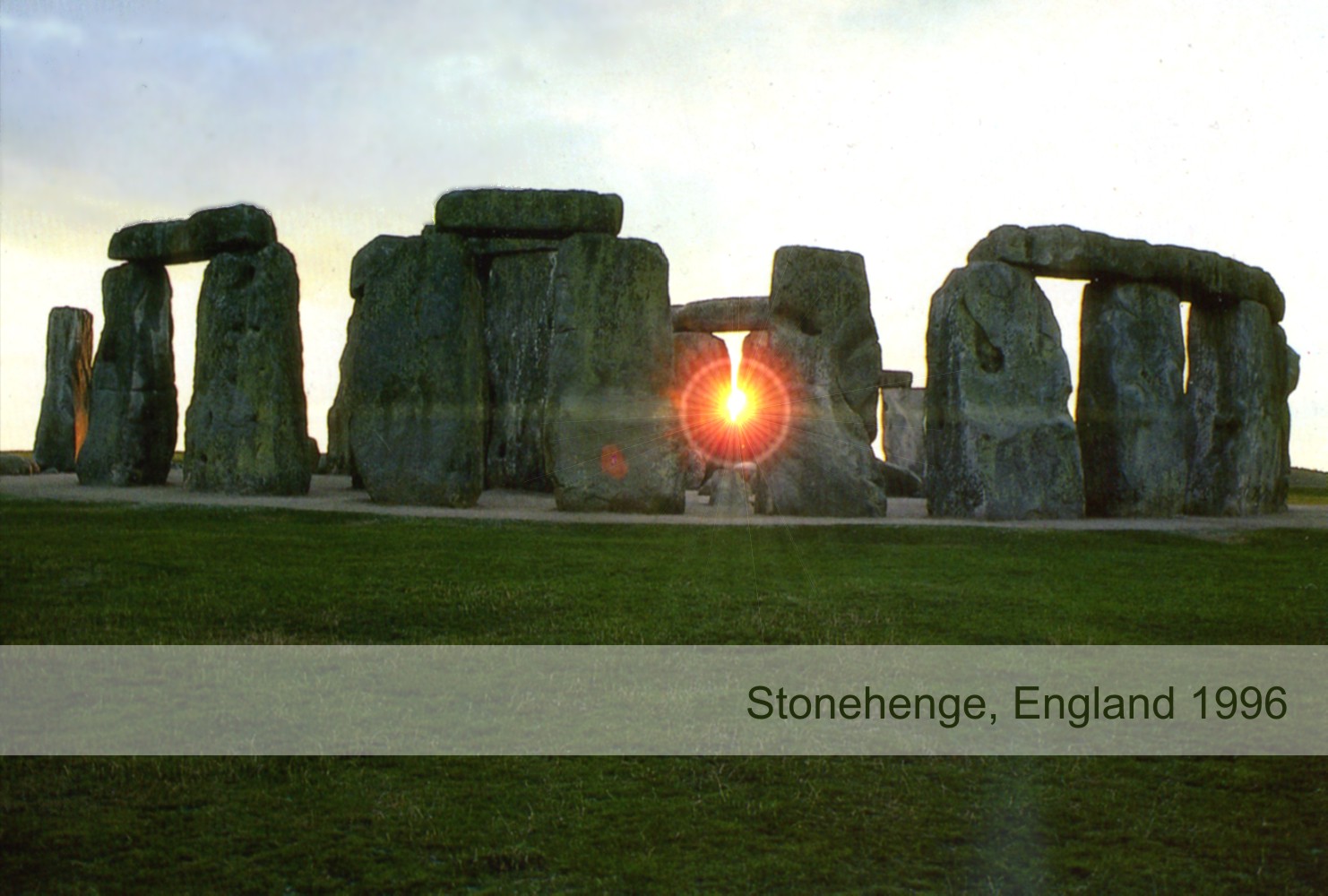
My foray into one of the more important sacred places in Europe took place after some exploration of the powerful spaces of the Grand Canyon and the ruins left behind by its indigenous peoples. A vast monumental effort, clearly tied to the visions of the skies and stars, is standing on the plain of Salisbury in England. A short history of the development of Stonehenge as we know it is here.

It is an established fact that Stonehenge was an astronomical observatory for both solar and lunar observations. One of its functions was the determination of the summer solstice date using the summer solstice sunrise. At the 21st of June the rising sun in the North East shines its light in between the Heel Stone onto the Alter Stone at the center of the Trilithons or horseshoe of Stonehenge. A more comprehensive study of its astronomical alignment and structure is here.

What struck me about this place was the strong presence of a mindfulness of 5000 years ago; the structure and scale of something that has left no imprint in history, yet has a resonance that strikes me as did the ruins of Tihuanaco in Bolivia, the Aztec pyramids of Teotihuacan in Mexico, and the ruins of Mesa Verde in Colorado . Human presence and intent, lost in the abandonment of a historic place because of famine or drought. Yet the patterns remain, giving up their secrets reluctantly, if at all.

Ancient folk worked with what they had in their technology and resources, but had no lack of comprehension about their ecology, their environment or its resources. While they lived more or less in concert with natural forces, there were times of extremes of weather - mostly drought - that forced them to relocate to other lands. This would tend to indicate that there is a set of boundaries within which human consumption and sustainable existence can coexist. Going past that involves the costs of technology - energy needs and its attendant pollution and carbon dump - that are now threatening the global balance of climate and biology.

I'm just hoping that we can readjust our priorities while we can.

Thursday, April 1, 2010

Filing - The Final Solution

After having the recent opportunity to visit my tax guy and my legal guy, I find that we all approach our information systems the same way. Each different pile has exactly the information one needs and is a relational system, depending upon where the stack is located and how tall it is.

With that thought in mind, I recall the famous last shot in "Raiders of the Lost Ark", with the camera panning out from the Ark being located in the government storage facility, which is an homage to one of the final shots in Citizen Kane. That's the picture above. Best way to permanently lose something is to misfile it, hence the piles in clear view. Here's the Indy page on it.

During the chase scene at the beginning of the "Raiders" movie, you briefly see a broken crate with the Ark partially revealed. 9906753 was the identifying number used on the crate that held the Ark of the Covenant in the cavernous warehouse of Hangar 51. It is only later revealed in the fourth Indy film, "Kingdom of the Crystal Skull", that the Ark had been taken to Hangar 51, a military facility near Groom Lake in Nevada. All this - for four movies - because an adequate filing system isn't available for the Federal Government.

Human nature, I suppose. Otherwise we would never have found the Dead Sea scrolls and the cuneiform tablets scattered all across the Middle East. Which means they were all lost by the folks that were supposed to keep track of them.

Have a great April Fool's Day!

PS you can do this digitally, too. Go to Bump Top owned by Google now.

Wednesday, March 10, 2010

Mexico - New Approaches

I'll never forget the beauty and fragrance of the ancient city of Monte Alban, overlooking the Oaxaca Valley. Its scale of temples, pyramids and ballcourts is very human and walkable, influenced by, but much smaller than, Teotihuacán in Mexico City. These Zapotec, Olmec and Mayan cultures included a very rich and colorful heritage of carvings, sculptures, fabrics and artifacts that express a very different vision of habitation than that of the Europeans.

Looking to our southern neighbor, we see some emergent urban visions that combine the best of these built approaches: a focus on the fabric of urban biodiversity and an integration of scale in the built environment. In Mexico City, the firm of Foster + Partners has proposed a sustainable urban development for a medical facility:

"Foster + Partners has revealed its designs for a 71-hectare teaching and medical facility in Mexico City upon notice of their appointment to the project. Campus Biometropolis masterplan in the south of the city will integrate care facilities with high tech teaching spaces, research institutions and laboratories and feature a vital new nature reserve showcasing the Pedregal lava fields as a highlight of the design.

"The wilderness area, together with enhanced landscaped zones, will account for half of the site and preserve Mexico City’s indigenous plants and animal species whilst creating an attractive landscape for the built areas."

More practial urban strategies for implementing sustainability to counteract the dramatic overconsumption of resources are Mexico City's Plan Verde as well as its plan for water self-sufficiency by 2020.

Friday, December 25, 2009

Grand Canyon Regeneration

The Grand Canyon is an extraordinary place for those of us who go back to it for rafting and camping; it's a place I return to every few years to reinvigorate my thinking and immerse myself in its powerful spaces. I began in this area with Arcosanti, and came back again and again with friends to explore the river and its canyons, and of course run the rapids (Lava Falls is a 10).

The Glen Canyon dam has a 50-year history of controversy, not only over the dam itself, but how to manage the river, the fish, the ecosystem and subsequently deal with the invasive plant species that have encroached into the Grand Canyon's ravines and along the river. A prime example of this is the tamarisk, or saltcedar trees, that are degrading the environment along the riverbanks and up in the plateaus of the ravines. They consume tremendous amounts of water as well as overgrowing other native plant species.

The story of radical environmentalism as well as the original exploration of the Canyon by John Wesley Powell spans the arc of the southwestern colonial era to the present day issues of water and environmental preservation.

So it was with relief and hope that I found that the Grand Canyon Sandbar Restoration experiment in 2008 has paid off in a new protocol by the Department of the Interior for experimental releases of high water flows to restore the sand beaches and ecosystem that were essentially cut off by the Glen Canyon dam. This is the start of a new approach to integrating natural processes and the controversial massive public works projects like the dam in order to minimize the environmental degradation that occurs with large dams.

Ultimately, perhaps, we can learn to use resources and integrate systems in a way that makes brute-force engineering like Glen Canyon Dam unnecessary. At least as it stands now, there will be no more Federal dollars put towards dam projects because of the consequences of damming rivers and disrupting the natural benefits of the rivers and their ecosystems.

Monday, December 21, 2009

Building Community


That was my theme when I served as AIA Chapter President in 2000, and it continues to serve as the part of the social capital component of my approach to sustainable urban planning and architecture. The other component, also missing in the calculations of the development community, is natural capital. One vision that integrates all of these elements is continuing to evolve out on the mesa above Scottsdale, Arizona. This is the Arcosanti "arcology" by Paolo Soleri that's shown in the video above.

I was a workshopper for a summer in 1978, and it was concurrent with coursework at SLO that involved the investigation of evolutionary concepts related to "Omega Point" and extensively elaborated graphically and textually by Soleri in his monographs. It's resulted in a form-based solution to human habitation at a different scale that incorporates landscapes and structures based on community and natural capitalism, i.e., living with the means of natural and human resources. It's about connections and how art, community, urban design, construction and site-based design come together in novel ways.

This vision is grounded in understanding place and form, as well as natural processes. It's about the special experience of a place and its nature, rather than the imposition of generated forms into the urban fabric or natural environment regardless of scale. These are the valuable lessons that arise from understanding a place and the needs of the people and institutions that inhabit this place. Sometimes the answer, after all the solution-seeking, is not "a building".
(Note that you might have to switch to Internet Explorer to view this video)

Wednesday, September 30, 2009

Public Parks are Public Trust

Alaska's incredible public parks didn't happen by accident, they happened because of the commitment of the US government and the public to the preservation of wild lands and native cultures. Right now a PBS special by Ken Burns is highlighting Denali National Park as well as the other parks established in this state. Alaska has the most acreage of the US Park System, and Denali is the largest, which includes Mt. McKinley and its immense snowfields and cloud covers, home to wolves and the caribou who survive on lichen and other plant forage, at least for now. I went on a charter flight that operates out of the local airfield and takes 5-6 people on a "bush pilot eye view" of the terrain and lakes. Chased a bear on the way back.

The ecosystem preservation is critically important, but the global climate change is heavily influential in this area, particularly in the sensitive north latitudes. Hence, public awareness and participation beyond a superficial impression is key to the solution to this problem. The Alaskan native culture and wilderness extends all the way down through Canada to the Pacific Northwest, and is very prevalent in the Seattle historic parks and cultural galleries. They embody a way of life that adapted to the natural ecology, and was able to exist within it.These influences can be seen in the Alaskan native architecture that adapted to the climate and terrain thousands of years ago, which has been preserved most fully in the wilderness park areas. Some of the areas of Alaska that have not yet been built out still have the rough-and-tumble quality of the old logging, hunting and canning operations that were carried out in the region hundreds of years ago. These resources are in the process of being further built over and drilled out, and it's imperative that the public commitment to these wilderness lands be reinforced. Viable ecosystems are critical to human civilization.

This shot is from the Seward Highway south of Anchorage. Kenai Lake is fed by melting glaciers and does not have the silt that many of the lakes and streams have, which results in an emerald color. It's a good fishing spot, and this lake feeds into Ressurection Bay at Seward. At Seward, the Fijord cruises depart around the Kenai Peninsula, and we spotted otters, steller sea lions, harbor seals, humpback and grey whales, puffins, eagles, and gulls. On the Kenai Peninsula, along the steep banks of the Fijords, it's not hard to spot bears and mountain goats.

It's still possible to see some of the sunken forest beds and displaced landscape (by about two feet) resulting from the Good Friday earthquake of 1964 that created a tsunami (tidal wave) that essentially destroyed Seward. The harbor was rebuilt afterwards, and is currently undergoing a change of character as the fishing industry declines and the tourist industry increases.

Sunday, September 27, 2009

Earth, Life, Structure, Communicating


For me, an early fascination with built form and the reasons for its shape and patterns has led to some "global galloping" in exploration of indigenous architecture and how living creatures change their environment as they interact with each other in the web of life. All the way from the inhabitants of Galapagos and the African savannah to the early indigenous forms of civilization in Peru, Bolivia, Mexico, China, the American Southwest, Alaska, Hawaii and Indonesia, to the old ruins of Stonehenge and built remnants in France, Spain and Italy, I've found coherence in form response to climate and habitation patterns, human and animal.

Architecture is an earth science and a formgiver of purpose and vision in human cultures, evolving into ever more complex patterns. The beginnings of built form, starting with animal adaptations (the Darwinian approach) through to the human modification of the earth that emerged in different cultures and climates are at the roots of this practice. Animal-created architecture presents a valuable window on organizing natural systems, outlined in Animal Architecture: "As ecosystem engineers, the influence of builders is extensive and their effect is generally to enhance biodiversity through niche construction. Animal builders can therefore represent model species for the study of the emerging subject of environmental inheritance." A more general book by the Goulds is Animal Architects. An interesting blog also delves into what its author calls "Cospecies Coshaping"

This is what life does. It organizes patterns to higher levels of effectiveness and dynamic interaction, using available resources. Systems theory (Check out Robert Pirsig's "Lila"). In this sense life is anti-entropic, and the built environment as we create it today is destructive to life, the arrow of entropy moving from vital systems to entombed molecular structure.

As our human ancestors began their large monumental earth-shaping structures based upon their cultural and belief patterns, the first emergent structures were tombs and religious pyramidal structures that oriented to and interacted with sun, moon and stars. The smaller structures that housed shops and living quarters, such as those found in Pompeii, were small, repetitious structures that flexibly accommodated living patterns and chains of commerce and gradually built up into temple structures and civic plazas.

The cultures of Indonesia and Asia produced indigenous structures unique to their climates, local materials and living patterns. Early human settlements represent a very dynamic interaction between the agricultural societies and the resources of the region. These ancient constructions, embedded in human history, emerged with an immense variety and diversity of form strategy and mastered the ability to passively modify climate to the advantage of humans for food and shelter. Prodigious numbers of these ethnoarchitectural structures emerged over thousands of years of history. They have lessons for modern humans in their richness of form and simplicity and durability of structure. Biomimicry Guild is a leading proponent of incorporating these lessons.

These kinds of constructs, from the animal kingdom to the human world, are purpose-driven and integrate valuable systems of behavior to the benefit of natural systems and living societies of all kinds. I think our self-directed evolution has gotten far off track, relying on brute-force-engineering and must now move to a greater wisdom in a post-industrial form of habitation - that is constructive of rather than destructive to - living systems. Civilizations must live within their means to survive and prosper.


The overgrown Angkor Wat in Cambodia

Saturday, September 12, 2009

The Impossible

While in Peru (Machu Picchu of course) and Bolivia back in 2004, I did make it up onto the altiplano to Tiahuanaco, an ancient city that has been undergoing formal excavation and study for almost 100 years. The ruins of the Kalasasaya (see the map on this page) have been partially restored, and the adjacent Acapana pyramid was just beginning excavation when I was there. In observing the dig, I was struck at how deliberate the excavation work was, the trenching followed precisely in the plan of the uncovered stones, rather than being a single large hole or random diggings.

I consulted our Aymara guide, Rose Marie, about this, and she showed me the cruciform-shaped tablet that was being used like a compass to direct the excavation. This tablet image has been passed on down through the oral and graphic traditions of the Tiahuanacota people who had no written language. But clearly they had a geometric and graphic record of their methodologies in constructing the city, and rules about how things were to be oriented and scaled. So this tablet provided all the instructions needed to accurately excavate the pyramid, which the local Aymara laborers were doing under the direction of the Bolivian government. It is now a World Heritage site.

There are questions as to its exact age and purpose, but it's clearly a ceremonial site with statues and the Gate of the Sun covered in geoglyphs. It appears to have been oriented according to skycharts regressed back 15,000 years through a study of archeoastronomy, and its "sound holes" that magnify voice and its framed statuary in concise orientation are all indicators of a highly evolved understanding of geometric structure and celestial positioning.

The more conventional description of its age and its cultural context dates the construction to around A.D. 200, but that could be the time when the Aymara moved into the existing site and its ruins, primarily due to its agricultural resources, capable of supporting a large population.

Lake Titicaca, 12 miles away, has many ancient beliefs attached to it, particularly at the Island of the Sun. In the ancient Andean myths, the world is recreated after a massive natural holocaust by the god Viracocha who emerged from the lake.

Tuesday, July 21, 2009

Changing the Form


Much discussion these days on how to accommodate people and their cars and "stuff" without obliterating the planet. What is readily apparent is that things can't continue in "business as usual" mode, the limits of our resources have already been exceeded. All of our social and planning models are predicated on continuing expansion and growth instead of better efficiencies and more creative use of resources. So we need to change the form of the city. An idea that's been around for decades out in the Arizona mesa is Arcosanti, the beginnings of an Arcology that is predicated on human settlements developed with passive energy and the use of form to modulate an environment for living within urban densities yet integrating the natural processes. The idea of "miniaturization" is integral to its concept.

In 1978 I participated in a summer workshop at Arcosanti, the East Crescent construction, in conjunction with earlier college class studies and for college credit at SLO. Got my hands dirty and my head "stretched"! Paolo Soleri was a former intern with Frank Lloyd Wright at Taliesen West, but didn't last long there (clash of the Titans) and established his own shop at Cosanti Foundation in Scottsdale before starting up the big project out on the desert mesa. He's Italian, and by virtue of his early exposure to Catholicism and the theology of Teilhard de Chardin, he developed a unique, if convoluted, approach to the way humans should live on the earth. The ideas follow the "Omega Point" phenomenology of this Jesuit priest, which essentially argues that mankind is co-creating its own spiritual development to an ultimate point of existence that many religions define as "God". This leads into some heavy conceptualizations about creating that spiritual space, the "noosphere", that facilitates this transformation with close proximity and high interaction. Soleri's argument is that it's necessary for humans to live in a densely interconnected way in order to move towards this "Omega Point". This was before the internet and Twitter.
So this approach is grounded in a spritual-network approach as well as an environmental one, that ends up with a radically different way of changing the form of human habitation. Its form is probably too dense and collaborative for our culture, but it lends itself as a good model for dense urban areas that require a regenerative approach to make these areas viable environmentally and socially. It is a precursor to "multi-use" zoning and transit oriented developments that are evolving models in urban planning today, affecting the legal, accounting and finance sectors of our business practices as our cities shift towards this model. As developments become more complex and dense, the project delivery system is also shifting towards an integration of building practices, known as partnering.

Soleri discusses his philosophies developed over the decades on the Arcosanti website, and also provides examples of the development of many Arcologies and other environmental projects, some of which have come to fruition. Fertile ground for some necessary thinking about our urban spaces and how we live.

Sunday, June 14, 2009

In Memoriam to a Space Cadet

I wanted to post a small memorial to a good friend who passed away suddenly on June 3: Dick Edwards (on the right) Co-Founder of Space Settlement Design Competitions for high school students in 1984. His volunteer service in Southern California included active membership and officer responsibilities in the American Institute of Aeronautics and Astronautics, engineering honor society Tau Beta Pi, and the Judging Policy Advisory Committee of the California State Science Fair. Space Settlement Design Competitions have grown to involve over 1000 students annually on six continents; Dick literally traveled around the world to help conduct Competitions for students. An engineer for the Boeing Space Shuttle program now based in Houston, he'll be deeply missed by students, friends, colleagues and of course the Grand Canyon River Rats.

Sunday, April 26, 2009

Easter Island at a global scale


The current issue of Scientific American discusses the consequences of current global population impact upon water consumption and the food chain supply. As happened on Easter Island, overconsumption resulted in social devastation, ecological collapse and the final, poignant array of bleak volcanic faces gazing out to the ocean.

The article discusses the impact of trend-driven climate change on global commerce, as well as the likelihood of many failed states that could pull down the global network. We've begun to see this in Somalia and Zimbabwe as these states disintegrate under the weight of population, failure of government structures and lack of sustainable policies.

One answer to this among many is a carbon tax, which would provide incentives for capitalism to manage the carbon cycle. Thomas Friedman makes an example of Costa Rica, and its strategies to maintain its ecosystem while providing revenue to local businesses and residents. Beyond taxing the carbon process are the opportunities to derive profit from the "deconstruct" side of business and manufacturing - recycle, reuse and remake, while producing oxygen and water instead of toxic byproducts. There is more profit in this model than there is in fighting to keep the primitive industrial processes and supply chains.

Wednesday, December 17, 2008

From the Gadget Lab at Wired: Antikythera


An ancient Greek computer comes back to life. A British museum curator has built a working replica of a 2,000-year-old Greek machine that has been called the world's first computer. Featured on the History Channel in December 2004, the complete reconstruction now also has further inscriptions replicated. A Conference was held on it in 2006 in Athens. See the article, a video and historical links here.History reaches to us in the present, in many forms. Just like the Intihuatana - the sun's hitching post at Machu Picchu - the brilliance of early cultures in understanding the cycles of the natural world led to astonishing constructs that expressed the nature of the physical world. This knowledge was used to harness a place and its resources to human purpose. Its purpose carried human meaning as well as consequences of use and its influence on the natural environment.

Is it possible in this era to now capture the intelligence that will allow humanity to inhabit the earth in balance? Can we take biomimicry to the next level in human affairs? Can we express our purpose so that it benefits all living things and embraces life instead of destroying it?


Update 12/7/16: Built by more than one person on the island of Rhodes, it shows that the ancient Greeks were apparently even further ahead in their astronomical understanding and mechanical know-how than we’d imagined.

Update 11/13/18:  While scientific study continues,  the discovery has drawn attention to both the existence of this ancient ‘calculator’ and its amazing history.

Update 1/27/19: In 1900, sponge divers stranded after a storm in the Mediterranean discovered an underwater statuary on the shoals of the Greek island Antikythera. It turned out to be the wreck of a ship more than 2,000 years old. During the subsequent salvage operation, divers recovered the remnants of a puzzling clocklike contraption with precision-cut gears, annotated with cryptic symbols that were corroded beyond recognition. For years, the device lay unnoticed in a museum drawer, until a British historian named Derek de Solla Price rediscovered it in the early 1950s and began the laborious process of reconstructing it — an effort that scholars have continued into the 21st century. We now know that the device was capable of predicting the behavior of the sun, the moon and five of the planets. The device was so advanced that it could even predict, with meaningful accuracy, solar or lunar eclipses that wouldn’t occur for decades.

Update 3/24/21: Scientists may have finally made a complete digital model for the Cosmos panel of a 2,000-year-old mechanical device called the Antikythera mechanism that's believed to be the world's first computer.
.